Search

conversations on the fringe

Category

Uncategorized

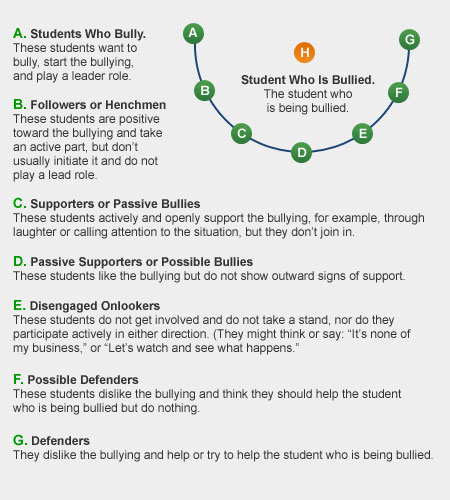
Bullying (part 4): The Bystander


Four Reasons for not intervening:

1.  The bystander is afraid of getting hurt himself.  The bully is bigger and stronger and has a reputation that justifies the fears; so jumping into the melee doesn’t appear to be a smart thing to do.


2.  The bystander is afraid of becoming a new target of the bully.  Even if the bystander is able to intervene successfully, there is a chance she will be singled out at a later date for retribution.  Bullies are quick to disparage and malign anyone who tries to intervene.


3.  The bystander is afraid of doing something that will only make the situation worse.


4.  The bystander does not know what to do.  He hasn’t been taught ways to intervene, to report the bullying, or to help the target.  Just as bullying is a learned behavior, so must young people be taught ways to stop it.


Excuses for not Intervening:

  1. The bully is my friend
  2. It’s not my problem!  This is not my fight!
  3. She’s not my friend
  4. He’s a loser anyway
  5. He deserved to be bullied, asked or it, had it coming
  6. Bullying will toughen him up
  7. Kids have a deeply embedded code of silence
  8. It’s better to be in the in-group than to defend the outcasts
  9. It’s too big a pain

Everyone plays a role in the bullying cycle.  Educating the “players” is an important first step in ending the gripping power of bullying.  We often focus, to the exclusion of the others, on just the bully or victim.  Educating and empowering the other participants, regardless of how passive their roles may be, is a crucial step towards addressing the issue of bullying.

Bullying (part 2): Warning Signs


The following is a list of warning signs that a student may be getting bullied.  Please make a copy, edit it, be creative, add artwork or whatever, but place it publicly where your students can see it.  Consider making a copy and editing it for your parent’s newsletter/email.


  • Shows an abrupt lack of interest in school or a refusal to go to school.  (According to a National Association of School Psychologists report, 160,000 children in the United States miss school every day for fear of being bullied.)


  • Takes an unusual route to school.  (Going north and three blocks east to get to a school that is south of your home makes a lot of sense if going directly south will put you in the path of bullies.)


  • Suffer a drop in grades.  (It’s hard to concentrate on school work when you are trying to figure out how to avoid the bullies.)


  • Withdraws from family and school activities, wanting to be left alone.  (When you feel isolated, shamed, scared, and humiliated, you just want to curl up in a ball and not talk to anyone – or lock yourself in your room and cry.)


  • Is hungry after school, saying he lost his lunch money or wasn’t hungry at school.  (The bully takes great pleasure in extorting lunch money.  The lunchroom ranks third behind the playground and hallways in the order of places where bullies attack their targets, so it’s a good place to avoid, even if you do have lunch money.)


  • Is taking parents’ money and making lame excuses for where it went.  (Once again the bully separates you from your money.  The threat of retaliation can convince you that stealing from your mom’s purse or your dad’s wallet poses a lesser risk to body and mind than not showing up with the money for the bully.)


  • Makes a beeline to the bathroom when she gets home.  (Since bathrooms are number four on the list of places bullies like to attack, you figure it’s best to “hold it,” even at the risk of a bladder infection.  A bladder infection can’t possibly hurt as much as having your head dunked in a swirling toilet or seeing your reputation attacked via insulting graffiti on the mirrors over the sinks.)


  • Is sad, sullen, angry, or scared after receiving a phone call, text, email, or IM, etc.  (You don’t know how to tell your parents that the girls on the other end of the line called you ugly names and then all laughed at you before hanging up.  You are ashamed to talk about the obscene lies the boy in your English class write about you and sent to all 500 friends on MySpace or Facebook.  Even your cell phone isn’t safe anymore.  If they can reach you in your own home then how can anyone help you?)


  • Does something out of character.  (You would rather get caught skipping school than caught in the school yard or on the wrong block by a bunch of bullies who circle around you every day and “pretend” to be playing.  You would be willing to pull your pants down at recess if it meant those girls would promise to quit taunting you and let you into their social cluster.)


  • Uses derogatory or demeaning language when talking about peers.  (If you’re being called ugly names, poked, shoved, shunned, and laughed at, you won’t have any terms of endearment for the kids who started the bullying or for those who joined or looked the other way.)


  • Stops talking about and everyday activities.  (If you’re being bullied, you have no everyday activities that are not colored in pain, frustration, fear, and terror.)


  • Has disheveled, torn, or missing clothing.  (You don’t like to resolve conflict by duking it out, and it wasn’t a one-on-one fight by equals.  But saying you got into a fight sounds better than saying you got beaten up.  Besides, last time you told your dad about the bullying, he told you to fight back.  Or you surrender your favorite jacket rather than risk an attack, but saying that you “accidentally” left it in the locker room will go over better at home than admitting how you really lost it.)


  • Has physical injuries not consistent with explanation.  (Saying that you walked into a locker sure sounds better than admitting you were shoved into one.  Saying you sprained your ankle running to class beats revealing that those girls tripped you in the middle of the bus aisle, then laughed at you as you limped back to your seat.  “I don’t know how I got that back eye; I must have fallen out of bed,” rings less painfully that recalling how you were held down and kicked in the face on the way to school.)


  • Has stomachaches, headaches, panic attacks, is unable to sleep, sleeps too much, is exhausted.  (Bullies can be real pains in the brain and in the body.  The body responds to the stress of being targeted by turning on its chemical defense system so you can fight or flee.  But with daily attacks, this system can never shut down.  Adrenaline keeps getting released.  The body stays on hyper-alert, churning up the stomach, twitching the limbs, and numbing the brain.  Constantly resisting and fearing the bully taxes the mental and physical defenses.  Eventually the system breaks down and the mind and body collapse into a state of exhaustion.)

National Eating Disorder Awareness Week


For more information on and help for eating disorders please visit the following:


National Eating Disorders

National Institute of Mental Health

Something Fishy

Conversations on the Fringe

Mercy Ministries

Overseeing Boundary Issues Among Volunteers


A boundary is a real or understood line in what is acceptable adult volunteer behavior, what falls within their responsibility and competency. A boundary crossing is a benign deviation from the standards of care that is done so in a way that is not harmful or exploitive to the student. An example of this is to catch a student who trips on your desk on the way out of a mentoring or discipleship meeting or picking up a same gender student in your car and transporting him/her to a safe place when you see that student standing in a blizzard, with no means of transport.  A boundary violation is a significant deviation from standards of care that likely is harmful or exploitive of the student.

Where is the line between a boundary crossing and a boundary violation?  Here are some clues:

  • Is it a repetitive pattern for the volunteer?
  • To what extend is the behavior out of context or the culture in which the  mentoring/discipleship is provided?  Or outside the normal youth ministry frame?
  • Time, place, purpose and intent are key indicators of potential violation (meetings lasting longer for certain students, meetings help outside of normal times, excessive contact between meetings, inappropriate self-disclosure).
  • Meetings lack focus and purpose, adrift or repetitive.
  • There are discrepancies between the adult’s behavior and what’s being reported.
  • Sexual fantasies about students.

What happens for youth ministry volunteers and staff that think a boundary violation is appropriate?  Some people have “magical thinking”, a rescue complex, believing they are the only one who can help a certain student(s).  Some want to be idolized by the students and their peers.  Some use the students to work out their own life issues.  Some need to be needed.  But, most often, the problem is we have an “exception fantasy,” the belief that “I’m different.  I don’t need to abide by that code.”

There are unique concerns also for certain students: those with a history of trauma or abuse; needy and highly dependent individuals; and manipulative students who want to set a quid pro quo between themselves and the youth worker (“I will do something for you if you do something for me”).  Another area of concern  regarding boundaries in ministry ought to be new frontiers with technology: email, texting, Skype, IM, Facebook, Twitter and other social networking sites.

The following are risk management approaches to for staff supervising volunteers in a litigious society and to reduce the potential for boundary violations:

  1. Monitor performance through direct observation of the volunteer or staff member.
  2. Minimize the degree of direct, unsupervised contact between adults and students by clearly defining the limits of the mentoring/discipleship relationship.
  3. Ask “cui bono,” who benefits from this interaction?  Is this in the student’s best interest?  Does this enhance or detract from the spiritual growth of the student?
  4. Documenting questionable conversations and immediate reporting of such information to direct supervisor.
  5. Watch for the warning signs of boundary crossings and violations.
  6. Help the adults to identify the issues, conflicting values, duties, and impact on various supportive others and possible alternative courses of action.
  7. Examine with the adult the reasons for/against a particular action, including what’s in the best interest of the student, and what  are the ministry’s policies and procedures.
  8. Be clear, it is always the adult’s responsibility (not the student’s) to set the boundary.  And we do not blame the student if a boundary violation occurs.  Boundary testing can lead to a boundary violation.  On the other hand, boundary testing is an important part of defining the nature of the relationship.

It is important to broaden the question of boundary violations from a simple “don’t ever do that.”  That’s a simplistic, legalistic approach.  Instead we need to  acknowledge that there are times when there is intentional breaking of confidentiality, such as duty to warn, mandated reporting and the such.

2011 Poll for CotF


Violence Training (part 2 0f 2)


Young men and boys may develop the following personlity characteristics, that can lead to violence, as part of male sex-role training:

Sense of right

Engendered in males is the idea that they may hurt or kill or enforce justice, right worngs and punish.  A man is taught that he is doing what is necessary and correct when he hurts those who “deserve” it.

A young male may perceive their significant other’s behavior as immoral, unfair or inadequate.  When an abusive and violence man believes that his mate has hurt him in some fashion, he feel he is within his rights to injure her.

Sense of duty

Men who go to war know they may die.  They risk death because they have been taught that death is preferable to being thought of as cowardly.  Men have been taught that it is their duty to defend their families or culture from danger.  Some men feel overwhelmed by this responsibility and run away from the family, while others remain and are resentful.

Even though a young person may resent their feelings of “duty” to their significant other, he may not be able to leave her because of feelings of guilt over disobeying what they perceive as a cultural imperative.  They may alternate between stability and instability, responsibility and irresponsibility, reason and rage.  Their erratic feelings have little, if anything, to do with their mate’s behavior.  They reflect their internal sense or belief about his ability to be the man they think they should be.  They probably doubt their ability to be the protector, guide, teacher or leader of the relationship or family, and this failure is too great to bear.  As a result they tend to blame, attack and criticize others or retreat into alcohol, drugs, sex or work.

Ability to objectify

In war, men do not kill people; instead they kill objects.  These objects are often overgenrealized labels such as Gooks, Krauts, Japs, Yanks, Communists, Imperialist, etc.  The list is as long as mankind.  The process of objectifying is critical to the process of killing and violence.

In a relationship a young male may hit, injure or kill a “bitch,” “whore,” or “slut.”  She ceases to be a loved one.  She is only an object.

Sense of disconnect

Men a typically not as connected to other people as women are.  They are trained to be impersonal and distant.  It is hard enough to risk death without having to face a massive loss of joy and closeness.  Men are taught to substitute ideology for connection or to put ideology before connection to people.

*I’m just a little curious as to whether we, in the church today, might be unintentionally be reinforcing some of these ideas through a poor understanding of the biblical dynamics of male/female relationships.


Top 10 Most Read Blog Posts Of 2010


While trying to discern what information is being searched for and consumed the most we were able to identify topics that are in need of further exploration.  Our top 10 list of 2010 is not a self-congratulatory pat on the back but rather an attempt to guide our focus for 2011.

The following posts we our most read blog posts of 2010 and therefore the ones that revealed some of the areas of greatest need.

  1. The State of Male Adolescence Today
  2. 10 Things You Need To Know About Date Rape
  3. The Importance Of Harmonious Peer Relationship
  4. Forgiveness: A Leap Of Faith
  5. Teen Dating Violence
  6. Roles Of Children In Dysfunctional Families
  7. Self Injury Quick Reference
  8. Ten Strategies for Working with Boys
  9. Cognitive Distortions
  10. Basic Brain Function and Emotional Hijacking

It’s obvious to us that there is a great need for resources/information on working with and understanding young, developing boys, teen dating violence, self-injury, and understanding the brain of adolescents.  But we’d also like to hear from you about what topics, information, research we can provide so you can continue to grow in your capacity for loving and equipping young people to follow in the ways of Jesus.

From us to you and yours, prayers of blessings and gratitude for your support of Conversations on the Fringe in 2010.

When A Student “Falls In Love” With The Youth Worker


Because of the difficulties students have in early and mid-adolescence to manage strong feelings of intimacy, the new experience of having someone who listens and whom they can trust sometimes lead them to believe that they are in love with their youth worker.  Sadly, many at-risk students are so accustomed to negative feelings (shame, fear, guilt, anger) that positive feelings (joy, trust, contentment, playfulness) are unfamiliar to them.  Such students may not understand their own feelings, and they may not have the skills to differentiate them.  In some cases, if a student has been abused (physically or sexually) and/or is abusing drugs or alcohol, romantic obsession or sexual fantasies can be a substitute for reducing anxiety or stress.  Powerful romantic feelings may be directed toward the youth worker, threatening the health of the relationship.

The youth worker may first become aware a student is having strong feelings by subtle changes in their demeanor or by more obvious signs, such as requests to the worker in non-ministry related settings.  The youth worker must, above all, avoid transgressing the boundaries of the relationship and continue to emphasize the context of the relationship of one spiritual in nature.  He/She should not consent to personal requests , even if they seem innocent.  Second, even if he/she only suspects a student of harboring sexual feelings for him/her, he/she should immediately bring the matter to the attention of a colleague or other staff person.  This consultation will serve not only to protect himself/herself, should legal complications arise later, but can also help him/her work through the difficulty in the relationship itself.

If the youth worker senses that a student is developing romantic feelings for him/her, he/she can try to discuss the matter openly by asking questions, such as “I sense that you are feeling very strongly about something today.  Is there something in particular you want to talk about?”  If the student eventually discloses romantic or sexual feelings, the youth worker must maintain a spiritual focus and uphold the boundaries of the student-youth worker relationship.  Students should be encouraged to examine the feelings rather than act on them.  The tension of this interaction can lead to a “teachable moment” in which the student learns to better differentiate his/her feelings.  The youth worker should remind the student repeatedly of the purpose of their meetings, emphasizing what the youth worker and the student will and will not do as part of their relationship.  Students often use attraction to the youth worker to avoid dealing with unresolved feelings or emptiness.

Another, less confrontational way to deal with this type of situation is to maintain the boundaries of the student-youth worker relationship but to use the clients’ feelings to help them discover solid but non-sexual relationships with peers who will listen.  The student can be assisted to differentiate feeling good from feeling sexual desire.  The youth worker can explain that the “attractive” aspects of their relationship, such as trust and feeling safe, are qualities that students will want to look for in their personal relationships.

Similar problems of inappropriate attachments and boundary issues can occur in small group settings as well, and youth workers (whether group leaders or one-on-one mentoring) must be prepared to work with the students on this dynamic.  Here, too, defining roles and expectations from the outset that address interactions between group members and between group leader and members.  Students should avoid letting any of these relationships become too personal and should be made to understand why, in this setting, developing sexual relationships would be detrimental to the group as a whole.  Youth workers, in turn, must understand and support the bonding that occurs when students share their innermost thoughts in a safe and sympathetic environment – and the confusion group members may have about their feelings of dependence on or the responsibility for other group members.

Students most at risk for these behaviors have likely been abuse, neglected, rejected, marginalized, and abuse substance.  The lack of rational insight and poor emotional management, coupled with supportive and safe listening, opportunity for full-disclosure of problems make the student-youth worker a fertile ground for unhealthy and even dangerous interactions to occur.  Our youth ministry and many other youth ministries have safety plans and policies to address these and other issues.  If yours doesn’t have one in place feel free to contact us at cschaffner@fringeconversations.com for sample policies to put in place to protect you and your ministry efforts.

Suicide Prevention


Almost inevitably, family members and friends are drawn into the painful world of suicide.  In light of the numerous cases of suicide over the last month we think it would be helpful to give some guidelines for families and friends of those who struggle with suicidal ideation. 

If a family member or friend is acutely suicidal, it may be necessary to take away their credit cards, car keys, and checkbooks and to be supportive but firm in getting them to an emergency room or walk-in clinic.  If the person is violent, it may be necessary to call the police.  These are difficult things to do but often essential.

The National Depressive and Manic-Depressive Association, a national patient-run advocacy and support group based in Chicago, makes the following specific recommendations to family members and friends who believe someone they know is in danger of committing suicide:

  • Take your friend or family seriously.
  • Stay calm, but don’t underreact.
  • Involve other people.  Don’t try to handle the crisis alone or jeopardize your own health or safety.  Call 911 in necessary.
  • Contact the person’s psychiatrist, therapist, crisis intervention team, doctor, or others who are trained to help.
  • Express concern.  Give concrete examples of what leads you to believe your friend (or family member) is close to suicide.
  • Listen attentively.  Maitain eye contact.  Use body language such as moving close to the person or holding his or her hand, if it is appropriate.
  • Ask direct questions.  Find out if your friend (or family member) has a specific plan for suicide.  Determine, if you can, what methode of suicide he or she is thinking about.
  • Acknowledge the person’s feelings.  Be empathetic, not judgmental.  Do not relieve the person of responsibility for his or her actions.
  • Reassure.  Stress that suicide is a permanent solution to temporary problems.  Provide hope.  Remind your friend or family member that there is help and things will get better.
  • Do not promise confidentiality.  You may need to speak to your loved one’s doctor in order to protect the person.  Don’t make promises that would endanger your loved one’s life.
  • If possible, don’t leave the person alone until you are sure they are in the hands of competent professionals.

There are several excellent advocacy and research organizations, many of which have patient and family support groups with suicide prevention and mental illness. 

If you or someone you love is suicidal, we recommend contacting the National Suicide Prevention Lifeline toll-free at 800-273-8255. Additional crisis and suicide hotlines are available in the category below, Crises and Suicide.

AIDS

AIDS Hotline
(800) FOR-AIDS

American Social Health Association: Sexually Transmitted Disease Hotline
(800) 227-8922

CDC AIDS Information
(800) 232-4636

AIDS Info: Treatment, Prevention and Research
(800) HIV-0440

National AIDS Hotline
(800) 342-AIDS

ALCOHOL

Alcohol Hotline
(800) 331-2900

Al-Anon for Families of Alcoholics
(800) 344-2666

Alcohol and Drug Helpline
(800) 821-4357

Alcohol Treatment Referral Hotline
(800) 252-6465

Alcohol & Drug Abuse Hotline
(800) 729-6686

Families Anonymous
(800) 736-9805

National Council on Alcoholism and Drug Dependence Hopeline
(800) 622-2255

CHILD ABUSE

Child Help USA National Child Abuse Hotline
(800) 422-4453

Covenant House
(800) 999-9999

CRISIS AND SUICIDE

Girls & Boys Town National Hotline
(800) 448-3000

International Suicide Hotlines

National Hopeline Network
(800) SUICIDE

National Suicide Prevention Lifeline
(800) 273-TALK (8255)

National Youth Crisis Hotline
(800) 442-HOPE (4673)

DOMESTIC VIOLENCE

National Domestic Violence Hotline
(800) 799-7233

National US Child Abuse Hotline
(800) 422-4453

MEDICAL

American Association of Poison Control Centers
(800) 222-1222

America Social Health: STD Hotline
(800) 227-8922

OTHER

Shoplifters Anonymous
(800) 848-9595

Eating Disorders Awareness and Prevention
(800) 931-2237

Teen Help Adolescent Resources
(800) 840-5704

PREGNANCY

Planned Parenthood Hotline
(800) 230-PLAN (230-7526)

RAPE AND SEXUAL ASSAULT

Rape, Abuse, and Incest National Network (RAINN)
(800) 656-HOPE

National Domestic Violence/Child Abuse/ Sexual Abuse
(800) 799-7233

Abuse Victim Hotline
(866) 662-4535

RUNNING AWAY

National Runaway Switchboard
(800) 231-6946

National Hotline for Missing & Exploited Children
(800) 843-5678

Child Find of America
(800) 426-5678

SUBSTANCE ABUSE

Poison Control
(800) 222-1222

National Institute on Drug Abuse Hotline
(800) 662-4357

Cocaine Anonymous
(800) 347-8998

National Help Line for Substance Abuse
(800) 262-2463

A WordPress.com Website.

Up ↑