Search

conversations on the fringe

Category

Youth Ministry

Sleep Hygiene (youth pastor life skills series pt. 1)


Poor sleep habits (referred to as hygiene) are among the most common problems encountered in our society. We stay up too late and get up too early. We interrupt our sleep with drugs, chemicals and work, and we overstimulate ourselves with late-night activities such as television. Good sleep habits is a must for anyone trying to avoid burnout and maintain overall wellness.

Below are some essentials of good sleep habits. Many of these points will seem like common sense. But it is surprising how many of these important points are ignored by many of us.

• Your Personal Habits

• Your Sleeping Environment

• Getting Ready For Bed

• Getting Up in the Middle of the Night

• A Word About Television

• Other Factors

Your Personal Habits

• Fix a bedtime and an awakening time. Do not be one of those people who allow bedtime and awakening time to drift. The body “gets used” to falling asleep at a certain time, but only if this is relatively fixed. Even if you are retired or not working, this is an essential component of good sleeping habits.

• Avoid napping during the day. If you nap throughout the day, it is no wonder that you will not be able to sleep at night. The late afternoon for most people is a “sleepy time.” Many people will take a nap at that time. This is generally not a bad thing to do, provided you limit the nap to 30-45 minutes and can sleep well at night.

• Avoid alcohol 4-6 hours before bedtime. Many people believe that alcohol helps them sleep. While alcohol has an immediate sleep-inducing effect, a few hours later as the alcohol levels in your blood start to fall, there is a stimulant or wake-up effect.

• Avoid caffeine 4-6 hours before bedtime. This includes caffeinated beverages such as coffee, tea and many sodas, as well as chocolate, so be careful.

• Avoid heavy, spicy, or sugary foods 4-6 hours before bedtime. These can affect your ability to stay asleep.

• Exercise regularly, but not right before bed. Regular exercise, particularly in the afternoon, can help deepen sleep. Strenuous exercise within the 2 hours before bedtime, however, can decrease your ability to fall asleep.

Your Sleeping Environment

• Use comfortable bedding. Uncomfortable bedding can prevent good sleep. Evaluate whether or not this is a source of your problem, and make appropriate changes.

• Find a comfortable temperature setting for sleeping and keep the room well ventilated. If your bedroom is too cold or too hot, it can keep you awake. A cool (not cold) bedroom is often the most conducive to sleep.

• Block out all distracting noise, and eliminate as much light as possible.

• Reserve the bed for sleep. Don’t use the bed as an office, workroom or recreation room. Let your body “know” that the bed is associated with sleeping.

Getting Ready For Bed

• Try a light snack before bed. Warm milk and foods high in the amino acid tryptophan, such as bananas, may help you to sleep.

• Practice relaxation techniques before bed. Relaxation techniques such as yoga, deep breathing and others may help relieve anxiety and reduce muscle tension.

• Don’t take your worries to bed. Leave your worries about job, school, daily life, etc., behind when you go to bed. Some people find it useful to assign a “worry period” during the evening or late afternoon to deal with these issues. Learn to manage your worries through effective prayer.

• Establish a pre-sleep ritual. Pre-sleep rituals, such as a warm bath or a few minutes of reading, can help you sleep.

• Get into your favorite sleeping position. If you don’t fall asleep within 15-30 minutes, get up, go into another room, and read until sleepy.

Getting Up in the Middle of the Night

Most people wake up one or two times a night for various reasons. If you find that you get up in the middle of night and cannot get back to sleep within 15-20 minutes, then do not remain in the bed “trying hard” to sleep. Get out of bed. Leave the bedroom. Read, have a light snack, do some quiet activity, or take a bath. You will generally find that you can get back to sleep 20 minutes or so later. Do not perform challenging or engaging activity such as office work, housework, etc. Do not watch television.

A Word About Television

Many people fall asleep with the television on in their room. Watching television before bedtime is often a bad idea. Television is a very engaging medium that tends to keep people up. We generally recommend that the television not be in the bedroom. At the appropriate bedtime, the TV should be turned off and the patient should go to bed. Some people find that the radio helps them go to sleep. Since radio is a less engaging medium than TV, this is probably a good idea but watch the kind of music you listen to and how loud the volume is. Slipknot is not good music to fall asleep to.

Other Factors

• Several physical factors are known to upset sleep. These include arthritis, acid reflux with heartburn, menstruation, headaches and hot flashes.

• Psychological and mental health problems like depression, anxiety and stress are often associated with sleeping difficulty. In many cases, difficulty staying asleep may be the only presenting sign of depression. A physician should be consulted about these issues to help determine the problem and the best treatment.

• Many medications can cause sleeplessness as a side effect. Ask your doctor or pharmacist if medications you are taking can lead to sleeplessness.

• To help overall improvement in sleep patterns, your doctor may prescribe sleep medications for short-term relief of a sleep problem. The decision to take sleeping aids is a medical one to be made in the context of your overall health picture.

• Always follow the advice of your physician and other healthcare professionals. The goal is to rediscover how to sleep naturally and get the rest God intended us to have.


Humor


“I’m a lesbian.” she said.  She chose to self-disclose right in the middle of a youth group gathering.  She just dropped a big elephant right in the center of the group.  We were rocked.  Moments before we were discussing the importance of being transparent with each other.  God has a funny sense of humor.  The silence was awkward and uncomfortable at best.  Those word just hung there in mid air, waiting for a response.

It was then that Josh, our student with down syndrome, shouted, “Wrestlemania Baby!  Hulk-A-Mania’s gonna run wild on you!”

We lost it!  We all laughed so hard we couldn’t catch our breath.  After nearly ten minutes of this we finally composed ourselves.  We all needed a moment to gather our thoughts.  We needed time to let go of our fears and judgments.  We needed something to pop the tension.  We weren’t avoiding the elephant but we needed to come up for air, for this was a very vulnerable moment of self-revelation, that if handled wrong could have lasting negative effects.  Laughter, at that moment, was a gift from God.

By now the benefits of humor have been well documented.  Humor connects us to other humans, as we share a laugh over life’s absurd moments.  Like love, humor warmly surrounds us and soothes pain, making it more bearable.  When we can laugh at our problems, we gain distance, perspective, and a sense of mastery.  Humor says, “Things may suck right now, but that’s okay.  I might be a hot mess right now, but there’s light at the end of the tunnel.”  A humor break can recharge creative batteries.  In addition, laughter results in numerous beneficial effects on the body: relief from pain, cardiovascular conditioning, improved breathing, muscle relaxation, and improved immune system functioning.

Several cautions apply to humor as well.

  • The overuse of humor can be a form of avoidance, which can prevent one from processing pain.
  • Sarcasm or “put-down” humor is a thinly disguised form of hostility, and is rarely appropriate.  Humor, like sex, works best when surrounded by love.
  • Making light of someone’s pain can seem insensitive and can undermine trust.  Humor may require that a certain amount of healing has taken place.  It may be premature to try to get someone to laugh at intense pain.
  • Humor is NOT a panacea, not a substitute for therapy.

Given these precautions, these principles might help incorporate more humor into our lives.

  • Be willing to “Play the Fool” at times.  This openness undermines the rigid need to be legalistic and perfect.
  • Just be willing to play.  If we allow for unstructured downtime we invite spontaneity to play along with us.
  • Humor does not require that one be a stand-up comedian or a loud laugher.  A sense of humor includes simply being able to notice the incongruities of life with a light heart.
  • Humor is not an all-or-none skill.  A sense of humor is standard issue, and each person has the capacity to develop it over time.
  • Don’t be discouraged if not many things seem funny to you.  The work we do is often intense.  On any given day we could deal with deep emotional problems, intense relationships, demands of others, and the consequences of at-risk behaviors.  It’s hard to laugh when one is emotionally numb.  We can often become numb as a protective shield against life’s difficulties.  Instead, simply allow time for healing.  With time you’ll probably become open to humor at your own pace and in your own way.

Most of us in youth ministry are kind of screwy to begin with.  We have to be to do what we do for so little in return.  We’re already bent towards a wicked sense of humor but sometimes the daily grind of life and ministry can steal our laughter.

God promises us in Joel that “He will replace what the locusts have eaten.”  May He do that for you today.

To Be A Boy


When I pause and watch the teenage age boys in our community, and when I reflect on my own adolescent experience, I begin to understand the struggle that every boy confronts in his efforts to navigate adolescence.  He is faced with a complex set of internal demands: sexual drives, longing to give and receive love, the drive to prove his masculinity – and through it all he doesn’t want to get hurt or rejected.  This is a daunting emotional challenge, because each of these internal demands involves difficult obstacles and consequences if handled wrong.

Boys yearn for emotional connections, but they are allowed very little practice at it.  Most have spent a majority of their free time engaged in competitive games, trying to “man up” and prove themselves superior.  I still see constant teasing and “bashing” during their regular interactions.  As they get older, often the consumption of alcohol allows them a psuedo-sense of emotional connection.

Boys also long for an intimate connection between themselves and girls but developmentally lack the emotional language to connect in a meaningful way.  They often lack the ability to pick up on emotional cue and other non-verbal communications such as facial expressions or body-language.  This impedes their ability to empathetically connect with members of the opposite sex and since modern culture doesn’t encourage boys to cultivate empathy, they misread social and sexual cues from the girls.  This is obviously reiterated in the statement I hear regularly from these boys, “I just don’t understand girls”.  The natural follow statement to that is, “Screw it, let’s just go shoot hoops”, and they remain aloof, never learning to untangle the emotional ball of string they are presented with.

Whether boys become kind, devoted lovers and sexual partners, or heartless and exploitative, depends on the boy, his early experiences with gender roles, his social environment, the kind of “script” that is written for him by his family, peers, and the culture in which he lives.  From his earliest gender experiences, and the adolescent stirrings of lust and curiosity, a boy develops his own sense of what relationships and sexuality are all about.

Reference: Raising Cain by Dan Kindlon Ph.D & Michael Thompson Ph.D

We all play a role in shaping our young men and women.  If you don’t like what you see today we must first accept partial, if not total, responsibility for systematically abandoning them.  We have, in many cases, left them to figure out the adolescent journey by themselves. 

Here are some questions to wrestle with your teams/families.  How you answer them has potential consequences for the youth in your care.

  • Are there older men and women in your church that seek out young people, outside of  “programs”?
  • Are the youth in your community left to fend for themselves the other six days of the week?
  • Do you mainly use other young adults, often not much older than the youth themselves, to provide a majority of spiritual and life guidance?  What are the pro’s and con’s of doing this?
  • Has your pastor lifted up the value of the older generations pouring themselves into the younger generations?  Why or why not?
  • How does your church culture reinforce positive/negative gender stereotypes?
  • Is sexuality openly discussed in your current faith context?  Why or why not?
  • Does how you handle “sex and sexuality” in your church impact young people’s sexual behaviors?  How?

Stigma, Identity, and Risk in LGBT Youth


LGBT youth have the same developmental tasks as their heterosexual peers, but they also face additional challenges in learning to manage a stigmatized identity.  This extra burden puts LGBT youth at increased risk for substance abuse and unsafe sexual behaviors and can intensify psychological distress and risk for suicide.

Studies of more recent generations of lesbian and gay youth suggest that the period between becoming aware of same-sex attraction and self-identifying as lesbian or gay is much shorter that in previous generations exposing them to greater potential social stressors at important developmental stages. (see chart below)

Average Age (Years) Event Onset

Behavior/Identity

Earlier Studies*

More Recent Studies**

Males

Females Males

Females

First awareness of same-sex attraction

13

14-16 9

10

First same-sex experience

15 20 13-14

14-15

First self-identified as lesbian or gay

19-21 21-23 14-16

15-16

From “A Providers Introduction to Substance Abuse Treatment for LGBT Individuals” www.samhsa.gov

*Studies of adults who remembered their experiences as children and adolescents

** Studies of adolescents who describe their experiences as they were happening or right after they happened

Although people may be more aware that an adolescent may be gay, they are generally no more tolerant and may even be less accepting of homosexuality in adolescents.  In fact, violence and harassment against LGBT youth appear to be increasing.  For those youth who choose to self-disclose or are found out, coping with this stressful life event is most challenging.  Adolescents at this point in their lives have not developed coping strategies and are more likely than adults to respond poorly to these stressors.  These youth must adapt to living in a hostile environment and learn how to find safety.  Combine this with other intersections such as; race, ethnicity, socio-economic, etc. and you have a kids on the fringe.

So my question is this…

What would an appropriate response from youth ministry look like to the problems LGBT youth face today?

Andrew Marin, founder of the Marin Foundation has been working to build bridges between the LGBT communities and the church.  I have the privilege of calling him my friend and support his work around the world.  If you’re not familiar with the work the Marin Foundation is doing you can visit their website here.

Andrew wrote a book last year entitled, “Love is an Orientation“.  In it he says this,

“We’re not called to posit theories that support our assumptions.  We’re not called to speculate about genetics or developmental experiences or spiritual oppression in faceless groups of other people.  We’re called to build bridges informed by the Scriptures and empowered by the Spirit.  We’re called to let a just God be the judge of his creation.  We’re called to let the Holy Spirit whisper truth into each person’s heart.  And we’re called to show love unconditionally, tangibly, measurably.”

So how do we move into that?  How do we move past our fears and judgements?  What will it take?

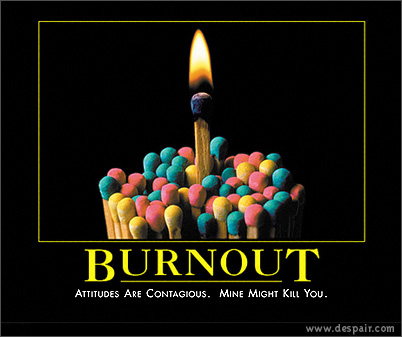
Coping With Burnout


For youth workers (paid or volunteer), there can be nothing more frightening than the belief that something terrible might happen to a student that you have invested so much time and energy in.  As a substance abuse counselor, I struggle with the reality that one day someone could overdose and die regardless of how much I try to help.  I live with the often frantic sense that “there had to be something I could have done!”

Never knowing when crisis or tragedy might happen we learn to be hypervigilant…always on our guard.  Is today the day I get the call?  Will it be a car accident?  A school shooting?  Suicide?

Sometimes we feel as though we’re in a lethal game of chess with our kids, always trying to be two moves ahead and aware of the possible counter-moves.  This type of hypervigilance can be exhausting.

As a youth worker of At-risk kids, you may find yourself on a constant emotional rollercoaster with no scheduled stops.  In times of crisis we often set aside our own needs entirely and as a result we risk burnout and compassion fatigue.  Be reassured that the time for balance will come if you’re intentional, but there are some things you can do now.

1.  Seek supportive relationships – This will be essential in avoiding burnout.  Build a network of friends, family, and peers who are kind and encouraging.  Don’t isolate yourself in fear or shame.  Seek respite in these relationships from the intensity of the situations your kids are facing.

2.  Develop health-conscious behaviors– This is three-fold as I see it; rest, exercise, nutrition.  Get adequate sleep, avoid snack foods, take a brisk walk daily.  All three are important for emotional stability and combating low levels of energy.

3.  Have fun – A life that is overrun with doom and gloom and that is absent of joy is not one worth having.  We need recreation.  It brings balance.  Laughter releases endorphins which cause us to feel pleasure in our brain.  Often, when working with At-risk kids we lose our ability to laugh.  The best cure for a “lost laugh” is a “Three Stooges-I Love Lucy-Gilligan’s Island” marathon.

4.  Spiritual retreat – It is essential that we create time for retreat.  We should develop the discipline, schedule in our calendars, add to our budgets, the practice of seeking spiritual direction.  There’s something magical and refreshing about pulling away from the insanity and seeking Abba’s face in solitude or with a spiritual companion.  Jesus would often pull away after a busy day of ministry to connect with his Father.  He would travel across the lake, go up the mountain, or into the garden to pray.

This simple act breaks us of our dependency on ourselves.  It causes us to reflect on whether or not we are growing a savior complex.  Have I, with the best intentions, placed myself in the position of God?  I have found that when my levels are the lowest it’s because I have been the one trying to “save” and “fix” kids myself.  Being God is hard work and I’m just not cut out for it.

If we expect to be in this for the long-haul we must pace ourselves.  It is an intentional discipline that we need help in cultivating.  I am thankful for the other youth workers God has placed in my life that help me find balance.  They constantly remind me I am not God.  And, we laugh a lot.  As a result we have a better chance of loving and ministering to the kids in our community out of an overflow instead of a deficiency.

Tipping Points


Take a jar of water, cool it and cool it, and it remains water down to 35 degrees, then 34, then 33, then suddenly the water turns to ice.  The temperature was consistently reduced, but at one point the whole system suddenly changed.  The point at which the system changed is what we know call the “Tipping Point”.  Arguably the most complex system known to science is the human brain.  There are billions upon billions of neurons, each with possibly thousands of synaptic connections bathed in multiple chemical transmitters, it is difficult to imaging the sheer volume of interactions that go on.  It may be hard to determine what small factor could have been in the wrong place at the wrong time to contribute to a mental health problem – like a tiny pebble kicked off a path that creates an avalanche further down the mountain.

The beauty of tipping points is that a complex system can just as easily tip up as down.  A small and seemingly inconsequential action can lead to a successful turn around from a seemingly hopeless situation.  Perhaps a lonely, depressed young man decides one day to go for a walk.  Then he starts walking a few times a week.  On one occasion he tries running for a while.  Then he begins to run more often.  Each time he can go a little farther.  He soon notices that he is sleeping and eating better, that he has more energy and looks better in the mirror.  That isolated first walk hay have started a sustained chain of events that are now building toward improving the man’s self-esteem and increasing his energy, affecting his entire brain-body system.  One day, feeling physically and mentally stronger, the man finds a new job.  He begins to make new friends, starts to laugh = and suddenly he finds his life has turned around.

As youth workers we must understand that each moment we spend with a student is potentially that student’s tipping point toward a full life in Christ.  The potential holistic impact is off the charts.  That one, seemingly innocuous conversation, that trip to the store where you invited him/her to “tag along”, that one encouraging text message might turn out to be the turning point in the story.  Likewise, that moment when a student is being “jokingly” picked on and we don’t advocate, that one moment when I’m too busy with budget stuff to take a call, that one moment when I refuse to listen to another break up story could have a lasting impact as well.  Everything we do has impact, whether we know it or not. 

“Be wise in the way you act toward outsiders; make the most of every opportunity. Let your conversation be always full of grace, seasoned with salt, so that you may know how to answer everyone,” Col. 4:5-6(NIV)

Excerpts taken from “A User’s Guide to the Brain” by John J. Ratey M.D.

Sometimes It Blows Up In Your Face


You pour your life into students, let someone else pour some life into you. At the National Youth Workers Convention they create an environment where times of worship, seminar speakers, and communicators pour some life back into you. Learn more at http://nywc.com/

Bullying: Everyone Plays A Role


Most of the time when we think of bullying we only see two parties as being involved; the bully and the bullied.  Olweus theory suggests that everyone plays a role in bullying.  If this is true then to combat bullying would require a collaborative effort by all parties.  Below is a diagram of the various parties involved in bullying.

After seeing this chart I began noticing the specific roles in the youth in our community.  Bullying is a systemic problem that requires a well thought out approach if we are going to quell this dangerous behavior and it’s consequences.  Below is Olweus’s components for addressing bullying in our communities.

Our churches and ministries can and should take the lead in confronting this behavior and implementing a plan of action to address bullying.

What might it say should a church take the lead in this fight?

What does this communicate to our kids when a community fights for their safety?

How does this impact an adolescents search for identity and autonomy?

Sobering Statistics On Eating Disorders


PREVALENCE

It is estimated that 8 million Americans have an eating disorder – seven million women and one million men One in 200 American women suffers from anorexia

Two to three in 100 American women suffers from bulimia

Nearly half of all Americans personally know someone with an eating disorder (Note: One in five Americans suffers from mental illnesses.)

An estimated 10 – 15% of people with anorexia or bulimia are males

MORTALITY RATES

Eating disorders have the highest mortality rate of any mental illness

A study by the National Association of Anorexia Nervosa and Associated Disorders reported that 5 – 10% of anorexics die within 10 years after contracting the disease; 18-20% of anorexics will be dead after 20 years and only 30 – 40% ever fully recover

The mortality rate associated with anorexia nervosa is 12 times higher than the death rate of ALL causes of death for females 15 – 24 years old. 20% of people suffering from anorexia will prematurely die from complications related to their eating disorder, including suicide and heart problems

ACCESS TO TREATMENT

Only 1 in 10 people with eating disorders receive treatment

About 80% of the girls/women who have accessed care for their eating disorders do not get the intensity of treatment they need to stay in recovery – they are often sent home weeks earlier than the recommended stay

Treatment of an eating disorder in the US ranges from $500 per day to $2,000 per day. The average cost for a month of inpatient treatment is $30,000. It is estimated that individuals with eating disorders need anywhere from 3 – 6 months of inpatient care. Health insurance companies for several reasons do not typically cover the cost of treating eating disorders

The cost of outpatient treatment, including therapy and medical monitoring, can extend to $100,000 or more

ADOLESCENTS

Anorexia is the 3rd most common chronic illness among adolescents

95% of those who have eating disorders are between the ages of 12 and 25

50% of girls between the ages of 11 and 13 see themselves as overweight 80% of 13-year-olds have attempted to lose weight

RACIAL AND ETHNIC MINORITIES

Rates of minorities with eating disorders are similar to those of white women

74% of American Indian girls reported dieting and purging with diet pills

Essence magazine, in 2008, reported that 53.5% of their respondents, African-American females were at risk of an eating disorder

Eating disorders are one of the most common psychological problems facing young women in Japan.

While the previous statistics are sobering there is hope.  This hope is in direct proportion to those who are willing to get involved in the messiness that comes with loving those with an ED and an increase in awareness and education of this horrible condition.  If you have suffered from, or someone you love has suffered from an ED we invite you to join the fight.  We invite you to use your voice and influence. We invite you to share your experience, strength, and hope to those who have lost theirs.  You can do that in one of several ways:

1.)  Leave a comment here.

2.)  Refer your friends and loved ones to this and other websites as an ED resource.

3.)  Utilize your social networking sites (Facebook, Twitter, etc.) and provide links to ED websites.

4.)  Talk to your local school/park districts/churches/etc. and educate them on ED.

5.)  Share your stories of overcoming ED. (If you have a story you’d like to share to inspire others feel free to email us at cschaffner@fringeconversations.com.

A WordPress.com Website.

Up ↑