Search

conversations on the fringe

Category

Youth Ministry

ScreenWorld vs. RealWorld


I ‘ve been reading a challenging new book, Virtually You – The Dangerous Power of the E-Personality, written by Elias Aboujaoude, MD from Stanford.  In this book he pulls on years of research the looks at how our online personalities (e-personalities) are shaping how we interact with the offline world.  While he recognizes the unlimited potential of the internet for good he has identified some very dangerous changes in how we relate to, communicate with, and behave in the real world.  He identifies correlations between how we act and interact on the internet and how that in turn shapes us in non-screenworld.  I think this is a must read for anyone living in the technological age.

I have long wondered how the advent of instant, social, and mobile technology impacts our real world lives and here’s just a few things I’m thinking about in no particular order:

LinkedIn – Everyone I connect with is just a means to an end.  Every connection I make is meant to be a networking opportunity, on this site.  But when I become conditioned to see others through a “what can you do for me” lens this has the potential to negatively impact my real time relationships in the same way.

iProducts – With such a focus on individualization in how we experience our technology we can further reinforce this self-centered worldview that we fight so hard to diminish.  With apps on every interface I can make everything I use completely customized to my preferences.  It is precisely this behavior that sabotages our real time relationships.  Everything is about me and every encounter we have with others should be about reinforcing the idea that I am the center of the universe.  iAM.

Also, we can not only add apps that we want we can filter out anything we don’t want or that we don’t like.  I love Facebook’s content filters on my wall so I can hide or delete content from my “friends” that I don’t agree with, that is embarrassing to me, or I just flat out disagree with.  The ability to do this seriously retards our ability to tolerate anything that doesn’t conform to my ideology and beliefs.  I never have to be challenged or held accountable for anything online because I can just unfriend you or hide you news feed.  This also conditions us in real time to be intolerant to those who are different than us and does not lend itself to diversity.

I’m not even going to spend much time on the subject of instant gratification.  This should be a no-brainer.  If it’s not just Google it.

I’ve noticed that people tend to say things online that they would NEVER say in real life.  It’s like we can hide behind the wall of technology and convince ourselves that this isn’t real because I can’t see the other person.  Or, I am not even really being myself online so nobody knows it’s even me.  We tend to be more snarky, pretentious, and just downright mean.  When we spend inordinate amounts of time interacting behind a façade online we soon forget how to interact with people in real time and adopt many of our online behaviors as the new norm.

One last thing I’d like to mention is how disposable the internet makes things (i.e., relationships, apps, websites, etc.).  If this displeases us I will just move on to the next one.  We have been conditioned to not be content.  If a “friend” says something you don’t like, DELETE!  If you beat that game, DELETE!  If you are tired of Facebook, Google+.  There is always another option.  We are all free agents.  Loyalty is hard to come by on the web.  Can you see how dangerous this can be in real time?  Do we treat others the same way?

As we spend increasing amounts of time “connected” online we must know that it can, will, and is shaping how we interact with the real world around us, and not always for the better.  There are assuredly other ways technology is impacting us (i.e., shorted attention spans, impulsive shopping, compulsive gambling, shaping our sexual experiences and lives, etc.).  As we work with kids who have never know a world without mobile phones or the internet we must be increasingly aware of our own online behaviors and seek to bring the two world together as much as possible in a healthy and balanced manner.


Warning Signs You May Be Taking Your Spouse For Granted


This happens more often than not in ministry and we can justify it by claiming we are doing “God’s work” or “Kingdom work”.  But too often those we love most sit home while we “run the race set before us”.  Christian’s a divorcing at a rate comparable to non-Christians and I think neglect is one of the bigger offenders.  Here’s a quick checklist to see if you are in danger of taking your spouse (if you’re married in ministry) for granted. 

  • Do you spend more time on work, ministry, trips, camps, and the youth than you do alone with your spouse?
  • Do you spend nonquality time with your spouse feeling either bored or stressed?
  • Do you share your feelings, thoughts, and dreams more easily and more openly with friends, colleagues, students and strangers at conferences than you do with your spouse?
  • Do you view going home as something you have to do between ministry gatherings and meetings, not something you look forward to?
  • Do you seldom make an effort to look your best when you are with your spouse?
  • Do you seldom play or spend spontaneous time together?
  • Do you say more negative comments to your spouse than  warm, loving ones?
  • Do you treat your mate more like a roommate or “friend with benefits” than a loving partner?

If you answered yes to any of these questions you may need to take a serious look at the lack of balance in your life.  Ministry demands a lot from us but it should never come at the expense of those closest to us.

Unhealthy Family System Model (Exploring Family pt. 2)


Most members of unhealthy family models oscillate between extremes of behavior choosing, mostly unconsciously, whichever behavior promises the greatest chance of surviving the moment.  You may see many of the following extremes in youth in your ministries.  It’s important to understand that these behaviors are functional and serve a purpose for these kids.  Understanding that will help you know what they need from us most.

High Intensity vs. Shutdown:  Alternating between feeling overwhelmed with emotional vs. physiological responses and shutting down.

Overfunctioning vs. Underfunctioning:  Alternating between working overtime to fill in what is missing vs. falling apart or barely holding it together.

Enmeshment vs. Disengagement:  Alternating between being overclose or fused in identities vs. avoidance, or cutting off leading to disengagement.

Impulsivity vs. Rigidity:  Alternating between behavior that leads to chaos vs. rigid, controlling behavior.

Grandiosity vs. Low Self-Worth:  Alternating between grandiose ideas and fantasies vs. feelings of low self-worth.

Denial vs. Despair:  Alternating between a state in which reality is denied or rewritten vs. despair, helplessness (or rage at having life as we know it slip away).

Abuser vs. Victim:  Alternating between the role of victim vs. the role of perpetrator.

Caretaking vs. Neglect:  Alternating between over concern leading toward enmeshment vs. underconcern leading toward disengagement.

Living with dysfunction is traumatizing to the body as well as the mind.  And living in this kind of system can lead to the kind of emotional deregulation that makes us want to turn to high-risk behaviors (substance use, unsafe sexual behavior, self-injury or violence towards others) to regain a sense of calm and regulation that dysfunction undermines.  The kids in our ministries are not typically “bad kids” making immoral choices because they lack long-term consequential thought processes.  Often the behaviors we see in our kids is simply their best attempt to manage life and survive in a world where most of the adults have left them to fend for themselves.

Understanding Family Systems (Exploring Family pt. 1)


 So much has been said about the current state of the family that there’s hardly anything new to add to the conversation.  It is regularly reported that the family is under attack and is falling apart due to changes in our culture.  However, the future need not be bleak for families that are seeking recovery from dysfunction.  Those who embrace the healing that God offers often report that they “do not regret the past nor do they wish to shut the door on it.”  This is because they have learned to find meaning in their struggle and allow it to be transformed into wisdom and a deepened capacity to experience the mystery, beauty and passion of God’s grace and the human condition.

All families are systems in that they have their own sets of rules and behaviors, interrelated substructures, and predictable patterns of behavior.  Family systems theorists have outlined some basic ideas to describe some of the fundamentals of the family system:

Families have interrelated elements and structures: The elements of the system are its family members.  Each element or family member has it’s own set of characteristics.  There are relationships between the elements that function in a relatively independent manner, and all of these create a structure.

Families interact in patterns:  There are predictable modes or patterns of interaction that emerge in a family system.  These patterns help maintain a family’s equilibrium and provide clues to how one functions in this system.

Families have boundaries that tend to be open or closed:  They have ways if defining who is on the inside or on the outside of the system.  Open boundary systems allow other elements to influence them and may even welcome external influences.  A closed system isolates its members in a self-contained world.  No family system is entirely one way or the other.

The whole is more than the sum of its parts:  Families function by this composition law.  Though families are made up of individual elements, the elements combine to create a whole which is greater than the sum of its parts.

There are messages and rules that shape relationships:  These messages, rules and agreements prescribe and limit a family member’s behavior over time.  They tend to be repetitive and redundant and are rarely, if ever, explicit or written down.  They may give power, induce guilt and control or limit behavior, and they tend to perpetuate and reproduce themselves.  Most messages can be stated in just a few words: be responsible, look good, keep family business private, succeed, etc.

Families have subsystems:  These subsystems contain a number of small groups, usually made up of two or three people.  The relationships between people in these subsystems are known as alliances or coalitions.  Each subsystem has its own boundaries and unique characteristics, and membership in the subsystem can change over time.

Families maintain a homeostasis or equilibrium:  (Steiglass 1987).  Families tend to make many small and large adjustments to maintain what family theorists refer to as homeostasis or an overall equilibrium.  This is much like a mobile, which when acted upon, will adjust to rebalance itself. (Satir 1988)  A family system, too, will seek to rebalance itself in order to maintain its equilibrium when the winds of the world act upon it.

It’s important when ministering to the whole family (which we should be doing more of) that we understand each unique family system and it’s many subsystems that support it.  It is especially important for us to assist the family in achieving homeostasis (balance) and it is upset.  This is a real, practical way of showing, teaching, and reinforcing that the God of the universe cares deeply for them and their current condition.  To be the incarnation of Jesus when a family’s world is falling apart is a great place to lead our ministries.

What You Assume Is What You Get


“Most of us are aware that our expectations affect our own behavior.  If you envision yourself losing this afternoon’s tennis match, you are more likely to lose.  If you assume you will win, your chances of winning increase significantly.  We call these self-fulfilling prophesies.  What many people don’t know is that one person’s beliefs can contribute to another’s outcomes.

Time and again, research has demonstrated that our assumptions shape the outcomes.  In an experiment, the Harvard professor Robert Rosenthal told students he had developed a strain of highly intelligent rats that could zip through a maze in record time.  Then he passed our regular old rats to all the students.   He told half of them they were getting the smart rats; the other half, he said, were getting dull rats.  The “smart” rats became faster and more accurate every day; the “dull” rats wouldn’t even leave the starting gate 29 percent of the time.”

The Art of Connecting by claire Raines and Laura Ewing

I read this today and wondered how many kids we leave at the starting gate, not because of their ability or capacity but because of our preconceived beliefs about them. 

It’s sad enough when we self-impose limitations on ourselves but when we do the same to others we fail at our fundamental task as youth workers…seeing what God sees in them and calling it out.

Where are we limiting the kids we influence?

Where are we calling out what God intended?

What Are We Saying When We Don’t Say Anything?


“When we block our awareness of feelings, they continue to affect us anyway.  Research has shown repeatedly that even without conscious awareness, neural input from the internal world of the body and emotion influences our reasoning and our decision making.  Even facial expressions we’re not aware of, even changes in heart rhythm we may not notice, directly affect how we feel and so how we perceive the world.  In other words, you can run but you can’t hide.”

excerpt from Mindsight by Daniel J. Siegel, M.D.

If what Dr. Siegel suggests is true then this holds implications for how we interact with young people in our ministries.  For example, a 14 year old girl in your youth group asks to talk to you privately.  She reveals that she is a victim of sexual abuse and to cope with it she cuts herself.  How we respond to her, including our tone, facial expressions, and body posture will all communicate something to her. 

What are we communicating to our young people beyond our words? 

How does this help or hinder their ability to trust us? 

How can we grow in our own emotional management?

Angry Urban Youth – Survival Of Fittest


Anger and fear are closely related emotions.  For instance, they both travel through the amygdala in the brain.  They need to be closely connected in our brain because people often have to decide quickly between standing their ground or running away in the face of immediate danger.  That’s the classic fight-or-flight choice.  However, kids growing up in impoverished, urban settings seem to have a strong fight and flight reaction when they perceive a threat.

Imagine you are one of a small group of soldiers conducting a search for enemy troops.  You’re expecting to run into a few of the enemy at a time.  Instead, though, you stumble across a much larger unit.  The enemy greatly outnumbers you.  So now, what do you do?  You must shoot and run at the same time.  That’s the only way to survive.  And what are you feeling?  Both anger and fear.  Your anger helps you fire at the enemy.  Your fear helps you escape.

It’s easy to see that for urban youth survival or defensive behaviors are usually triggered by mixed (and very strong) feelings of fear and anger.  It’s the combination of these two emotions that overwhelms reason.  True, when someone is raging, all you can see is the anger.  But remember the core message: “I’ve got to kill you before you kill me.”  That’s very different than “I want to kill you and get what I want” or “I want to kill you to get you out of my way.”  It’s the fear of death that directs the attack.

Why is this so important?  It means that when helping urban youth we are likely going to have to equip them to deal with their his or her fear as well as his or her anger.  It means that feeling safe is key to overcoming such a reflexive response.  We’re talking about helping youth change how they relate to the world.

Now here’s the dilemma.  Traumatized people (many urban youth have been traumatized) see danger everywhere, anywhere, with everyone.  There is no safe place.  There are no safe people.  Most importantly, they often see danger where there is no danger.  So how can youth quit experiencing survival rage?  The answer, obviously, is complex.  He or she must experience places in their lives that they are safe enough, so he or she can stop running and stop shooting.  Note the words “safe enough” – not perfectly safe.  None of us live in a perfectly safe world.  A safe enough world is one in which you feel no immediate danger to your life and well-being.  A safe enough place is one in which you believe that most people, especially those closest to you, are on your side and want to protect rather than harm you.

That is a beautiful picture of the body of Christ coming alive in these forgotten places.  Providing refuge and sanctuary for weary urban youth simply looking for a place safe enough to stop running.

What We’re Reading 02/15/2011


The Rise and Fall of the American Teenager – Thomas Hine

This book takes a look at the historical context of the American teenager experience.  Hine gives a great overview of the invention and development of the “adolescent” and their unique roles throughout our country’s history.  It drags at times but if hang in there you will walk away with a better sense of how the current state of affairs facing our youth today came to be.

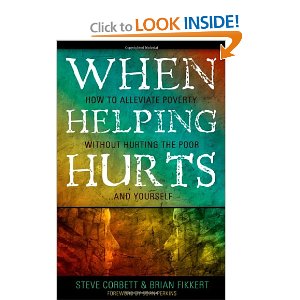
When Helping Hurts – Corbett & Fikkert

The subtitle of this book says it all, “How to alleviate poverty without hurting the poor and yourself”.  Many serve with the best of intentions but those intentions often don’t really help and can often make the problems worse.  This is a must read if your calling is to work with those in poverty regardless if the poverty is found in a third-world, urban city, or rural community.

Growing Up In America (the power of race in the lives of teens) – Christerson, Edwards, & Flory

Kara Powell at Fuller Youth Institute first brought this book to our attention.  If you work in a diverse population and want to understand how race shapes the experiences of our youth then this is a good primer.


Fist Stick Knife Gun – Geoffrey Canada

“If you wonder how a fourteen-year old can shoot another child his own age in the head and then go home to dinner, you need to know you don’t get there in a day, or week, or month.  It takes years of preparation to be willing to commit murder, to be willing to kill or die for a corner, a color, or a leather jacket.” (from inside flap)

This is a challenging book for us to read.  As we turned page after page we realized that we were part of the problem.  We all were.  For anyone  working in community where violence is the norm, this also is a must read.

Would Jesus Sit In The Smoking Section With A Gay Huckleberry Finn?


In Mark Twain’s novel The Adventures of Huckleberry Finn, Huck wrestles through a moral dilemma about demonstrating true friendship to a stigmatized person of his day – a man who bore a dual stigma of being black in a racist society and slavery in an exploitative one.  To help his friend Jim escape meant violating not only human law but also divine law as it had been interpreted in that society, because to help a slave escape meant stealing property from his or her owner.  Not only did Huck worry about God and about going to hell for obeying the impulse of his heart, but he also worried about what people would think of him.  “It would get all around that Huck Finn helped a negro to et his freedom; and if I was eer to see anybody from that town again I’d be ready to get down and lick his boots for shame.”  But such worries did not prevent him from doing what he knew to be right.

Jesus knew all about stigma.  He never hesitated to move among the oppressed people of his day, including the most despised social outcasts.  He went about his ministry without worrying about what others would say about his character, his motives, his righteousness.  “If this man were a prophet,” said some, “he would have known who and what kind of woman this is who is touching him – that she is a sinner” (Luke 7:39).  He also ignored the insinuations and seemed unconcerned about his reputation among the townspeople.  “Look,” said those who criticized Jesus and passed judgment on him, “a glutton and a drunkard, a friend of tax collectors and sinners!” (Luke 7:34).

Jesus was not afraid of being called names, nor was he afraid to be identified with the most hated, discredited people in the society in which he lived.  He cared about them.  He felt their pain, knew their hunger and thirst, recognized their humanity, saw the image of God in them.  In short, he loved them.  And he longed to minister to them – even if others misunderstood and vilified him.  Name calling was as common then as it is now, and to label someone with a scornful term identified with a stigmatized group has always been considered an extreme insult.  Today, terms of insult are frequently associated with homosexuality – “queer,” “fag,” “dyke,” “lezbo.”

During the time that Jesus walked the earth, the stigmatized people were the Samaritans, and the term of insult was “You Samaritan!”  Samaritans were half-breed leftovers from previous generations when God’s people were enslaved, raped, and plundered by the Assyrians.  Not only were they bi-racial and therefore not clean, they were reminders of the horrible atrocities committed against the Israelites during that time.  That’s what is so powerful about the story of the Good Samaritan.  The hero in the story was one of the most despised people in all of the New Testament yet Jesus refused to dissociate himself from this disdained group of people that he loved.

Have our youth ministries become sanctified segregation machines?  Why is it that most of the churches in the suburbs are all white?  Why don’t diverse inner-city churches adopt-a-block in affluent neighborhoods?  Why do LGBTQ students still avoid the church like the plague?

We should long for the day when people call us “faggots,” and “cutters,” and accuse us of having AIDS because of the company we keep and we aren’t compelled to defend ourselves because we don’t care what man has to say about us.  I think if Jesus came back today you might find him hanging out at a Gay-Straight Alliance meeting or with kids who were at a skittles party the night before or out on the corner with all the smokers.  You would probably be able to smell cigarette smoke on his robe so he’d be accused of being a smoker too…

A WordPress.com Website.

Up ↑