Search

conversations on the fringe

Category

Youth Ministry

Bueller…Bueller…(Youth Ministry 101)


Remember this scene from Ferris Bueller’s Day Off?  Man, this scene resonated with me because I had experiences like this when I was a student.  I have also, unfortunately had youth ministry experiences like this when students wiped their saliva off their cheek after nodding out from listening to me drone on and on…

Our first objective as teachers is to capture our students’ attention.  If we don’t gain their attention, the chance that they’ll learn anything is remote at best.  The process of attention serves two primary purposes, the first of which is survival.  The brain kept our ancestors safe by alerting them to possible hazards in their midst like strangers, thunder clouds, or wild animals.  Fortunately, it is the rare occasion that survival is at stake in youth ministry.  Instead, attention serves its second purpose – maintaining pleasurable feelings.  The hot girl with the pierced tongue, a double chocolate ice cream bar, and listening to pop music are pleasurable diversions for modern teenagers.  So are funny stories, terrible tragedies, and first loves, which the bible is full of.  

So why does it seem that our kids are tuning out?

The brain is bombarded with information from the senses.  Everything we see, hear, touch, smell, and taste finds its way to the sensory receptors, from the clothes on your back to the beige walls of the youth group room and the radio playing softly in the back ground.  At the base of the brain is the brain stem, which controls involuntary actions like breathing, blood pressure, and heartbeats.  Deep within the brain stem is the reticular formation, a system of neurons that gathers information from all of your senses and controls your awareness levels.  Some awareness is at a conscious level (what you see and hear a speaker do and say) and some at an uncounscious level (the color of the walls or the socks you are wearing).  It would be impossible for the brain to consciously focus on each bit of data it receives.  You may be oblivious to the feel of a baseball hat on your head while the cute girl beside you captures your full attention.  Consider the immense amount of information the brain is capable of absorbing, from the food stuck in your teeth to the lint on your coat, we are fortunate to be able to forget most things.  Otherwise, we’d overload.

Ask a group of teenagers what they think about youth group teaching times and you might hear answers like: “Boring.” “Stupid.” “It sucks.”  Of course, friends, potential dates, meals, and doodling don’t bore them; the adolescent brain is fascinated by (and seeks out) novelty and emotion (Koepp et al., 1998; Spear, 2000).  Sitting through a youth group lecture (especially one that is self-indulgent) that fails to include either is the real test of a teen’s attention.  Many teaching strategies have a great deal of difficulty keeping attention and arousing emotion, both of which are necessary to stimulate change in behavior.  Lecture, which can be an efficient way to deliver information, is often not emotionally charged.  Objective memorization rarely generate emotion and are often difficult to apply to real-world applications.  Yet lecture is still a dismayingly popular means of presenting content.  We miss opportunities when we overuse strategies that neglect our emotional and cognitive constitution – two powerful memory builders.

I’m not suggesting that we dress up like clowns and juggle for our students.  I am suggesting that we understand their learning abilities and compensate for their developmental limitations and strengths.

How can we engage our students cognitive and emotional abilities in ways that motivate change in their hearts and their behaviors?

Beliefs + Emotions = Action


Have you wondered why your students have a tendency to overreact emotionally?  Have you ever wondered why some of them seem to think the world revolves around them?  Have you ever wondered why, in spite of your and their parent’s best efforts, one of your high school students regularly leaves youth group in tears or angry and their friends? 

Adolescents are particularly prone to patterns of irrational thinking. Influenced by a myriad of sources, they often have an skewed perspective on themselves and the world they live in.  Dr. David Elkind coined the term “Imaginary Audience” that many adolescents belive they are in front of every minute of every day.  This type of thinking can be irrational and lead to all sorts of difficult behaviors.

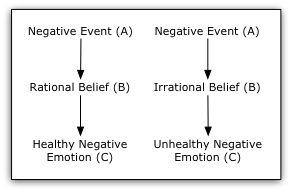
Albert Ellis (1977) described an ABC(DE) model of emotional disturbances that illustrates how beliefs influence emotions and how people become upset.  As shown below an individual’s beliefs (B) about an activating event (A) cause his or her emotional and behavioral consequences (C).  This is contrasted with the commonly held belief (by adolescents) that emotions and behaviors are caused by the events.  Disputation (D), or questioning and challenging irrational beliefs that young people might hold about themselves, others, events, and the world they live in will lead to a more constructive emotional and behavioral effects (E).


Ellis and his colleagues have identified numerous irrational beliefs commonly held in our culture that appear to cause emotional disturbance.  Some of the most frequently cited irrational beliefs can be found here.

Ellis (1980, pp.5-7) indicates that the irrational beliefs listed stem from the following three major irrational belief clusters:


  1. “I must do well and win approval for my performance, or else I rate as a rotten person.”
  2. “Others must treat me considerately and kindly in precisely the way I want them to treat me; if they don’t, society and the universe should severely blame, damn, and punish them for their inconsiderateness.”
  3. Conditions under which I live must get arranged so that I get practically everything I want comfortably, quickly, and easily, and get virtually nothing that I don’t want.


Bernard and Joyce (1984) state that these three irrational belief clusters cause major problems during childhood and adolescence as well as adulthood.  Waters (1982, p.572) has identified the following ten irrational beliefs of children:


  1. “It’s awful if others don’t like me.”
  2. “I’m bad if I make a mistake.”
  3. “Everything should go my way; I should always get what I want.”
  4. “Things should come easy to me.”
  5. “The world should be fair and bad people must be punished.”
  6. “I shouldn’t show my feelings.”
  7. “Adults should be perfect.”
  8. “There’s only one right answer.”
  9. “I must win.”
  10. “I shouldn’t have to wait for anything.”


In addition, Waters (1981, p.6) identified ten irrational beliefs held by adolescents:


  1. “It would be awful if my peers didn’t like me.  It would be awful to be a social loser.”
  2. I shouldn’t make mistakes, especially social mistakes.”
  3. “It’s my parents’ fault I’m so miserable.”
  4. “I can’t help it; that’s just the way I am and I guess I will always be this way.”
  5. “The world should be fair and just.”
  6. “It is awful when things don’t go my way.”
  7. “It is better to avoid challenges than to risk failure.”
  8. “I must conform to my peers.”
  9. “I can’t stand to be criticized.”
  10. “Others should always be responsible.”

We, as youth workers, are in a unique position where we can influence a students perspective and beliefs.  It is with great fear and reverence that we should move forward into this position.  We are in a position to shape their identity and the lens by which they interact with the world around them.  We are not alone in this as parents, teachers, friends and other play this role as well, but we have the privilege of helping them navigate this stage of life.  We should measure our words and be careful because we can either reinforce irrational beliefs (that shape their behaviors) or speak life and truth into their lives that help them understand who they are in Christ and the unique role they play in the Redemption Story.

The Three R’s of Bullying Interventions


The issue of bullying just doesn’t seem to be going away so today let’s talk about strategies to fix what bullying does.  The following would be a great resource to put in the hands of parents of your students.  It is also good kindling for discussion on reconciliation.

Restitution, Resolution, and Reconciliation 

If student was a follower/supporter of the bully: 

  1. Intervene immediately
  2. Provide a system of graceful accountability while allow natural consequences to occur
  3. Create opportunities to “do good”
  4. Nurture empathy
  5. Teach friendship skills – assertive, respectful, and peaceful ways to relate to others
  6. Monitor/Criticize/Converse about TV shows, movies, music, and video games that reinforce violence against others
  7. Engage in more constructive, entertaining, and energizing activities 

If your student hurt others through gossip: 

  1. apologize to the child who was harmed by the rumor
  2. go to everyone she told it to and tell them it wasn’t true
  3. ask them to stop spreading it
  4. ask them to let everyone they told that she was a part of spreading the rumor and that she wants to correct it
  5. to the best of her ability, repair any damage done to the target by the act of spreading the rumor
  6. take the next step of building a new and healthier relationship 

Three principles that foster moral independence: 

  1. Teach your student that he and only he is responsible for the consequences of his actions (kids who accept responsibility for their own actions are more likely to live up to their own moral code) 
  2. Build your student’s confidence in his or her ability to make good decisions (Kids who have confidence in their own judgments are not easily manipulated by others) 
  3. Teach your student how to evaluate reasons on his or her own (Kids who have confidence in their own ability to reason are more questioning and more resistant to passive acceptance of orders.)

reference: Bully, the Bullied, and the Bystanders by Barbara Coloroso

Creating Caring Communities that Challenge Bullying


The following is a brief outline for creating an environment that leaves little room for bullying.  Whether your group is in a classroom, youth group room, large group meeting room, or small group this following principles will be helpful for the leader to cultivate a safe environment.  This can also be used in training volunteers as there is a Powerpoint Presentation that goes with it at the bottom of this post.

Four Key Principles 

  1. warmth, positive interest, and involvement from adults
  2. firm limits as to unacceptable behavior
  3. in case of violations of limits and rules, consistent application of non-hostile, non-physical sanctions (discipline as opposed to punishment)
  4. behavior by adults at home and in community organizations that creates an authoritative (not authoritarian) adult – child interaction

 Elements to Effective Anti-Bullying Policies 

  1. A strong, positive statement of the organizations desire to promote positive peer relations and especially to oppose bullying and harassment in any form it may take by all members of the community
  2. A succinct definition of bullying or peer victimization, with specific examples
  3. A declaration of the rights of individuals and groups in the community – students, teachers, clergy, LGBTQ, minorities, etc – to be free of victimization by others
  4. A statement of the responsibility of those who witness peer victimization to seek to stop it
  5. Encouragement of students and parents with concerns about victimization to speak with school/church/community leaders about it
  6. A general description of how the community organization proposes to deal with the bully/victim problem
  7. A plan to evaluate the policy in the near future

 Prevention Strategy 

  1. Gathering information about bullying in community directly from students
  2. Establishing clear organizational rules about bullying
  3. Training all willing adults in the community to respond sensitively and consistently to bullying
  4. Providing adequate adults supervision, particularly in less structured areas, such as playgrounds, parks, swimming pools, etc.
  5. Improving parental awareness of and involvement in working on the problem.

Bullying Training

Four Markers of Bullying


With every person we talk to about bullying we get a different definition of what it is.  There seems to be some difficulty defining what bullying is and what it isn’t.  Norwegian researcher Dan Olweus defines bullying as when the person is

“exposed, repeatedly and over time, to negative actions on the part of one or more other persons.”

He defines negative actions as “when a person intentionally inflicts injury or discomfort upon another person, through physical contact, through words or in other ways.”

The following are markers that may help determine if an act of aggression is actually bullying or simply the result of conflict between two parties.

1. Imbalance of Power

The bully can be older, bigger, stronger, more verbally adapt, higher up on the social ladder, of a difference race, or of the opposite sex. Sheer numbers of kids banded together to bully can create this imbalance. Bullying is not sibling rivalry, nor is it fighting that involves two equally matched kids who have conflict.

2. Intent to Harm
 
The bully means to inflict emotional and/or physical pain, expects the action to hurt, and takes pleasure in witnessing the hurt. This is no accident or mistake, no slip of the tongue, no playful teasing, no misplaced foot, no inadvertent exclusion.
 
3. Threat of Further Aggression
 
Both the bully and the bullied know that the bullying can and probably will occur again. This is not meant to be a one time event. When bullying escalates unabated, a fourth element is added:
 
4. Terror
 
Bullying is systematic violence used to intimidate and maintain dominance. Terror struck in the heart of the child targeted is not only a means to an end, it is an end in itself. This is not a one time act of aggression elicited by anger about a specific issue, nor is it an impulsive response to a rebuke.

Faith or Rigidity (Help, I Have an Aspie in my Youth Group!)


Left to their own devices, children with AD will often go through life like a train on a track: one way, straight ahead, never varying, and avoiding the unexpected.  It is hard to live a life of faith without the flexibility to take-risk, something that is difficult for an Apsie.  Aspie’s need to learn how to go off-roading..  Telling the child – and showing them through many experiences over the years – that taking risks and steps of faith is a good thing and to not be controlled by fear.  Compliment the child when they are flexible, bending and changing and trying new things.

Youth workers can partner with the parents by helping these children develop skills at surviving in the world.  Plan to take them places they might enjoy, such as restaurants, on public transportation, and to age-appropriate entertainment during youth group outings but be aware, that too much pressure to read so many pieces of sensory and social information at once can be exhausting and stressful.  Plan you activities accordingly.  It is appropriate to increase your expectation as the child gets older and working in partnership with the parents makes discerning this easier for the youth worker. 

This really is an issue of teaching the Aspie how to have faith.  Faith is a gift that is given to some of us by the Spirit in a supernatural way but a child with AD may struggle with the flexibility needed to respond to Spirit’s promptings.  Walking with and modeling way to do this will reinforce in the Aspie a healthy expression of faith where one can take risks in following the God who loves them and allows them a seat at the kingdom table.

Youth Ministry 101 (Communication)


Efficient and clear communication is essential in the youth ministry world, whether it be between the Sr. Pastor and the Youth Pastor, student and volunteer, or between parents and youth workers.  Yet too often, we are not as aware as we coupld be of the skills of good communication.  Yes, we were trained in the art of speaking, preaching, and teaching but rarely are we taught how to listen well.

Good communication requires first of all quieting the the internal dialogue which often prevents us from listening clearly to others.  Particularly if we have a lot of negative or destructive ruminations swimming in our minds, we need to learn to still these internal voices.  When our internal world is quiet and calm, a balanced emotional awareness can develop and we are more able to see and hear others clearly.  We are also more likely to hear that small, still voice that guides us.

Next, we need to be able to listen.  Listening is a developed skill which requires practice and attention.  One of the keys to good listening is to avoid formulating a response until the person speaking is completely finished.  This is hard for us because we are training in the art of arguing our agenda.  If we are busy thinking of what we’re going to say next, we are probably not absorbing what the speaker is saying.  The next time you speak with a student or the Sr. Pastor, make a point of listening without reacting until they are finished speaking.  Then pause for a moment, take a deep breath, and let the other person know you have heard what they said before you proceed with your own feelings or opinions.  Repeating another person’s main messages for clarification is also useful.  You’ll be surprised sometimes at the difference between what you heard and what the speaker thought they said.  Discussing this can be very helpful.  In ministry, mistaken communication can come back to haunt you, so taking the time for clarification is very important.

Paying attention to nonverbal communication is just as important as listening carefully to verbal messages.  We communicate through our body language – gestures, eye movement, facial expressions, posture – just as much as through our words.  Good communicators know how to listen and respond to this nonverbal communication.  For instance, if a student assures you that things are going fine at home, but fidgets and looks nervously towards the door as they speak, you may want to gently inquire further about some of the specifics of the situation.  Make eye contact and use a gentle tone of voice when responding to these nonverbal clues.  Often a person expresses things through their body when they are uncomfortable articulating them openly.  If we remain calm and show respect for the student’s feeling, the student is more likely to feel that they can express their thoughts more directly.  Everyone benefits when communication is open and clear.

One final thought…when talking with others, as far as it’s possible by you, suspend immediate judgement whenever you can.  For example, a young teenage girl takes a huge risk by sharing with you that she cuts herself when she’s upset.  If you’re immediate response is to overreact and shame her or express disgust, you have effectively closed the door on the discussion.  She has just interpreted that as you cannot be trusted with sensitive information.  There will be a time to challenge certain beliefs and behaviors but keep the conversational door open long enough to establish trust and earn the opportunity to be heard.  The other person will be much more likely to hear what you have to say then.

I Have An Aspie In My Youth Group!


In a setting which relies heavily on spoken and written words the Asperger’s child is at a disadvantage.  With a growing awareness of Asperger’s and its nuances youth ministries need to adjust some of their practices to make it more accessible to those who have traits of or a diagnosis of the disorder.

 There are three main interrelated general areas of functional liability in children with AD:

  1. Visual-spacial processing and sensory-motor integration
  2. Information processing and organizational skills
  3. Social skills and pragmatic language development

These areas will need to be discussed in greater detail by youth ministries as this is largely misunderstood people group that are not being effectively impacted with the Good News, not for a lack of want but likely from a lack of understanding and awareness on our part.  For the time being we’ll simply provide an overview of these three areas of difficulty and leave it up to you to contextualize in your ministry setting.

Visual-spacial processing and sensory-motor integration

Examples of visual-spacial skills include the ability to walk a narrow beam or to run while accurately throwing a ball to another person.  Most of us take these skills for granted.  You probably think nothing of the fact that you know the relative size of things.  When going to pick up a stack of books, you know that they will be heavier than the single book you just put down, and you’ll adjust your motor movement to account for that difference.  You take for granted that you can find your way from one place to another in a large building.  For youth with AD, the visual-spacial and visual discrimination skills required to accomplish all these activities are often impaired, contributing to a natural clumsiness and frequent experiences of getting lost.

Visual-spacial processing impacts learning in many ways and this has a direct impact on discipleship efforts, given that we primarily teach about our Christian faith like a classroom subject.  Students with AD find tasks such as handwriting, taking notes, and filling out forms and worksheets difficult at best and often impossible.  Given the difficulties these children have in visual spacial processing and coordinating sensory-motor integration, seemingly simple tasks are not simple and can impede their ability to grow and develop spiritually as their peers.  The problem is not one of failing to understand the task or not having the knowledge to complete the task (i.e., bible study); rather, the problem is that these youth have a specific disability that interferes with the processing of visual-motor and visual-spacial information.

Information processing and organizational skills

Processing the many forms of information that you encounter daily is dependent on a complex set of interconnections between multiple parts of the brain.  In students with AD this process is impaired, leaving them unable to easily or quickly make sense of simple day-to-day tasks (like homework or chores), or individual expectations (grooming or managing relationships).  The information goes in, but once it enters the labyrinth of the mind it becomes jumbled and their ability to organize, recall, or use the information is hindered by their cognitive processes.  Imagine trying to relate a parable of Jesus to a student with AD.  This can often appear on the surface to be oppositional in nature but upon further inspection it is simply the result of a complex cognitive process that has gone off the track.

Social skills and pragmatic language development

In the development of social skills and day-to-day language that conveys social meaning the AD child struggles.  This is partly due to the first two issues addressed above.  The student’s difficulties processing information and accurately comprehending the actions of others, along with spacial, motor, and organizational problems combine to create pain nd anxiety for the child.  Normal social interactions occur on so many levels at the same time, some overt (verbal messages) and some covert (hidden messages, tone of voice, nonverbal, gestures, body language, etc.).  Youth with AD do not fully grasp these nuances, missing social cues and implied meanings that others understand.  Aspies often take things at face value, interpreting statements literally, often missing sarcasm, subtly humor, or even threats. 

Just because a child has AD does not mean they will skip being a teenager.  The student is just as  likely to go through the normal variations of mood and personality as any teen; they just go through adolescence with more baggage.  The good news is that, developmentally, most of these teens are slower to become aware of adolescent issues of sexuality, drugs, or rebellion, but these issues will eventually come up  The social culture that our youth are a part of is difficult at best, and many of these teens are not prepared to deal with the pressures they face daily.  We have a tremendous opportunity to show the love of Christ to Aspies and their families by entering into the potential messiness of their day-to-day living and getting our hands dirty.  The message this sends when we seek to understand is that they matter.  They matter to us and more importantly, they matter to the God who created them.

Troubleshooting Guide for Difficult Students


We’ve all met those oppositional students from time to time.  Maybe they suffered from R.A.D. (reactive attachment disorder) or some extreme form of A.D.H. D. or just simply suffered from a serious conduct disorder.  Regardless, we can find ourselves in a “battle of the wills” with these students and often in the middle of small group.  The following is not an exhaustive list but serves as a troubleshooting guide for handling some of the more common problems with difficult students.

Won’t Speak To You…

  •  Try to help the adolescent realize that you have no interest in making them talk.  It’s always going to be more important that the student wants to speak that the adult is spoken to.
  • In the spirit of collaboration, invite the student to help troubleshoot the silence with you.
  • Give them permission not to speak.  This way the pressure to speak is relaxed.

 Is Disrespectful During Youth Group Meetings…

  •  Deflect or ignore the comment so it can’t be taken personally.
  • Without challenging him/her, point out their role in the deterioration of the conversation/meeting.
  • Do not use your position as leverage.  This is usually about exerting autonomy and control.  Don’t fight fire with fire.
  • Use empathy to diminish defensiveness on the student’s part.

 Tries To Pick A Fight…

  •  Try forecasting the inevitable, and troubleshooting for it together in advance, is a handy was of defusing anticipated friction between adults and students.
  • Don’t assume you know what’s driving the behavior but asking what purpose this behavior serves can generate a good discussion.

 Talks About Everyone Else But Himself/Herself…

  •  Discussing one’s friends is often a testing ground to see how the adult will react when they share something personal.  Be careful regarding what you say because you will expose your judgments and values and send a message to the student that you are either safe to share with or someone to be avoided.

 Tells War Stories…

  •  Comment on the effect that the student’s actions are having on your time together, or on you, not their purpose.
  • Point out the dilemma this kind of story telling puts you in, if you point out the negative in this story it will likely impact your relationship with the student.  If you don’t, you may be enabling the student’s sin.  Ask the student how they would expect you to respond to these stories.
  • Be patient and don’t reinforce.

A WordPress.com Website.

Up ↑