
Search

conversations on the fringe

Category

Technology

ScreenWorld vs. RealWorld


I ‘ve been reading a challenging new book, Virtually You – The Dangerous Power of the E-Personality, written by Elias Aboujaoude, MD from Stanford.  In this book he pulls on years of research the looks at how our online personalities (e-personalities) are shaping how we interact with the offline world.  While he recognizes the unlimited potential of the internet for good he has identified some very dangerous changes in how we relate to, communicate with, and behave in the real world.  He identifies correlations between how we act and interact on the internet and how that in turn shapes us in non-screenworld.  I think this is a must read for anyone living in the technological age.

I have long wondered how the advent of instant, social, and mobile technology impacts our real world lives and here’s just a few things I’m thinking about in no particular order:

LinkedIn – Everyone I connect with is just a means to an end.  Every connection I make is meant to be a networking opportunity, on this site.  But when I become conditioned to see others through a “what can you do for me” lens this has the potential to negatively impact my real time relationships in the same way.

iProducts – With such a focus on individualization in how we experience our technology we can further reinforce this self-centered worldview that we fight so hard to diminish.  With apps on every interface I can make everything I use completely customized to my preferences.  It is precisely this behavior that sabotages our real time relationships.  Everything is about me and every encounter we have with others should be about reinforcing the idea that I am the center of the universe.  iAM.

Also, we can not only add apps that we want we can filter out anything we don’t want or that we don’t like.  I love Facebook’s content filters on my wall so I can hide or delete content from my “friends” that I don’t agree with, that is embarrassing to me, or I just flat out disagree with.  The ability to do this seriously retards our ability to tolerate anything that doesn’t conform to my ideology and beliefs.  I never have to be challenged or held accountable for anything online because I can just unfriend you or hide you news feed.  This also conditions us in real time to be intolerant to those who are different than us and does not lend itself to diversity.

I’m not even going to spend much time on the subject of instant gratification.  This should be a no-brainer.  If it’s not just Google it.

I’ve noticed that people tend to say things online that they would NEVER say in real life.  It’s like we can hide behind the wall of technology and convince ourselves that this isn’t real because I can’t see the other person.  Or, I am not even really being myself online so nobody knows it’s even me.  We tend to be more snarky, pretentious, and just downright mean.  When we spend inordinate amounts of time interacting behind a façade online we soon forget how to interact with people in real time and adopt many of our online behaviors as the new norm.

One last thing I’d like to mention is how disposable the internet makes things (i.e., relationships, apps, websites, etc.).  If this displeases us I will just move on to the next one.  We have been conditioned to not be content.  If a “friend” says something you don’t like, DELETE!  If you beat that game, DELETE!  If you are tired of Facebook, Google+.  There is always another option.  We are all free agents.  Loyalty is hard to come by on the web.  Can you see how dangerous this can be in real time?  Do we treat others the same way?

As we spend increasing amounts of time “connected” online we must know that it can, will, and is shaping how we interact with the real world around us, and not always for the better.  There are assuredly other ways technology is impacting us (i.e., shorted attention spans, impulsive shopping, compulsive gambling, shaping our sexual experiences and lives, etc.).  As we work with kids who have never know a world without mobile phones or the internet we must be increasingly aware of our own online behaviors and seek to bring the two world together as much as possible in a healthy and balanced manner.

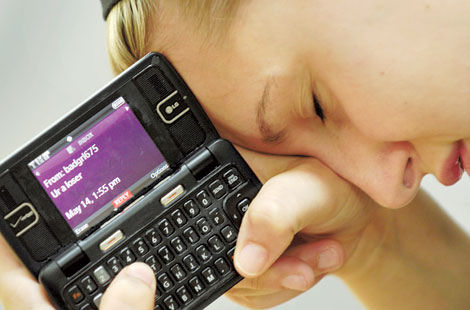
Bullying (part 3): Text-Bullying And Mobile Technology


Adults are becoming more and more savvy about protecting kids from cyber bullying—harassment using technology, such as email, instant messaging, or social networking sites like MySpace, Facebook, and Twitter. But during the upcoming spring break, when kids have more unstructured time than usual, they are also at risk of exposure to bullying through text messaging (“text bullying”), or even being “sexted,” using the text-messaging feature on cell phones, which a reported 87 percent of teens own (National Campaign to Prevent Teen and Unplanned Pregnancy, 2008).

Sexting” is sending nude or sexually suggestive pictures and accompanying text via cell phone. Although the original “sexter” may only send the suggestive message to one person—a girlfriend or boyfriend, for example—that message can be forwarded to anyone in the recipient’s address book, and from there, all across a school or community. Once it’s out there, there’s no way to take back the message or the accompanying embarrassment or humiliation.

There are possible long-term consequences, too. Since school admissions officers and potential employers often look at online profiles, the repercussions of sending an inappropriate message could be endless. And one newspaper reports that sexters can “face felony charges for child pornography” (Borgman, 2009), landing them on the registry for sexual predators, a label they’ll bear for the rest of their lives.

What Kids Can Do About It

According to the Anti-Defamation League, critical thinking is “the best tool against hate” (Tiven, 2003). You can coach kids to use the same problem-solving skills for text bullying that they would use in any other situation. The more they think before pressing the “send” key, the less likely they will be to disseminate a photo or message that will get them in trouble and ruin their reputation.

When kids receive harassing or inappropriate text messages, there are several things they can do:

  • Never, ever respond to the message sender.
  • Report it as soon as possible to a trusted adult (and if that person doesn’t help, tell others until someone does).
  • Save or print the message to keep a record, then delete it from the phone.
  • Only keep contact information of close friends and family in their address book.
  • Talk to their wireless provider about how they can help (such as blocking the messages or changing their number).

What Parents Can Do About It

If critical thinking is a kid’s best defense against text bullying, communication is yours. Just as you talk to your kids about sex, relationships, and drugs, it’s also important to talk to them about how they use their phones, and with whom.  “Supervising and monitoring your kids’ whereabouts in real life and in cyberspace doesn’t make you a nag; it’s just part of your job as a parent” (NCPTUP, 2008).

It’s best not to take away kids’ phone privileges when they come to you with a text bullying problem. That might make them feel as if they’re being punished for someone else’s transgression. Here are some things you can do instead:

  • Talk to your kids about text bullying and sexting, especially the short- and long-term consequences.
  • Monitor their cell phone use: Who are they texting? Who is texting them?
  • Suggest that everyone’s cell phone stay on the kitchen counter or another centralized place while they’re home.
  • Set rules about the kind of behavior that is and is not acceptable—on a cell phone, or anywhere else. Remind kids of the rules periodically.
  • Many cell phone provider’s website allow for varying degrees of parental control available from their website.  This allows for parents to control the hours of which a child may receive or send text/pix messages, block callers/numbers from any activity on that specific phone line, and keep record of your child’s mobile activities.

References

Borgman, L. (2009, February 24). Safe sexting? There’s no such thing. Lexington Herald-Leader.

Brock, K. (2008, May 6). Text bullying. WLS-TV Chicago, IL. Retrieved February 24, 2009 from http://abclocal.go.com/wls/story?section=news/national_world&id=6124134.

National Campaign to Prevent Teen and Unplanned Pregnancy. (2008). Sex and tech: Results from a survey of teens and young adults. Washington, DC: Author.

NCH: The Children’s Charity. (2005). Stoptextbully top 10 tips. Retrieved February 24, 2009 from http://www.pkc.gov.uk/NR/rdonlyres/F1ABA3FA-C050-4913-BD29-0AC7A531F110/0/StoptextBullyingTop10Tips.pdf.

Tiven, L. (2003). Hate on the Internet: A response guide for educators and families. Albany, NY: Anti-Defamation League.

Compassion on the Decline Among College Students


The results of research done at the University of Michigan tells us that compassion among college students is declining.   Researchers analyzed data on empathy collected from almost 14,000 college students over the last 30 years.   “We found the biggest drop in empathy after the year 2000,” said Sara Konrath, a researcher at the U-M Institute for Social Research.

You can read the entire article here.

I wonder if there is any correlation between the consumer mindset so prevalent in modern churches today and the decline of the hallmark personality trait of Jesus.  The scriptures regularly address the issue of compassion or the lack thereof.

What are we doing to challenge ourselves and those we serve to grow in compassion?

What are we doing, inadvertently or intentionally, that may be contributing to the decline in empathy and compassion in out young people today?

What does this mean as we do bridge-building work among marginalized communities? (i.e., LGBTQ, Homeless, Substance Abusers, Incarcerated, etc.)

Here’s a great video to get the discussions started about compassion. 

Constance – Mr. J. Medeiros


We know this video was released a couple years ago but it warrants being recycled every now and again because of the powerful message it has.

WARNING:  The content of this video addresses themes of pornography and the internet.  It is useful for beginning discussion with you teens on the long reaching effects of pornography.

Next time you’re tempted to click…remember.

Technology & Abuse


Texting friends is fun and a great way to stay connected with your group during the day. The same goes for our dating partners – we love to get those texts that let us know the other person is thinking of us. But some dating partners take texting to a whole other level to become possessive, controlling, and constantly wanting to keep tabs on you. These behaviors are so common in teen dating relationships, but they are also abusive: 1 in 3 teens is text messaged 10, 20, 30 times an hour by a dating partner who wants to know where they are, what they’re doing, who they’re with…(2007 survey, LoveisRespect.org).

more…

Mobile Phones and Adolescent Depression


By Ian Ball

There are increased problems associated with the improper usages of mobile phones by adolescents; however, modern technological advancements also put its footsteps to use mobile phones as a wonderful device to identify adolescent depression. The Murdoch Children Research Institute claims for the crown in this aspect exclusively for its wonderful innovation.

The Murdoch Children Research Institute

The Murdoch Children Research Institute offers its valuable contribution to the field of research primarily focusing on different health aspects of children and adolescents. It is considered as the one of major child health research institutes around the world. The research team comprises of 900 passionate research scholars who are continuously contributing in the research era with their detailed understanding and creative aptitude.

The Innovation

The Murdoch Children Research Institute is offering a Java-based mobile application that enables an understanding of observation and early identification of warning-sign of adolescent depression. It is assumed to be first ever made application that can be used for such purpose.

The research had been conducted in Australia with a focus group consisting of 40 young individuals. The adolescents were supplied with Nokia 6260 where the application was pre-loaded.

As noted by Dr. Sophie Reid, adolescents’ anxiety and depression have become one of the major complications that need to take into serious consideration. The present strength of the adolescent sufferers may include a population of more than 30% and there is an increased possibility that this complication will strike the nation as one of the serious ones during 2020.

The application will primarily concern the idea how youngsters responds to the signal of distress. The application collects all the relevant data pertaining to the adolescents’ response to distress; this essentially comes out with several questionnaires popping up on the screen in a regular interval.

After one week, the researchers downloaded all the data using Bluetooth technology or infrared facilities and then analyzed the data.

The Future

However the application is a promising one in order to find out a real-time application for monitoring and detecting changes in health aspects. In recent future, the researchers are expecting to implement automated code generation technology to make the system more sophisticated refraining from the need to employ programmers. It also plans to include voice capturing facilities especially for open-ended questions. The Murdoch Children Research Institute collaborated with Harvard Medical Institute to make a safer place for implementing this technology in near future.

Technology and Teens


“It’s 10 p.m. Do you know where your children are?”

Remember that phrase from your own childhood? It’s still a valid question, but now, it comes with a twist: “Do you know where your kids are — and who they’re chatting with online?”

Social networking sites have morphed into a mainstream medium for teens and adults. These sites encourage and enable people to exchange information about themselves, share pictures and videos, and use blogs and private messaging to communicate with friends, others who share interests, and sometimes even the world-at-large. And that’s why it’s important to be aware of the possible pitfalls that come with networking online.

Some social networking sites attract pre-teens – even kids as young as 5 or 6. These younger-focused sites don’t allow the same kinds of communication that teens and adults have, but there are still things that parents can do to help young kids socialize safely online. In fact…

more…

A WordPress.com Website.

Up ↑