Search

conversations on the fringe

Category

Spirituality

The Trinity Of Depression


Beck (1963, 1964) noted the way depressed patients interpreted their current life experiences.  The depressed person tended to distort their experiences; they misinterpreted specific, irrelevant events in terms of personal failure, deprivation, or rejection; they tended to greatly exaggerate or overgeneralize any event that bore any semblance of negative information about themselves; they also tended to obsess over making indiscriminate, negative predictions of the future.  It is important to note that the depressed person’s cognitions reflect a systematic bias against oneself.  Because of this overemphasis of negative data to the relative exclusion of positive data, the label “cognitive distortion” is most appropriate when describing the thinking of depressed persons.

When an individual suffers from cognitive distortions they develop other idiosyncratic negative thematic content not observed in those of nondepressed persons.  This is referred to as the Triad of Depression.

A negative view of self.  The depressed individual shows a marked tendency to view himself/herself as deficient, inadequate, unworthy, and to attribute their unpleasant experiences to a physical, mental, or moral defect in himself/herself.  Furthermore, they regard themselves as undesirable and worthless because of their presumed defects and tends to reject himself/herself (and to believe others will reject him/her) because of it.

A negative view of the world. His/Her interactions with the environment are interpreted as representing defeat, deprivation, or disparagement.  He/She views the world as making exorbitant demands on him/her and presenting obstacles which interfere with the achievement of his/her life goals.

A negative view of the future. The future is seen from a negative perspective and revolves around a series of negative expectations.  The depressed person anticipates that his/her current problems and experiences will continue indefinitely and that he/she will increasingly burden significant others in his/her life.

I can name countless students who present in our ministries like this every day.  What are we doing, teaching, and modeling that would challenge the negative views of themselves, their world, or their future?  The triad exists when there is no hope.  Are we telling a story that communicates that there is hope for our personal redemption (through Christ), reconciliation in our relationship (with the Father), and a guiding, sustaining presence when times get dark (by the Spirit)?

Stress Management (youth pastor life skills series pt. 2)


What Happens To Our Bodies Under Stress?

You are driving down the interstate highway on a rainy evening.  Visibility is very poor and you are being more cautions than usual.  You are a few minutes late for youth group and are a bit preoccupied with getting there on time.  Suddenly the car in front of you skids out of control!  It smashes into the guard-rail and flips over into your lane.  You slam on your brakes and jerk the steering wheel to the left to avoid a crash.  The front of your car catches the rear bumper of the disabled vehicle and you feel yourself thrown violently toward your windshield.  Your seatbelt and shoulder strap pull forcefully on your body, and then your car comes to a jolting halt.  You and the other driver bolt from your automobiles and run to the shoulder of the road to avoid oncoming traffic.  Then you breathe a sigh of relief and you feel legs trembling.  You have survived!

This is a clear-cut stressor.  It has a definite beginning and ending, and the body’s reaction to it is very predictable.  To handle a crisis like the one above, our bodies are programmed to do several things which give us adder strength and alertness.  Some of these bodily reactions are:

  • Increased heart rate
  • Increased blood pressure
  • Increased blood sugar levels
  • Increased muscle tension
  • Increased brain activity
  • Digestion slows or stops
  • Peripheral blood vessels constrict

Healthy Stress Response

The idea here is that the body is now ready for an emergency.  There is more blood available to the brain and muscles, and unimportant functions like digestion are slowed or stopped.  The last reaction on the list, constriction of peripheral blood vessels, allows more blood to go to the muscles and brain and reduces the risk of severe blood loss should the person be cut during the emergency.

Under normal circumstances the body will return to its baseline state after the event is over.  This is what happens when we are able to keep the stressors clear in our own minds.  When stressors are too vague, and when our bodily mechanisms have gotten out of control, then something else happens.

Unhealthy Stress Response

When our bodies get use to high levels of stress, when our lifestyle has taught us that the only way to survive is to stay mobilized or stay vigilant, we get escalating stress.  The stress accumulates like an unhealthy negative bank balance until we can no longer maintain the physical roller-coaster that we are on.  At this point, some sort of physical or emotional collapse likely occurs.

Hypertension, tension headaches, colds and flu, migraine headaches, ulcers, colitis, depression, anxiety, loss of interest in sex, heart disease, irritability, fatigue, substance abuse, apathy, lack of interest in people, isolation, family conflicts, and spiritual bankruptcy.  There are others, but the picture should be clear.  One of the most insidious things about stress and burnout is that by the time we develop some of the more serious effects on the list, we have become so out of touch with our Creator and ourselves we haven’t the foggiest idea how we got there. 

Example of Stressors

This is a list of typical stressors.  You may find that you have some or all of these:

Career

  • Conflict with superiors, subordinates or co-workers (these may be philosophical, methodological, theological, ecclesiological, missiological, etc.)
  • Inefficient use of time
  • Problems delegating
  • Too heavy a workload
  • Unrealistic expectations
  • Lack of training
  • Having too few challenges; being bored


Partner

  • Not enough time together
  • Too much time together
  • Power struggles
  • Differences in values or expectations
  • Sexual concerns


Kids (if you have them)

  • Discipline problems
  • Finding enough time to do things with them
  • Sibling rivalry
  • Interference from relatives
  • Attaching our value to their behavior/accomplishments


Friends

  • Not enough
  • Too many acquaintances, not enough close friends
  • Demanding too much of my time
  • Take but don’t give
  • Competitive or critical


Spiritual

  • Undisciplined devotional life
  • Too rigid devotional life
  • Too inward focused
  • Too outward focused
  • Not enough solitude
  • No meaningful prayer time
  • Spending time in the Word for teaching purposes only and not for communion with God


Other

  • Too many outside activities (spread too thin)
  • All work and no play
  • All play and no work
  • Trying to be “successful” and not faithful

In looking at stressors in your life, remember that this is subjective.  What may be negative stressors to you may be energizing, positive stressors for others.  God has wired you a very specific way for a very specific reason.  Spend some time this fall contemplating that and allow God to “trim away the fat” that may be causing you to be over-stressed.

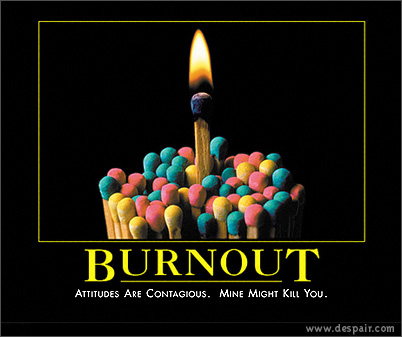
Coping With Burnout


For youth workers (paid or volunteer), there can be nothing more frightening than the belief that something terrible might happen to a student that you have invested so much time and energy in.  As a substance abuse counselor, I struggle with the reality that one day someone could overdose and die regardless of how much I try to help.  I live with the often frantic sense that “there had to be something I could have done!”

Never knowing when crisis or tragedy might happen we learn to be hypervigilant…always on our guard.  Is today the day I get the call?  Will it be a car accident?  A school shooting?  Suicide?

Sometimes we feel as though we’re in a lethal game of chess with our kids, always trying to be two moves ahead and aware of the possible counter-moves.  This type of hypervigilance can be exhausting.

As a youth worker of At-risk kids, you may find yourself on a constant emotional rollercoaster with no scheduled stops.  In times of crisis we often set aside our own needs entirely and as a result we risk burnout and compassion fatigue.  Be reassured that the time for balance will come if you’re intentional, but there are some things you can do now.

1.  Seek supportive relationships – This will be essential in avoiding burnout.  Build a network of friends, family, and peers who are kind and encouraging.  Don’t isolate yourself in fear or shame.  Seek respite in these relationships from the intensity of the situations your kids are facing.

2.  Develop health-conscious behaviors– This is three-fold as I see it; rest, exercise, nutrition.  Get adequate sleep, avoid snack foods, take a brisk walk daily.  All three are important for emotional stability and combating low levels of energy.

3.  Have fun – A life that is overrun with doom and gloom and that is absent of joy is not one worth having.  We need recreation.  It brings balance.  Laughter releases endorphins which cause us to feel pleasure in our brain.  Often, when working with At-risk kids we lose our ability to laugh.  The best cure for a “lost laugh” is a “Three Stooges-I Love Lucy-Gilligan’s Island” marathon.

4.  Spiritual retreat – It is essential that we create time for retreat.  We should develop the discipline, schedule in our calendars, add to our budgets, the practice of seeking spiritual direction.  There’s something magical and refreshing about pulling away from the insanity and seeking Abba’s face in solitude or with a spiritual companion.  Jesus would often pull away after a busy day of ministry to connect with his Father.  He would travel across the lake, go up the mountain, or into the garden to pray.

This simple act breaks us of our dependency on ourselves.  It causes us to reflect on whether or not we are growing a savior complex.  Have I, with the best intentions, placed myself in the position of God?  I have found that when my levels are the lowest it’s because I have been the one trying to “save” and “fix” kids myself.  Being God is hard work and I’m just not cut out for it.

If we expect to be in this for the long-haul we must pace ourselves.  It is an intentional discipline that we need help in cultivating.  I am thankful for the other youth workers God has placed in my life that help me find balance.  They constantly remind me I am not God.  And, we laugh a lot.  As a result we have a better chance of loving and ministering to the kids in our community out of an overflow instead of a deficiency.

Sometimes It Blows Up In Your Face


You pour your life into students, let someone else pour some life into you. At the National Youth Workers Convention they create an environment where times of worship, seminar speakers, and communicators pour some life back into you. Learn more at http://nywc.com/

Compassion on the Decline Among College Students


The results of research done at the University of Michigan tells us that compassion among college students is declining.   Researchers analyzed data on empathy collected from almost 14,000 college students over the last 30 years.   “We found the biggest drop in empathy after the year 2000,” said Sara Konrath, a researcher at the U-M Institute for Social Research.

You can read the entire article here.

I wonder if there is any correlation between the consumer mindset so prevalent in modern churches today and the decline of the hallmark personality trait of Jesus.  The scriptures regularly address the issue of compassion or the lack thereof.

What are we doing to challenge ourselves and those we serve to grow in compassion?

What are we doing, inadvertently or intentionally, that may be contributing to the decline in empathy and compassion in out young people today?

What does this mean as we do bridge-building work among marginalized communities? (i.e., LGBTQ, Homeless, Substance Abusers, Incarcerated, etc.)

Here’s a great video to get the discussions started about compassion. 

UYWI West Coast Conference


We have the awesome privilege of spending next week with urban youth workers from all over the country.  This is a unique and amazing tribe of people.  If you work with urban youth I’d like to invite you to join us for a week of training, rest, and fun. 

We’re leading two workshops at the conference this year on developing healing communities and current behavioral trends for at-risk youth.

Other presenters this year are:

The Paradox of Powerlessness


What are the negative consequences of not accepting personal powerlessness?

If we do not help our youth accept powerlessness over the uncontrollables and unchangeables in their life, then they could:

Begin to frustrate themselves in their attempts to gain control and to fix the non-fixable.

Become extremely rigid and dogmatic in their handling of life’s problems believing that there is “only one way” to do things, the “perfect” way.

Deny the enormity of the things which they do not have power to change and become locked into “fantasy” or “magical” thinking that given enough time, energy and resources they can succeed in changing them.

Become so full of self-pride as to believe that only they can be the “savior” for the ills or problems they are facing.

Become so self-preoccupied that they become incapable of reaching out to ask for others’ help and support in facing these problems which are beyond their power and control.

Lose their faith in the capability of human beings to help out a fellow human who is in need of help and support.

Become so frustrated and depressed in trying to solve the unsolvable problems that they find their temper, anger and rage igniting and flaring up spontaneously, inappropriately and disproportionately.

Feel so defeated by the non-fixable realities of life that they come to believe that God is impotent and inadequate.

Forget that they are a human being and as such open to failures and mistakes and not the “perfect being” who is omnipotent and infallible in all things.

Cling onto the people whom they cannot control or change until they one day walk out on them frustrated by their incessant efforts to change, correct or reform them.

Lose perspective of their own limits and not be self-protective of their energy, resources and spirit in their incessant effort to solve the unsolvable.

Increase in a sense of low self-esteem because they are incapable of making everything right and perfect with all people, places and things in your life.

Deny the existence of and need for the Holy Spirit in their life, upon whom they can call for help and assistance.

The Scriptures remind us that:

2 Corinthians 12:9-10 (NLT)

“Each time he said, “My grace is all you need. My power works best in weakness.” So now I am glad to boast about my weaknesses, so that the power of Christ can work through me.  That’s why I take pleasure in my weaknesses, and in the insults, hardships, persecutions, and troubles that I suffer for Christ. For when I am weak, then I am strong.”

Because of the very nature of their developmental stage students are prone to all of the above.  We, as caregivers, must help them understand that weakness and brokenness is a pre-requisite to entering the upside-down Kingdom.

A WordPress.com Website.

Up ↑