Search

conversations on the fringe

Category

Spirituality

Bueller…Bueller…(Youth Ministry 101)


Remember this scene from Ferris Bueller’s Day Off?  Man, this scene resonated with me because I had experiences like this when I was a student.  I have also, unfortunately had youth ministry experiences like this when students wiped their saliva off their cheek after nodding out from listening to me drone on and on…

Our first objective as teachers is to capture our students’ attention.  If we don’t gain their attention, the chance that they’ll learn anything is remote at best.  The process of attention serves two primary purposes, the first of which is survival.  The brain kept our ancestors safe by alerting them to possible hazards in their midst like strangers, thunder clouds, or wild animals.  Fortunately, it is the rare occasion that survival is at stake in youth ministry.  Instead, attention serves its second purpose – maintaining pleasurable feelings.  The hot girl with the pierced tongue, a double chocolate ice cream bar, and listening to pop music are pleasurable diversions for modern teenagers.  So are funny stories, terrible tragedies, and first loves, which the bible is full of.  

So why does it seem that our kids are tuning out?

The brain is bombarded with information from the senses.  Everything we see, hear, touch, smell, and taste finds its way to the sensory receptors, from the clothes on your back to the beige walls of the youth group room and the radio playing softly in the back ground.  At the base of the brain is the brain stem, which controls involuntary actions like breathing, blood pressure, and heartbeats.  Deep within the brain stem is the reticular formation, a system of neurons that gathers information from all of your senses and controls your awareness levels.  Some awareness is at a conscious level (what you see and hear a speaker do and say) and some at an uncounscious level (the color of the walls or the socks you are wearing).  It would be impossible for the brain to consciously focus on each bit of data it receives.  You may be oblivious to the feel of a baseball hat on your head while the cute girl beside you captures your full attention.  Consider the immense amount of information the brain is capable of absorbing, from the food stuck in your teeth to the lint on your coat, we are fortunate to be able to forget most things.  Otherwise, we’d overload.

Ask a group of teenagers what they think about youth group teaching times and you might hear answers like: “Boring.” “Stupid.” “It sucks.”  Of course, friends, potential dates, meals, and doodling don’t bore them; the adolescent brain is fascinated by (and seeks out) novelty and emotion (Koepp et al., 1998; Spear, 2000).  Sitting through a youth group lecture (especially one that is self-indulgent) that fails to include either is the real test of a teen’s attention.  Many teaching strategies have a great deal of difficulty keeping attention and arousing emotion, both of which are necessary to stimulate change in behavior.  Lecture, which can be an efficient way to deliver information, is often not emotionally charged.  Objective memorization rarely generate emotion and are often difficult to apply to real-world applications.  Yet lecture is still a dismayingly popular means of presenting content.  We miss opportunities when we overuse strategies that neglect our emotional and cognitive constitution – two powerful memory builders.

I’m not suggesting that we dress up like clowns and juggle for our students.  I am suggesting that we understand their learning abilities and compensate for their developmental limitations and strengths.

How can we engage our students cognitive and emotional abilities in ways that motivate change in their hearts and their behaviors?

Each Student is a Culture (art of connecting pt. 4)


The age of one-size-fits-all youth ministry is over.  It has to be.  We live in a dynamic time filled with diversity.  This is an exciting time to be in ministry to youth.  Our world is smaller than ever before.  Cultures are not only clashing but blending to create new expressions of culture.  In this new era of modern life(culture) context is king.

Think about your average youth group gathering.  Think about the different elements that are present in your group:

  • Countries of origin
  • Race and ethnicity
  • Religious background
  • Parenting styles that shaped them
  • Generational influences
  • Abilities and disabilities
  • Personality
  • Sexual orientation
  • Political leanings
  • Thinking styles
  • Values and beliefs
  • Style and tastes

Historically we would rush in with an attempt to connect with kids on our terms with our own personal culture leading the way (just a heads up, I’m pretty sure nobody listens to Petra anymore so don’t lead with that).  In other words, just like early missionaries did, we would try to strip them of their own culture and colonize them to be, think, look, and act just like us.  It’s no wonder they have gone underground.

Cultural Artifacts:

Instant digital music, iPods, YouTube videos, Facebook, etc.

What other cultural artifacts can you think of, as it relates to contemporary youth?

Values and Assumptions:

Individualism, consumerism, instant gratification, collaborations, cause-driven, tolerance, etc.

What other values and assumptions can you identify that are held by youth today?

Where did these values and assumptions come from?

Individual Personalities:

Jocks, emo, nerds, Queen Bee, bully, outgoing, shy, obnoxious, flirty, school spirit, etc.

What is the current dominant personality being presented by each individual student?

Is there a connection between the personality and behaviors? 

Often, all we see are the cultural artifacts and we base our own assumptions on these.

David Livermore, in his book Cultural Intelligence, says:

“When measuring your Cultural Intelligence, a few questions to ask yourself include:

  • Am I conscious of what I need to know about a culture that is unfamiliar to me?
  • Am I conscious of how my cultural background shapes the way I read the Bible?
  • Do I determine what I need to know about a culture before I interact with people from that culture?
  • Do I compare my previous ideas about a culture with what I actually experience during cross-cultural interactions?
  • Do I check for appropriate ways to talk about my faith in cross-cultural situations?”

Is it fair to expect that we should be intentionally asking ourselves these questions as it relates to working with youth today?  Can you image the amazing discussions you can have with your volunteers as you wrestle with these kinds of questions?

Building Bridges (art of connecting pt. 1)


One of the Apostle Paul’s most famous speeches took place at Mars Hill, the Areopagus, in Athens.  He noted that they appeared to be a very religious lot of people due to the sheer number of statues they had to their gods.  In a brilliant move he identified the one statue that was for the “unknown” god and he saw his bridge.  Paul then launched into his epic sermon about the “unknown” God and described our Father to the Greeks.  He masterfully used a technique called bridge building to connect with his audience.

Kids today are completely enmeshed in pop culture.  We could, and should be aware of what is shaping our youth today and much of what we see and hear impacts them more than we know.  But I’m not simply talking about knowing what the newest Katy Perry song is blazing up the charts, what I’m talking about is building a bridge with a language of the soul.

In order to connect with young people they first have to know that you’re interested and trustworthy.  They are most likely already suspicious of adults anyway.  Too often we have an agenda for them and they know that.  It’s what drives them underground many times.  What we’re talking about here is a fundamental belief that we have something in common with the young people we love and hope to reach.

If we say things like, “Teens today are just so much more _________ than we were.” or “Kids today are just lazy and apathetic.” we create distance between us and them.  If we fail to see that they have the same longings that drove us then and drive us now there will be no bridge to walk across.  All we will have to work with is a shallow relationship and all the change we’re likely to affect is shallow compliance to an empty belief system.  We have to find common ground and that common ground should be our shared humanity.

In his ground breaking book Hurt: Inside the World of Today’s Teenagers, Chap Clark identifies six intrinsic longings of all students.  Those longings are: to belong, to matter, to be wanted, to be uniquely ourselves, for a safe place, and to be taken seriously.  Who among us can’t relate to those longings?  I work with drug addicted emerging adults.  Daily they express to me their desire to satisfy those very longings and that much of their behavior was an attempt to do just that.

After some small talk I usually ask a student where in their life do they feel they belong.  Where do they and what do they do that makes them feel like they matter?  Who takes you seriously?  Where are the safest places for you to just be yourself?  These are the questions that matter to students even if they don’t have the language to articulate them.

What the Apostle Paul did was provide an opportunity for those in the crowd to have their longings satisfied in a permanent manner by depending on the One true God.  A civilization that worships everything is an empty civilization desperately searching for meaning.  They apparently hadn’t found that in the many false gods they worshipped.

We have the same opportunity to connect the kids in our community to the very God that Paul preached about to the Greeks but first we must take to time to build a bridge by learning about them and their longings.  There is ALWAYS a bridge and it’s up to us to find it.

Disabled Youth and Youth Ministry Gatherings (pt. 6 – marketing to disabled youth and families)


It is not enough for a youth ministry program to simply be ready to serve the Disabled Youth Community.  Rather, the ministry should be proactive in making the Disabled Youth Community aware of it’s accessability.  It is hoped that any ministry targeting  youth with disabilities will be in contact from the outset with any known families or organizations serving them. It would not be a bad idea to contact such agencies to present your willingness to provide ministry opportunities for students and families that are interested, thereby providing a person contact for any of the referring staff.  Of course, the best promotion for your youth group are students with positive experiences of interacting with your youth group. 

Outreach

Outreach material should assure potential students that your ministry gatherings are able to provide accessible, age appropriate youth ministry experiences for persons with a disability.  In addition to stating that accommodations and alternative communication strategies can be provided as needed, you may wish to assure the students with disabilities that they are welcome by including the universal accessibility symbol on your literature or website.


There are many facets of an outreach ministry that can be modified to accommodate the needs of youth with disabilities:

  • Tailor marketing materials, including signage, messages, brochures, website, and yellow pages ads to people with disabilities.  Have all such material state that accommodations are available.
  • If the ministry is committed to serving persons who are deaf or hard of hearing, have a dedicated line for a TDD, and have that TDD number printed on all outreach communications.
  • Provide a sign interpreter if one is available.
  • Create and use mailing lists of organizations that serve people with disabilities.
  • Conduct specialized training and presentations (include students with disabilities in the creation of) for adult volunteers and student leaders.
  • Adapt conference trips, camps, retreats, etc. with the disabled youth in mind.
  • Recruit students with disabilities to the student leader team or hire an intern/staff with a disability.
  • Work with family and support agencies (if necessary) to determine style of learning for students with cognitive impairments.
  • Link with particular disability groups for their expertise and to create staff training opportunities.
  • Be conscious of intersections (e.g. Latino youth who is gay and disabled)

Every ministry should expect to have students for whom they will have to make accommodations, but many of these accommodations will not require extensive or expensive changes.  Perhaps even more importantly, making accommodations and adapting your ministry for youth based on their functional limitation should create and environment in which they can be restored to community.  Often these disabilities carry with them stigmas that separate and isolation occurs.  God’s purpose for all of us is to participate in the restorative activity of God in this world.  This is just one of many ways we can do that.


Disabled Youth and Youth Ministry Gatherings (pt. 5 – physical disabilities)


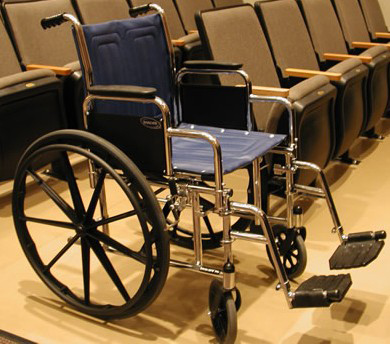
As a general modification to the typical youth ministry gathering, it is necessary to accept different types of body positioning for people with disabilities – some people may need to stand up or move during group, and this activity should not be considered rude.  Youth workers may have to keep group meetings short or schedule frequent breaks to help people who lack physical stamina and make allowances for increased travel time to gatherings for people who use wheelchairs or rely on public transportations. 

Sometimes students with spasticity or other motor problems, such as those associated with quadriplegia, have voluntary or involuntary movements that are sudden and unusual for people not familiar with them.  The youth worker should ensure that group members are not distracted by these movements and understand that they are a normal manifestation of some disabilities.

Youth workers are weary, and rightfully should be, of personal boundary issues (e.g. the side hug with members of the opposite sex).  With a student with a physical disability that sense of what is proper may need to be modified for some in need of assistance, such as adjusting a wheelchair, etc.  When the proper course of assistance is not apparent, ask the student of family for guidance. 

The relative height of the youth worker and disabled student, when seated and talking, may also be an important consideration when working with a student who has a physical disability.  Disproportionately great differences in seated height can hinder communication, especially relative to body language.

If a student with a disability has limited transportation options, the creative youth worker will find ways to minster to them and their family.  Often visiting them at home or at an alternative site is will allow the youth worker to gain valuable insights into a person’s life and ultimately facilitate effective ministry.  It also communicates to the student that they are valued enough to make the effort (we’re hopefully doing this to all students).  Going to the residence of a student with disability also provides invaluable information about that student’s lifestyle, interests, and immediate environmental challenges.

Lastly, we must take into consideration not only the physical limitations the student might have, such as; playing certain games or traveling over certain terrain, but also the psychological and social consequences of the disability.  Issues that may need to be addressed can include impulsivity, social isolation, low self-awareness relative to medical or psychological needs, anger, feelings of hopelessness, or outright fear at living life with the disability.  These issues are hardly new to a seasoned youth worker, nor are the unique to persons with disabilities; however, a disability may exaggerate the severity of these conditions or their impact on your ministry efforts.

Disabled Youth and Youth Ministry Gatherings (pt. 4 – cognitive disabilities)


Accommodations for students with cognitive impairments can include the use of visual cues, mixed media, and the repetition of major points.  Experiential exercises is often effective for a young person with intellectual or cognitive disabilities.  Role-playing works well for a person with developmental disabilities – the process of playing a role themselves helps them to internalize it.

The use of verbal and nonverbal cues will help increase participation and learning for students with cognitive disabilities and make the group run more smoothly for all.  People with cognitive impairments are often impulsive because they lack normal feedback mechanisms.  They do not wish to be impulsive, but lack the ability to regulate this behaviors for themselves.  Therefore, youth workers and peer students should try to provide external cueing until the student can internalize it.  The youth worker and the youth with a disability can design the cues but should keep them simple, such as touching the person’s leg and saying a trigger word (e.g. “interrupting”).  If cues are used in a setting where other people will observe them, alert the group to the cue in a matter of fact way as you would alert them to a use of a dog or the space needed for a wheelchair.  Cueing can be useful for people with other types of disabilities and for other purposes as well.

For students with Ad/HD, it is helpful to establish a maximum length of time, for example, 10 minutes, for presentations.  Another modification to the group setting, which is beneficial for those with developmental disabilities or brain injury (as well as for other students), is to set aside 10 minutes at the end of the meeting to reinforce what was taught during the group.  Such discussion ensures that content is retained and promotes active rather than passive learning.  Some students with cognitive disabilities may have problems with time management and will need to be reminded of group meeting times with an email, call, or text.

It may be necessary to make changes to group learning activities in order to accommodate students with cognitive disabilities.  The use of alternative media to replace traditional learning tools, such as writing and reading, can be very useful.  An individual who has an expressive language disorder may be unfairly judged as uncooperative in participating in group discussions.  However, given the opportunity to express himself or herself through artwork, they may be able to communicate quite a bit.

Mixed media can be incorporated in other ways as well.  As a group learning exercise, students could work together to “draw the narrow way” depicting all the potential stumbling blocks they might expect to encounter as they go back to school.  Students can create memory books or journals (to capture the content of each bible study), or flash cards (or words or pictures) to jog memory of previously taught stories or lessons.

Youth workers should not assume, however, that one student’s experience will be understood by another, particularly in the case of a student with a cognitive disability.  There may be a great deal of shared experience, but the student with a disability may not understand it unless it is made specific and pertinent to their own life.

Disabled Youth and Youth Ministry Gatherings (pt. 1 – overview)


This is the first in a series of posts on youth ministry and youth with disabilities.

While accommodations may be needed to integrate people with disabilities into your youth ministry group settings, it is important to first emphasize what all group members have in common.  Youth workers can emphasize to the group that, despite a wide variety of individual differences, all members are there for the same reasons.  Everyone is present to explore what it means to be a part of God’s unfolding story.

Some groups with a single person who has a visible disability may meet on a regular basis, and disabilities are never discussed.  For other groups, this topic may emerge quickly.  Although it’s not possible to have one rule that applies to all situations, there are some common considerations.  Group members should be oriented to any special considerations that someone with a disability may require in order to effectively participate.  Discussions about an individual’s disability can be quite therapeutic to the one with a disability and likewise educational to those who do not.

Group members (students and adults) can be trained to assist in making accommodations for peers who have disabilities.  It is important, however, to work with nondisabled students to minimize their enabling of or overcompensating for people with disabilities.  It is appropriate to describe to the group the practical aspects of helping the person with a disability, and ask that person to describe what he or she expects people around him or her to do.  It is not uncommon for a person with a disability to ask for assistance when needed however, for a person with less awareness or acceptance of their disability, it is important that peers are aware of what is appropriate help to offer.

When working with people with disabilities in a group setting, youth workers may find it useful to alter group participation expectations, limit the time in group, and work with the group to extend the group learning experience outside the confines of the group meeting.  While the actual accommodations used will likely be tailored to each individual, there are some general strategies (to be discussed in future posts) that have been successful in making the youth group gatherings more accessible for individuals with particular types of disabilities. (i.e., sensory disabilities, cognitive and intellectual disabilities, and physical disabilities)

One simple question:

Are your youth group gatherings welcoming and accessible to youth with disabilities?

Goofus and Gallant in Youth Ministry


Remember the old Highlights Magazine we use to read as kids?  I remember spending hours looking for the hidden objects scattered throughout the magazine.  I also remember the Goofus and Gallant comics.  They were two polar opposite characters meant to teach the children reading about right and wrong.  I used to love reading them but must admit I fell more on the Goofus side of things as a kid.

Having been involved in youth ministry for over a dozen years, in one way or another, I’ve noticed that we still have those Goofus and Gallant kids sitting in our chairs and it got me thinking about the expectations we have for them.  Often, youth workers want contradictory things from their students – docile, “Gallant”-like manners along with extraordinary feats of intellectual, creative, or physical stature.  But the extraordinary talents actually arise from the “Goofus” side of each student’s personality.  As youth workers it’s essential that we learn to see those intense, often irksome traits as the seeds of your student’s greatness, possibly even their God-given giftedness.

Try thinking of:

  • Your stubborn or whining student as persistent.
  • Your complaining student as discerning.
  • Your argumentative student as forthright and outspoken.
  • Your loud student as exuberant.
  • Your shy student as cautious and modest.
  • Your reckless, accident-prone, or rule-breaking student as daring, risk-taking, and adventurous.
  • Your bossy student as commanding and authoritative.
  • Your picky, nervous, obsessive student as serious and detail-oriented.

Too often we only see what lies on the surface of each student and often the problematic behaviors and attitudes are misdirected strengths and giftedness.  Maybe if we only see the negative in our students it’s because we haven’t provided a more appropriate, kingdom-minded outlet for them to direct their energy and passion towards.

Goofus would always take advantage of any opportunity that presented itself in the comic strip.  How useful might that skill and attitude be if it were redirected towards God’s purposes?

Privilege And Oppression In The American Church


There’s no denying that there are a handful of Evangelical churches that largely shape and control the American Christian culture.  You can probably think of a handful of them right off the top of your head.  Those churches have contributed much to the Kingdom and this post is not an attempt to argue whether their success is God-driven or marketing-driven.  Regardless, many necessary issues/concerns have been addressed by churches like this and they honored and glorified God in the process.

The focus of this post is the danger of having too much dominance over a culture and how the systems that govern many of these churches may be contributing to a larger problem that will impact our faith for a long time to come.

When any group rises to the top it is often accompanied by a sense of privilege.  It’s the “Good Ol’ Boys Club” mentality.  And, it often happens without its members even knowing it.  As a result of one group believing it is privileged another group consequentially is oppressed by the very nature of this belief system.  I have and you do not.

In other words, if dominant groups, in this case, larger affluent churches, really saw privilege and oppression as unacceptable – if white people saw race as their issues, if men saw gender as a men’s issue, if heterosexuals saw heterosexism as their problem – privilege and oppression wouldn’t have much of a place in the future of the church.  But that isn’t what’s happening.  Dominant groups don’t often engage these issues, and when they do, it’s not for very long or with much effect, and rarely do they address the systemic causes.

When asked “Why not?” certain responses pour out without hesitation.  These dominant church don’t see privilege as a problem.

  • Because they don’t know it exists in the first place.  They’re oblivious to it.  The reality of privilege doesn’t occur to them because they don’t go out of their way to see it or ask about it and because no one dares bring it up for fear of making things worse.  They also have no understanding of how their privilege actually oppresses others.
  • Because they don’t have to.  If you point it out to them, they may acknowledge that the trouble exists.  Otherwise, they don’t pay attention, because privilege insulates them from its consequences.  There is nothing to compel their attention except, perhaps, when a school shooting or sexual harassment lawsuit or a race riot or celebrity murder trial disrupts the natural flow of things.
  • Because they think it’s just a personal problem.  They think individuals usually get what they deserve, which makes the trouble just a sum of individual troubles.  This means that if whites or males get more than others, it’s because they have it coming – they work harder, they’re smarter, more capable.  If other people get less, it’s up to them to do something about it.
  • Because they want to protect their privilege.  On some level, they know they benefit from the status quo and they don’t want to change.  Many feel a sense of entitlement, that they deserve everything they have, including whatever advantages they have over others. 
  • Because their prejudiced – racist, sexist, heterosexist, classist.  They’re consciously hostile towards blacks, women, lesbians, gay men, the poor.  They believe in the superiority of their group, and the belief is like a high, thick wall. 
  • Because they’re afraid.  They may be sympathetic to doing something about the trouble, but they’re afraid of being blamed for it if they acknowledge that it exists.  They’re afraid of being saddled with guilt just for being white or male or middle-class, attacked and no place to hide.  They’re even more afraid that members of their own group – other whites, other heterosexuals, other men – will reject them if they break ranks and call attention to issues of privilege, making people feel uncomfortable or threatened.

Although doing the right thing can be morally compelling, it usually rests on a sense of obligation to principle more that to people, which can lead to disconnection (injustice) rather than to restorative justice (reconnection).  I take care of my children, for example, not because it’s the right thing to do and the neighbors would disapprove if I didn’t, but because I feel a sense of connection to them that carries with it an automatic sense of responsibility for their welfare.  The less connected to them I feel, the less responsible I’ll feel.  It isn’t that I owe them something as a debtor owes a creditor; it’s rather that my life is bound up in their lives and their in mine, which means that what happens to them in a sense also happens to me.  I don’t experience them as “others” whom I decide to help because it’s the right thing to do and I’m feeling charitable at the moment.  The family is something larger than myself that I participate in, and I can’t be a part of that without paying attention to what goes on in it.

Maybe that’s where we start…paying attention to all the members of the family.  No just the few in my club that look like me.  But, it can’t end there, as it usually does.  We must share resources, breach cross-cultural barriers, take risk, and sacrifice if the church is to ever be what God intended for it to be.

Where do you see privilege in your community?  Where do you see oppression?  What conversations do we need to start?  How are our youth being shaped by privilege and oppression?

——————————————————–

excerpts taken from:

Privilege, Power, and Difference by Allan G. Johnson

A WordPress.com Website.

Up ↑