Search

conversations on the fringe

Category

Self-Injury

Unhealthy Family System Model (Exploring Family pt. 2)


Most members of unhealthy family models oscillate between extremes of behavior choosing, mostly unconsciously, whichever behavior promises the greatest chance of surviving the moment.  You may see many of the following extremes in youth in your ministries.  It’s important to understand that these behaviors are functional and serve a purpose for these kids.  Understanding that will help you know what they need from us most.

High Intensity vs. Shutdown:  Alternating between feeling overwhelmed with emotional vs. physiological responses and shutting down.

Overfunctioning vs. Underfunctioning:  Alternating between working overtime to fill in what is missing vs. falling apart or barely holding it together.

Enmeshment vs. Disengagement:  Alternating between being overclose or fused in identities vs. avoidance, or cutting off leading to disengagement.

Impulsivity vs. Rigidity:  Alternating between behavior that leads to chaos vs. rigid, controlling behavior.

Grandiosity vs. Low Self-Worth:  Alternating between grandiose ideas and fantasies vs. feelings of low self-worth.

Denial vs. Despair:  Alternating between a state in which reality is denied or rewritten vs. despair, helplessness (or rage at having life as we know it slip away).

Abuser vs. Victim:  Alternating between the role of victim vs. the role of perpetrator.

Caretaking vs. Neglect:  Alternating between over concern leading toward enmeshment vs. underconcern leading toward disengagement.

Living with dysfunction is traumatizing to the body as well as the mind.  And living in this kind of system can lead to the kind of emotional deregulation that makes us want to turn to high-risk behaviors (substance use, unsafe sexual behavior, self-injury or violence towards others) to regain a sense of calm and regulation that dysfunction undermines.  The kids in our ministries are not typically “bad kids” making immoral choices because they lack long-term consequential thought processes.  Often the behaviors we see in our kids is simply their best attempt to manage life and survive in a world where most of the adults have left them to fend for themselves.

What Are We Saying When We Don’t Say Anything?


“When we block our awareness of feelings, they continue to affect us anyway.  Research has shown repeatedly that even without conscious awareness, neural input from the internal world of the body and emotion influences our reasoning and our decision making.  Even facial expressions we’re not aware of, even changes in heart rhythm we may not notice, directly affect how we feel and so how we perceive the world.  In other words, you can run but you can’t hide.”

excerpt from Mindsight by Daniel J. Siegel, M.D.

If what Dr. Siegel suggests is true then this holds implications for how we interact with young people in our ministries.  For example, a 14 year old girl in your youth group asks to talk to you privately.  She reveals that she is a victim of sexual abuse and to cope with it she cuts herself.  How we respond to her, including our tone, facial expressions, and body posture will all communicate something to her. 

What are we communicating to our young people beyond our words? 

How does this help or hinder their ability to trust us? 

How can we grow in our own emotional management?

National Eating Disorder Awareness Week


For more information on and help for eating disorders please visit the following:


National Eating Disorders

National Institute of Mental Health

Something Fishy

Conversations on the Fringe

Mercy Ministries

Would Jesus Sit In The Smoking Section With A Gay Huckleberry Finn?


In Mark Twain’s novel The Adventures of Huckleberry Finn, Huck wrestles through a moral dilemma about demonstrating true friendship to a stigmatized person of his day – a man who bore a dual stigma of being black in a racist society and slavery in an exploitative one.  To help his friend Jim escape meant violating not only human law but also divine law as it had been interpreted in that society, because to help a slave escape meant stealing property from his or her owner.  Not only did Huck worry about God and about going to hell for obeying the impulse of his heart, but he also worried about what people would think of him.  “It would get all around that Huck Finn helped a negro to et his freedom; and if I was eer to see anybody from that town again I’d be ready to get down and lick his boots for shame.”  But such worries did not prevent him from doing what he knew to be right.

Jesus knew all about stigma.  He never hesitated to move among the oppressed people of his day, including the most despised social outcasts.  He went about his ministry without worrying about what others would say about his character, his motives, his righteousness.  “If this man were a prophet,” said some, “he would have known who and what kind of woman this is who is touching him – that she is a sinner” (Luke 7:39).  He also ignored the insinuations and seemed unconcerned about his reputation among the townspeople.  “Look,” said those who criticized Jesus and passed judgment on him, “a glutton and a drunkard, a friend of tax collectors and sinners!” (Luke 7:34).

Jesus was not afraid of being called names, nor was he afraid to be identified with the most hated, discredited people in the society in which he lived.  He cared about them.  He felt their pain, knew their hunger and thirst, recognized their humanity, saw the image of God in them.  In short, he loved them.  And he longed to minister to them – even if others misunderstood and vilified him.  Name calling was as common then as it is now, and to label someone with a scornful term identified with a stigmatized group has always been considered an extreme insult.  Today, terms of insult are frequently associated with homosexuality – “queer,” “fag,” “dyke,” “lezbo.”

During the time that Jesus walked the earth, the stigmatized people were the Samaritans, and the term of insult was “You Samaritan!”  Samaritans were half-breed leftovers from previous generations when God’s people were enslaved, raped, and plundered by the Assyrians.  Not only were they bi-racial and therefore not clean, they were reminders of the horrible atrocities committed against the Israelites during that time.  That’s what is so powerful about the story of the Good Samaritan.  The hero in the story was one of the most despised people in all of the New Testament yet Jesus refused to dissociate himself from this disdained group of people that he loved.

Have our youth ministries become sanctified segregation machines?  Why is it that most of the churches in the suburbs are all white?  Why don’t diverse inner-city churches adopt-a-block in affluent neighborhoods?  Why do LGBTQ students still avoid the church like the plague?

We should long for the day when people call us “faggots,” and “cutters,” and accuse us of having AIDS because of the company we keep and we aren’t compelled to defend ourselves because we don’t care what man has to say about us.  I think if Jesus came back today you might find him hanging out at a Gay-Straight Alliance meeting or with kids who were at a skittles party the night before or out on the corner with all the smokers.  You would probably be able to smell cigarette smoke on his robe so he’d be accused of being a smoker too…

Self-Mutilation in Abuse Survivors


One of the ironies of surviving abuse is that victims might further harm themselves.  Self-mutilation includes; burning, hitting, cutting, excessive scratching, using harsh abrasives on skin or scalp, poking sharp objects into flesh, head banging, pulling out hair or eyebrows for noncosmetic purposes, inserting objects into body orifices, excessive fasting, self-surgery, excessive tattooing or piercing, or refusing needed medication.  This seems like such a paradox.  Why in the world would those who are already in intense pain further injure themselves?  It seems to make no sense, yet it does.  Most often, it follows a history of protracted childhood trauma (such as physical and/or sexual abuse), not a single exposure.  The person harms himself/herself in response to overwhelming, dissociated pain.  At least sixteen reasons account for this complex behavior.  Self-mutilation:

  1. Expresses pain that can’t be verbalized.  It can be expected when the abused child was told to keep the offense a secret, or when the abuse happened before the child learned to talk.  The nonverbal outcry says, “Something terrible has happened.”  It may be a plea for help.
  2. Attempts to convert emotional pain to physical pain.  Physical pain can be localized, displaced, and released, providing temporary distraction from psychic pain.
  3. Paradoxically relieves pain.  Stress triggers natural pain killers in the brain, temporarily easing psychic and physical pain.  This so-called stress-induced analgesia might also help explain victims become addicted to trauma-related stimuli.
  4. Is a way to feel alive.  Numbing and dissociation feel dead.  Perhaps feeling pain is better than feeling nothing.  Physical pain grounds one in reality and counters dissociation.  It returns focus to the present, providing relief from intrusion.  Some people report that blood provides a soothing, warm sensation that relieves stress and reminds them they are still alive.
  5. Provides an illusory sense of power, a sense of mastery and control of pain.  Reversing roles and assuming the role of offender, the person might think, “This time when I am hurt, I am on the controlling end.  I can determine when the pain begins and ends.”
  6. attempts to complete the incompleted.  The idea of repetition compulsion states that we repeat what we’ve experienced until we’ve completed old business – processing it and learning it and learning a better way.  Unfortunately, simply reenacting the abuse doesn’t change the trauma material.  Complete processing of the material does.
  7. Is a way to contain aggressive tendencies and pain.  The person thinks, “If I discharge my anger and hurt on myself, then I won’t hurt anybody else.”  Maybe it is the only way to stop anger, at least for a time.  Learning constructive ways to express emotions is the antidote for this approach.
  8. Vents powerful emotions that cannot be venter directly.  (e.g., I can’t rage at the powerful perpetrator, so I vent on myself instead).
  9. Makes the body unattractive to spare further abuse.  This harmful defense makes sense to a child who was powerless to stop sexual abuse.  Excessive thinness or weight might accomplish a similar purpose.
  10. Might become associated with pleasant moments.  Following abuse, some abusers become remorseful, attentive, and loving for a time.  Thus, the victims might be conditioned to think that pain signals the beginning of good times.
  11. Imitates what the child has seen.  Children naturally imitate behavior that is modeled by adults.  They learn to abuse if their parents are abusing, just as they will learn kindness if the parents model that.
  12. Can be an attempt to attach to parents.  Children have a deep need to attach to parents, even if they are rejecting.  In order to gain the abusive parent’s approval, the child might internalize his or her punishing attitudes.  The child’s thinking might be, “I’ll show I’m good and devoted to Mom by doing what she does to me.”  This makes more sense when we realize that abusers often isolate the victims, making them more dependent on them for approval.  Need for approval causes the victim to identify with the aggressor.  A child might confuse abuse with emotional closeness, especially if abuse was the only form of attention the parent showed.  The child might think, “If I keep hurting myself, eventually they will love me.”
  13. Can mark a return to the familiar, understandable past.  The child thinks, “I don’t understand loving, soothing behavior, but I do understand pain.  It doe not always feel good, but at least it is predictable.”
  14. Is consistent with one’s view of self.  People treat themselves consistent with their self image.  Abuse teaches the victim, “I’m worthless, bad, no good, an object – so it makes sense to treat myself like an object.”  Self-punishment consistently follows from feeling blameworthy, bad, or inadequate.
  15. Is consistent with one’s view of a maimed world and a nonexistent future.
  16. May ensure safety if it results in hospitalization. 

The fact that a young person hurts themself does not mean they are insane.  They are simply repeating what they learned to cope with intolerable pain.  As they learn productive ways to meet their needs they will no longer need to do this.

Self Injury Quick Reference


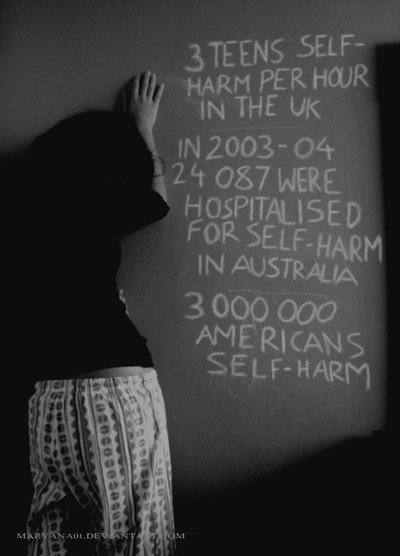
Self-injury is increasingly becoming a recognized problem in youth ministry, and all youth pastors and volunteer staff (in Jr. High, High School, and College Ministries) need a general understanding of self-injury, signs to look out for, and what to do if they become aware that a pupil is self-injuring.

Self-injury in middle and high school students should not be minimized or dismissed as “attention seeking” or “just a fad”. When people take the radical step of harming their bodies, they should be taken seriously and the sources of their stress addressed.” (Walsh, 2006, p.38)

Signs that someone is self-injuring:

People who self-injure often go to great lengths to conceal their injuries so it can be hard to know if a person does self-injure:

  • People who self-injure can seem withdrawn or depressed.
  • You may notice cuts or bruises that are always accompanied by excuses that don’t seem to fit.
  • Many people who self-injure will cut their arms and so they may wear long sleeves, even when it is very hot.
  • Within school pupils who self-injure may look for excuses not to have to wear shorts or short sleeves and therefore may avoid activities like PE or swimming.

Particularly where younger children are concerned it is important to keep a close eye on especially vulnerable pupils such as those with a history of abuse.

General advice for Youth Pastors and volunteers:

  • Listen to the student and try not to show them if you are angry, frustrated or upset. “Adults should learn that the best way to respond to common self-injury is with a ‘low-key, dispassionate demeanor’ and ‘respectful curiosity’ “(Walsh, 2006, p.245)
  • Learn about the difference between self-injury and suicide.
  • If someone tells you they self-injure it means they trust you and are willing to share this very personal problem.
  • Some people will just want to be heard and empathized with. Try not to push them by asking questions that may overwhelm them.

Ensure that your youth ministry has a self-harm policy – guidelines for writing a policy and further information can be found by emailing us at cschaffner@fringeconversations.com.

Things for Youth Pastors and volunteers to remember:

  • Anyone from any walk of life or any age can self-injure, including very young children.Self-injury affects people from all family backgrounds, religions, cultures and demographic groups.
  • Self-injury affects both males and females.
  • People who self-injure can often keep the problem to themselves for a very long time which means opening up to anyone about it can be difficult.
  • You can’t just tell someone who self-injures to stop – it is not that easy.

Dangers and Diseases Associated with Eating Disorders


ALL Eating Disorders are Dangerous

It is important to understand that even though a person may be suffering specifically with Anorexia, Bulimia or Compulsive Overeating, it is not uncommon for them to exhibit behaviors from each of the three. It is also not uncommon for one Eating Disorder to be swapped for another (Example: a person who is suffering with Anorexia switches to Bulimia; a persons suffering with Compulsive Overeating switches to Anorexia). This is why it is important to be aware of THE DANGERS BELOW, all of which are risks no matter what Eating Disorder you suffer with.

DO NOT FALL INTO THE TRAP OF THINKING “I ONLY DO THIS A FEW TIMES A MONTH SO I CAN’T BE AT RISK” OR “I DON’T DO THIS ALL THE TIME, I JUST GO THROUGH HEALTHY AND NON-HEALTHY CYCLES” — THAT DOES NOT MEAN YOU ARE NOT IN DANGER, NOR DOES IT MEAN YOU DO NOT SUFFER FROM AN EATING DISORDER.

For a list of eating disorder associated dangers and diseases click here.

Teen Self-Injury


Approximately 1% of the population has, at one time or another, used self-inflicted physical injury as a means of coping with an overwhelming situation or feeling.

Self-harm scares people. The behavior can be disturbing and difficult to understand, and it is often treated in a simplistic or sensational manner by the press. As a result, friends and loved ones of people who self-injure often feel frightened, isolated, and helpless. Sometimes they resort to demands or ultimatums as a way of trying to regain some control over the situation, only to see things deteriorate further.

The first step toward coping with self-injurious behavior is education: bringing reliable information about who self-injures, why they do it, and how they can learn to stop to people who self-injure and to their friends, loved ones, and medical caregivers. The following links will serve as a starting point for those interested in learning more about self-injury.

more…

A WordPress.com Website.

Up ↑