Search

conversations on the fringe

Category

Misc.

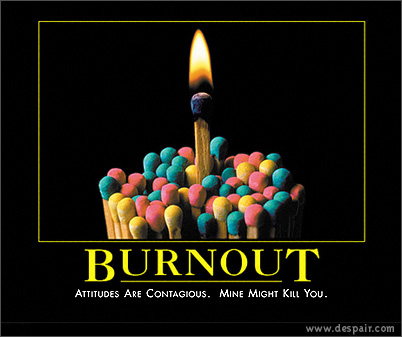
Coping With Burnout


For youth workers (paid or volunteer), there can be nothing more frightening than the belief that something terrible might happen to a student that you have invested so much time and energy in.  As a substance abuse counselor, I struggle with the reality that one day someone could overdose and die regardless of how much I try to help.  I live with the often frantic sense that “there had to be something I could have done!”

Never knowing when crisis or tragedy might happen we learn to be hypervigilant…always on our guard.  Is today the day I get the call?  Will it be a car accident?  A school shooting?  Suicide?

Sometimes we feel as though we’re in a lethal game of chess with our kids, always trying to be two moves ahead and aware of the possible counter-moves.  This type of hypervigilance can be exhausting.

As a youth worker of At-risk kids, you may find yourself on a constant emotional rollercoaster with no scheduled stops.  In times of crisis we often set aside our own needs entirely and as a result we risk burnout and compassion fatigue.  Be reassured that the time for balance will come if you’re intentional, but there are some things you can do now.

1.  Seek supportive relationships – This will be essential in avoiding burnout.  Build a network of friends, family, and peers who are kind and encouraging.  Don’t isolate yourself in fear or shame.  Seek respite in these relationships from the intensity of the situations your kids are facing.

2.  Develop health-conscious behaviors– This is three-fold as I see it; rest, exercise, nutrition.  Get adequate sleep, avoid snack foods, take a brisk walk daily.  All three are important for emotional stability and combating low levels of energy.

3.  Have fun – A life that is overrun with doom and gloom and that is absent of joy is not one worth having.  We need recreation.  It brings balance.  Laughter releases endorphins which cause us to feel pleasure in our brain.  Often, when working with At-risk kids we lose our ability to laugh.  The best cure for a “lost laugh” is a “Three Stooges-I Love Lucy-Gilligan’s Island” marathon.

4.  Spiritual retreat – It is essential that we create time for retreat.  We should develop the discipline, schedule in our calendars, add to our budgets, the practice of seeking spiritual direction.  There’s something magical and refreshing about pulling away from the insanity and seeking Abba’s face in solitude or with a spiritual companion.  Jesus would often pull away after a busy day of ministry to connect with his Father.  He would travel across the lake, go up the mountain, or into the garden to pray.

This simple act breaks us of our dependency on ourselves.  It causes us to reflect on whether or not we are growing a savior complex.  Have I, with the best intentions, placed myself in the position of God?  I have found that when my levels are the lowest it’s because I have been the one trying to “save” and “fix” kids myself.  Being God is hard work and I’m just not cut out for it.

If we expect to be in this for the long-haul we must pace ourselves.  It is an intentional discipline that we need help in cultivating.  I am thankful for the other youth workers God has placed in my life that help me find balance.  They constantly remind me I am not God.  And, we laugh a lot.  As a result we have a better chance of loving and ministering to the kids in our community out of an overflow instead of a deficiency.

Who’s Really In Charge?


As a parent I sometimes think this is really what’s happening.  😉

What’s a Trigger?


Often, we as youth workers, parents, teacher, etc.  don’t realize the impact our words can have on our students.  When a student has experienced trauma or substance abuse problems they can be “triggered” by elements in their environment that leads them back into their pain or negative behaviors.  We, as caregivers, need to understand what a trigger is and how it can impact our kids.  Once we understand this phenomena we can then capture it and bring it under the healing power of Christ.

So just what is a trigger?

PsychCentral describes a trigger as something that sets off a memory tape or flashback transporting the person back to the event of her/his original trauma.

Triggers are very personal; different things trigger different people. The survivor may begin to avoid situations and stimuli that she/he thinks triggered the flashback. She/he will react to this flashback, trigger with an emotional intensity similar to that at the time of the trauma. A person’s triggers are activated through one or more of the five senses: sight, sound, touch, smell and taste.

The senses identified as being the most common to trigger someone are sight and sound, followed by touch and smell, and taste close behind. A combination of the senses is identified as well, especially in situations that strongly resemble the original trauma. Although triggers are varied and diverse, there are often common themes.

Sight

Often someone who resembles the abuser or who has similar traits or objects (ie. clothing, hair color, distinctive walk).

Any situation where someone else is being abused (ie. anything from a raised eyebrow and verbal comment to actual physical abuse).

The object that was used to abuse.

The objects that are associated with or were common in the household where the abuse took place (ie. alcohol, piece of furniture, time of year).

Any place or situation where the abuse took place (ie. specific locations in a house, holidays, family events, social settings).
Sound

Anything that sounds like anger (ie. raised voices, arguments, bangs and thumps, something breaking).

Anything that sounds like pain or fear (ie. crying, whispering, screaming).

Anything that might have been in the place or situation prior to, during, or after the abuse or reminds her/him of the abuse (ie. sirens, foghorns, music, cricket, chirping, car door closing).

Anything that resembles sounds that the abuser made (ie. whistling, footsteps, pop of can opening, tone of voice).

Words of abuse (ie. cursing, labels, put-downs, specific words used).
Smell

Anything that resembles the smell of the abuser (ie. tobacco, alcohol, drugs, after shave, perfume).

Any smells that resemble the place or situation where the abuse occurred (ie. food cooking ,wood, odors, alcohol).
Touch

Anything that resembles the abuse or things that occurred prior to or after the abuse (ie. certain physical touch, someone standing too close, petting an animal, the way someone approaches you).
Taste

Anything that is related to the abuse, prior to the abuse or after the abuse (ie. certain foods, alcohol, tobacco).

Sometimes It Blows Up In Your Face


You pour your life into students, let someone else pour some life into you. At the National Youth Workers Convention they create an environment where times of worship, seminar speakers, and communicators pour some life back into you. Learn more at http://nywc.com/

French Gay Friendly McDonald’s Commercial Causing Quite A Stir


There’s a new viral ad for McDonald’s in France that’s causing quite a stir.  What are you’re thoughts on the video?  What do you like about the ad?  What do you dislike about the ad?  How can this stimulate healthy discussion about the issue of LGBTQ teens?

Defusing Emotional Reactivity


Reactivity originates in anxiety over self-expression and the need to be understood and taken seriously.  The more we listen, take serious, and respect young people’s opinions and feelings, the more secure and self-driven they become.  The less we listen, the more intolerant and critical we are, the more insecure and anxious they become.  The more conditioned they are to expect attack or argument, the more they learn to become defensive.  What makes them defensive more than anything else are the things adults tend to do that make them feel criticized, argued with, or ignored.

Emotional reactivity is the number one reason people don’t listen and to be good at working with adolescents means you must be a good, skillful listener.  When someone says something that triggers an emotional attack or withdrawal, understanding goes out the window.  If listening without acknowledging what the other person says turns a discussion into conversational ping-pong, overreaction can turn them into the Battle of the Bulge.  If the war metaphor seems melodramatic, take inventory of your emotions next time you’re engaged in a heated conversations that escalates to a series of attacks and counterattacks.  You’ll leave that conversations feeling wounded and bleeding in a dozen places.

Some kids are so intentionally provocative that it’s almost impossible to listen to them without getting upset.  Then you have those thin-skinned individuals who fly off the handle at the slightest sign of criticism.  Sure, they’re overreactive, but unless you view your relationship to them as expendable, your challenge is finding a way to get through to them.

Defensiveness is a paradox of the human condition: our survival and security seems to depend on self-assertion and defense, but intimacy and cooperation require that we risk being vulnerable.  All human communication – whether in business dealings or personal relationships – reflects the tension between self-expression (talking) and mutual recognition (listening).

How do we resist reacting emotionally or to emotionally charge students?

  1. Anticipate and plan for conflict
  2. Remember that feelings are facts to the person experience them
  3. Empathy kills defensiveness
  4. Listen Harder
  5. Pay attention to your impulses
  6. Concentrate
  7. Don’t blame
  8. Learn to take criticism
  9. Clarify
  10. Give time and space

When someone opens up on you with a mean mouth or listens with feigned interest, it’s natural to blame it on their personality.  When someone reacts with a sudden, verbal eruption to something you say, it’s impossible not to feel this emotional backlash as coming from them.  But reactivity, like everything else that happens in relationships, is interactional.  The only part of the equation you can change is your part.

Try analyzing for a week the amount of your communications that are (1) critical or instructional, (2) avoidant, or (3) affectionate or filled with praise.  To change the climate in most relationships you just shift from (1) or (2) to (3) and see what happens.

UYWI West Coast Conference


We have the awesome privilege of spending next week with urban youth workers from all over the country.  This is a unique and amazing tribe of people.  If you work with urban youth I’d like to invite you to join us for a week of training, rest, and fun. 

We’re leading two workshops at the conference this year on developing healing communities and current behavioral trends for at-risk youth.

Other presenters this year are:

Eight Ways to Go Green


Red staffer, Jen Kwiatek has some great ideas of how teens can celebrate Earth Day 2010 over at beRed on AOL.  Share these ideas with your students or create activities for them to participate in.  Either way, it’s a good thing to teach our students about the value of caring for God’s creation.

Fringe Editor

Some people only get involved in the environment on Earth Day. Don’t get me wrong … every little bit helps. But you can make Earth Day every day by just making a few changes in your daily routine. Not only will you be helping the environment, but you will probably save some money in the long run and live a much happier, healthier life. Here are eight ways that you can go green.

more…

Organizational Conceptions of Youth


A striking difference between effective and not so effective organizations that serve youth has to do with their conceptions of youth.  The majority of youth-serving programs view youth as a problem to try and fix, remedy, control, or prevent some sort of behavior.  From an adolescent perspective, this single-focused, problem-based program strategy fails on two counts.  First, it is too simple.  The needs or problems of teens today can rarely, if ever, be circumscribed by a single-issue effort.  Teen pregnancy, drug use, criminal activity, and school failure have multiple roots and require inclusive responses.  Second, such “lack of” programs too often only reinforce youth’s view that something is wrong with them, that they are somehow deficient, and that they are a problem.  It is not surprising that youth do not elect to participate in such organizations or activities to a significant extent.  The youth organizations that attracted and sustained young people’s involvement give a visible and ongoing voice to a conception of adolescents as a resource to be developed and as persons of value to themselves and to society.

Does your ministry see adolescents as a problem to be fixed or, do they see our students as an asset to our community?

A WordPress.com Website.

Up ↑