Search

conversations on the fringe

Category

Mental Illness

Medication Assisted Treatment (part 4)


In our last post we explored the neurological changes that occur in the brain when a person misuses opiates (heroin or prescription pain pills). We learned that the brain’s natural endorphin system shuts down and becomes dependent on an external source, such as heroin or prescription narcotics. We also learned the body requires endorphins to function normally; to manage pain, energy, and mood. So, an individual MUST continue using because it is a physiological necessity.

If a diabetic requires a medication to correct an internal imbalance, they would have the needed support from friends and family to do whatever they needed to do to get better. Yet, there is so much stigma, due to lack of understanding about the nature or opiate dependency, that creates unnecessary barriers to people getting the help they need, especially help that is proven to be the most effective form of treatment for this particular condition.

So how does one break the need to use opiates once these changes occur?

Methadone and Suboxone are both medications that can be prescribed to manage opiate withdrawals and craving while the brain begins the process of rebuilding its internal endorphin workforce.

Methadone is a full agonist opiate, meaning it has the potential to act like any other opiate. It has the potential to satisfy withdrawals and cravings but also has an abuse potential. Suboxone has less risk involved but is expensive and doesn’t work for everyone.

Methadone

Methadone is a synthetic opiate that sits in the brain’s opiate receptors. When prescribed a therapeutic dose, methadone will sit in the opiate receptor and do the necessary jobs of preventing withdrawal, stifling cravings, provide energy, stabilize mood, and manage pain, just like the natural endorphins will eventually begin doing again.

The length of time it takes each person’s brain to fully recovery varies based on many variable, such as; length of time using drugs, quantity and quality of the drugs consumed frequency of consumptions, personal physiology, psychological state, level of physical activity, nutrition, sleep habits, and recovery support.

There is the potential for abuse but if managed well this can be avoided. The methadone clinic providing the medication should always strive for conservative dosing (prevent withdrawal without sedation), random drug screens, diversionary practices, laboratory testing, and ensuring there is adequate recovery capital before allowing take homes.

Methadone tends to work better for individuals with a chronic opiate use disorder. These individuals are more likely to thrive when they have controlled dosing, daily engagement at the clinic, accountability and encouragement, case management and counseling.

Suboxone

Suboxone tends to work better for individuals who already have some measure of recovery capital. These individuals also are more likely to have jobs, transportation, stable housing, and supportive relationships. These individuals are also more likely to have used prescription narcotics vs. street heroin, although some long time users report significant benefits from using Suboxone.

Suboxone is a partial agonist, which means it only does part of the job of an opiate. There are two medications combined to make up Suboxone, the first is Buprenorphine. It will sit in the brain’s opiate receptors but won’t activate the brain’s pleasure/reward center. This is good news because that means there is very little chance of misusing this medication. It also has built in protective factors. There is a ceiling to how much Suboxone you can take. There is a max dose a person can take before they stop receiving benefit from the medication. This reduces the potential for using the medication to “get high”.

There is also naloxone in the medication. This is the same medication they give to someone who overdose on opiates. It is more commonly known as NARCAN. NARCAN, when introduced to the body with “kick” the opiates out of the opiate receptors and reverse an over dose (we’ll talk about NARCAN in greater detail in a future post). If someone on Suboxone tries to misuse this medication or, they try to use other opiates while on the medication, it has the potential to send them into immediate withdrawal. Because of this, there is very little risk that the individual will be able to misuse or abuse the Suboxone.

Because there is less while on Suboxone the consumer has a tendency to stabilize fairly quickly. Methadone takes slightly longer as the individual and treatment team work to establish a therapeutic dose by adjusting the medication over time.

The likelihood of an individual in severe withdrawal engaging in treatment, rebuilding relational trust, or going to work or caring for the kids is very low, if not nearly impossible. There will always be exceptions to this but it is not the norm. The brain will eventually begin to rebuild its own endorphin system and in time, many are able to taper off these medication altogether. There are a number of people who have used in such a way that their brain will never fully recover and will require medication for the remainder of their life.

So, once an individual becomes stable on medication, what does effective treatment for the opiate dependent individual look like. We’ll explore that in our next post.


Opiate Tolerance and Withdrawal (part 3)


Tolerance

The struggle that Adam and Eve discovered in the garden, on that fateful day when they ate the apple, was that they learned about something they were never intended to know. Much like the Adam and Eve narrative, when we use opiates our brain learns about something it never knew existed, the increased capacity to experience higher levels of dopamine output. If that sounds too clinical for you then let me make it simple; they (opiate users) discovered a higher, more intense level of pleasure than they ever knew possible. It is so powerful in its reward that it almost immediately sets a new default for pleasure that the brain will always try to attain again.

Our brain is amazing. It is very plastic and adaptive. When it sets its “mind” on something it obsesses on it (cravings/urges) and if we surrender to those cravings we strengthen our connection to that which we are craving.

In the case of the opiate user our brains, the pathways that support the natural endorphin production work just fine but compared to the new superhighway of heroin/prescription narcotics it pales in comparison. The brain is flooded with significantly more endorphins and the brain has to create new pathways and places for them to land. This causes the brain to change and actually grow new endorphin landing sites, which in turn requires more of whatever it is that is flooding the brain with larger amounts of dopamine. Repeat the process. This is called tolerance and the brain is designed to make this happen.

Meanwhile, the old pathways that the naturally produced endorphins use to travel and growing old and less used. Imagine old rural county highways that are overgrown with grass, wore out and crumbled, with cracks and dirt beginning to cover them. They are becoming less traveled because of the nearby superhighway that is allowing more endorphins to travel at higher speeds to the reward center of the brain. In time, nothing will travel on those old roads and if they do it is likely to get lost along the way.

So, what use to give us pleasure; sex, food, relationships, work, recreation, movies, candy, etc. now pale in comparison and no longer deliver what it use to. Now, try to imagine that for a minute…nothing gives you pleasure except the medication your doctor prescribed you for your back pain. You quickly learn the only thing worth pursuing is the next fix, because, as well talk about next, withdrawal is so bad you’ll wish you were dead.

Withdrawal

You’ve been using these pills for several months now. They no longer work like the use to because you’ve developed a tolerance and your doctor is starting to become concerned about the frequency of which you ask for refills and is beginning to talk about not prescribing them anymore. You start to panic and begin visiting different urgent care centers hoping to score some Vicodin.

Instead, you decide to just stop taking the pills. They are costing a fortune and you don’t like the feeling of needing them just to help the kids get ready for school in the morning. So you just stop taking them one day.

REVOLT!

The brain has become dependent on the level of medication you’ve been giving it daily for the last nine months. It shut down its own production of natural endorphins and now relies on you to give it what it needs to function normally, to just get out of bed and not hurt. When the brain revolts like this it makes you feel deathly sick. It is reported that you feel like you’re dying but it never comes.

Common withdrawal symptoms are:

  • Sweating
  • Nausea
  • Muscle cramps
  • Diarrhea
  • Cold sweats/fever
  • Tremors
  • Pain
  • Depression
  • Possible seizures

Your stomach and digestive system has opiate receptors as well and since one of the side-effects of opiate use is constipation, diarrhea would result when in withdrawal. These symptoms are so severe that they would drive you to temporarily suspend your morality and do things you never imagined doing, such as; lying, cheating, stealing, manipulating, breaking the law, becoming violent, all to get money to get more opiates so you won’t be sick any longer. The criminal behavior often associated with drug use is typically a function of the drug use not a personality or character flaw. Stealing and selling possessions, lying or coercing others to get money is simply to not be sick any longer and so they can just get up and take care of their family, house, job, etc.

It is here that sympathies break down. When someone addicted to opiates begins to steal from a loved one we tend to become less empathetic. It’s important to remember at this time that your loved one is suffering from a brain altering dependency on an opiate. Nobody grows up hoping to become a heroin addict.

The brain is a fickle organ. It wants what it wants when it wants it and when it gets it over and over and over again it changes its neurological make-up to accommodate it. This is the nature of a brain disease/disorder that has biological, environmental, behaviors, cognitive, and personality variables influencing the outcome of dependency. At some point the person dependent on opiates loses their ability to choose. They MUST continue to use.

*in our next post we’ll explore the role of medications like methadone and suboxone in helping someone overcome opiate dependency.

This is your brain on opiates (part 2)


What are Opioids?

Opioids are a powerful class of drug that includes the illicit drug heroin as well as the licit pain relievers, such as; oxycodone, hydrocodone, codeine, morphine, and fentanyl.

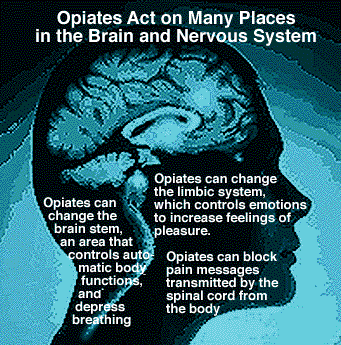
Our brains have natural opioid receptor hardwired within it. Opioid receptors interact with nerve cells in the brain and nervous system, controlling pain and delivering pleasure. Everyone on the planet does this naturally through our endorphin system.

brain3

When we engage in pleasurable activities the brain releases these feel good chemicals (dopamine/serotonin) and we experience them as a reward. These chemicals are the drive behind every habit we have. We will almost always do what that which gives us the greatest pleasure or has the greatest potential for removing pain or discomfort. We are hedonic seeking creatures. It’s why we eat when we’re hungry, have sex when we’re horny, and take medicine when we’re sick.

Our natural endorphin system has three primary functions; stabilize mood, provide energy/motivation, and control pain. All necessary to live a functional, normal life. Opiate dependent individuals ALL report they stopped using heroin and pain pills to get high within months of starting. They report primarily using just to feel normal, just to get up and go to work, take care of the kids, and not be sick.

scienceaddiction3

The Anatomy of an Opiate Addict

When we are prescribed or illicitly take opiates our brains hit the jackpot! Not only does this medication already belong in our systems, it’s much more powerful than the stuff we make naturally. If we take the medication or heroin long enough our brain, being a very efficient organ, will reduce or just stop manufacturing the naturally occurring chemicals and rely on you to provide it via drugs. It’s like the brain lays off all the workers and shuts down the factory.

Opiates are highly addictive because the chemical already belong there. The brain would fight off other foreign chemicals such as cocaine or methamphetamines because it sees them as a threat. But with opiates it just says, “Back that truck up and give me as much as you’ve got!” This is called dependency.

Unfortunately, the longer you use opiates the stronger the neural pathways get that support their use. Consequently, the lesser use natural pathways get weaker and less used neural pathways have a tendency to prune themselves to make room for more frequently used neurons/pathways. The brain, fueled by illicit or licit opiate use creates a superhighway that supports that drug use and he old, natural pathways are like rural back roads that aren’t driven anymore, overgrown and broken down. Even if you tried to take the old rural road it would be hard to traverse because of a lack of use.

So, now an individual is completely dependent on opiates and the brain structure has changed to accommodate this drug use. Paying for daily drugs gets expensive quickly as tolerance to the medication increases. This often leads a moral, kind, good person to do awful things they never imagined doing, such as stealing from grandmother, taking money from their kids piggy banks, selling the family jewelry, or robbing someone using physical force. All just to avoid feeling violently ill. All with the intent to make right as soon as they’re feeling better. But, that never comes. There’s always tomorrow and more sickness. The hole just gets deeper. Add to that the growing sense of shame, guilt, and remorse and you have a desperate, self-loathing person and the perfect antidote for feeling sick and hating yourself…use more drugs. Repeat. Repeat. Repeat.

If a person began using prescription pain medication and developed a dependency, it’s a short jump to heroin. Maintaining a pill addiction is very expensive and heroin is a cheaper, more powerful alternative. Once you use a needle to inject heroin, there’s no going back from there. Your life becomes a hopeless cycle of using drugs, getting high, hustling for money, getting high. Repeat. Repeat. Repeat.

Opiate use now becomes the only way for a person to function as a human. Most of the public lacks this understanding and perpetuates the false belief that if someone really wanted it bad enough they’d just stop using. Science tells us it simply does not work that way.

*In our next post we’ll explore the conditions known as tolerance and withdrawal and why quitting cold-turkey rarely works and can even be dangerous.


Overview of the Opioid Epidemic (part 1)


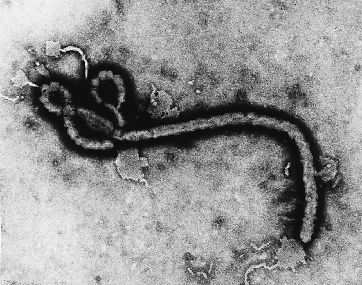
Let’s start with a brief overview of the current state of affairs related to the opioid crisis. Some of these number will shock you and some will be hard to believe. As an addiction counselor working exclusively with opioid dependent individuals I can tell you these number don’t surprise me at all. Having worked in this field for a few years now I can attest to the growing number of opioid users, especially among the populations listed below. We’ve also seen a growing number of overdose related deaths due to opioid use. To those of us working in the field, it feels like the problem is growing faster than we can treat it. If this were the Ebola virus and that was happening we would do everything we could to contain its spread without hesitation.

The numbers…

Drug overdose is the leading cause of accidental death in the US, with 47,055 lethal drug overdoses in 2014. Opioid addiction is driving this epidemic, with 18,893 overdose deaths related to prescription pain relievers, and 10,574 overdose deaths related to heroin in 2014. From 1999 to 2008, overdose death rates, sales and substance use disorder treatment admissions related to prescription pain relievers increased in parallel. The overdose death rate in 2008 was nearly four times the 1999 rate; sales of prescription pain relievers in 2010 were four times those in 1999; and the substance use disorder treatment admission rate in 2009 was six times the 1999 rate. In 2012, 259 million prescriptions were written for opioids, which is more than enough to give every American adult their own bottle of pills. Four in five new heroin users started out misusing prescription painkillers. As a consequence, the rate of heroin overdose deaths nearly quadrupled from 2000 to 2013. During this 14-year period, the rate of heroin overdose showed an average increase of 6% per year from 2000 to 2010, followed by a larger average increase of 37% per year from 2010 to 2013. 94% of respondents in a 2014 survey of people in treatment for opioid addiction said they chose to use heroin because prescription opioids were “far more expensive and harder to obtain.”

Adolescents (12 to 17 years old) 
In 2014, 467,000 adolescents were current nonmedical users of pain reliever, with 168,000 having an addiction to prescription pain relievers. In 2014, an estimated 28,000 adolescents had used heroin in the past year, and an estimated 16,000 were current heroin users. Additionally, an estimated 18,000 adolescents had heroin a heroin use disorder in 2014. People often share their unused pain relievers, unaware of the dangers of nonmedical opioid use. Most adolescents who misuse prescription pain relievers are given them for free by a friend or relative. The prescribing rates for prescription opioids among adolescents and young adults nearly doubled from 1994 to 2007.11

Women

Women are more likely to have chronic pain, be prescribed prescription pain relievers, be given higher doses, and use them for longer time periods than men. Women may become dependent on prescription pain relievers more quickly than men.

48,000 women died of prescription pain reliever overdoses between 1999 and 2010. Prescription pain reliever overdose deaths among women increased more than 400% from 1999 to 2010, compared to 237% among men. Heroin overdose deaths among women have tripled in the last few years. From 2010 through 2013, female heroin overdoses increased from 0.4 to 1.2 per 100,000.

*data from: http://www.asam.org/docs/default-source/advocacy/opioid-addiction-disease-facts-figures.pdf


Addressing the Heroin/Opioid Epidemic


The United States is in the midst of an epidemic. The small county I work in reports 3-5 calls per day for opiate related overdoses. Treatment programs from around the area have huge wait lists and people are dying every day. Experts at a recent round table discussion on the problem are predicting that it will only get worse as we tighten physician prescribing of opiates, as opiate dependent people will switch to the cheaper, more accessible heroin to fight off withdrawals.

This, and other reasons are why we are designating time and space to exploring this growing concern. Heroin and opiates are not an inner city problem. The largest growing base of new users are 20-something, middle class, Caucasians, especially women. This problem in already in your backyard if you live in the suburbs or a rural community.This is not to say opiates doesn’t affect those in the city but the myth that it’s inner city black males that are the largest consumer and dealer of illicit drugs in not supported by research.

Over the next several months we will explore the following topics related to the opiate epidemic that is sweeping across the nation.

  1. Who? What? Why? Where? – An overview of the current state of this problem
  2. Understanding how opiates change the brain
  3. Tolerance/Withdrawal/Detoxification
  4. Medication Assisted Treatment – Methadone & Suboxone
  5. What does effective treatment look like and what are the barriers to accessing it
  6. Harm Reduction (needle exchanges, narcan, and condoms)
  7. Mass Incarceration and the War on Drugs
  8. Co-occurring Disorders
  9. Family Systems and Substance Use
  10. Intersection of class, race, gender, sexual orientation
  11. Education and Employment
  12. What is the role of the church?

U.S. drug control strategy has largely been focused on law enforcement. Police have done their jobs and have done them well. In the last 20 year we have seen record arrests, drug seizures, and incarceration of drug offenders and yet the drug problem is only getting worse and more deadly, not to mention wasted valuable taxpayer resources. It’s time to collectively create a new way of addressing the drug problem in our country. What we’re doing now clearly isn’t working.

New Trainings for 2016


We’re excited to offer two brand new training opportunities for 2016. Both address much needed conversations around important and urgent issues; the opiate overdose epidemic, and the need for cultural intelligence in a rapidly changing world. If you are interested in bringing either of these conversations or any of our other trainings/workshops/community conversations to your area, just email us at cschaffner@fringeconversations.com

Connecting with Marginalized Youth (increasing your CQ)

Do you have a diverse group of kids? Do you want to be more effective in reaching a more diverse cross-section of youth in your community? Do you desire to impact the lives of LGBTQ youth, kids with disabilities, cross racial and ethnic barriers, and get to know those who are strikingly different than you and those in your ministry? Do you desire to increase your cultural intelligence in order to build a bridge across the gap between your church and others? This training focuses on developing and increasing our cultural intelligence (CQ) in order to begin the bridge building process of learning how to love our neighbors that appear to be different that us.

Understanding the Opiate/Heroin Overdose Crisis

According to a government website heroin related overdose deaths have seen a 10-fold increase since 2001. Many of those impacted by this growing trend at adolescents and young adults. Prescription narcotics and heroin have become the drug of choice for youth across all classes, races, and socio-economic ranges. Learn about the impact of opiates on the developing adolescent brain and body as well as how someone becomes addicted to opiates. In this training you will earn how to use a life saving medication called Naloxone, an opiate overdose reversal medication that can save a loved one’s life. This workshop is in partnership with the JOLT Foundation. Visit JOLT Foundation for more information on Naloxone.

Juvenile Justice Ministry: Reintegrating Juvenile Offenders


Youth incarcerated in juvenile detention centers are undergoing significant stress related to arrest, the uncertainties of their legal issues, and the potential loss of freedom, trust, respect of family and community, and future dreams. Effective ministry to these individuals should be based on the expected duration of the sentence (30 days vs. 1 year) but should also be focused more on the transition out of incarceration and reintegration back into the community. The better this transition is the greater the likelihood that the youth will not recidivate back into illegal behaviors.

SAMHSA Substance Abuse Treatment for Individuals in the Criminal Justice System identifies the following key factors to consider when helping an individual coming out of incarceration:

 Substance Use

  • Substance use history
  • Motivation for change
  • Treatment history

 Criminal Involvement

  • Criminal thinking tendencies
  • Current offenses
  • Prior charges/convictions
  • Age of first offense
  • Type of offenses (violent vs. non-violent, sexual, etc.)
  • Number of offenses
  • Prior successful completion of probation/parole
  • History of personality disorders (unlikely if under 18 years of age)

 Health

  • Infectious disease (TB, hepatitis, STD, HIV, etc.)
  • Pregnancy
  • General health
  • Acute conditions

 Mental Health

  • Suicidality/History of suicidal behavior
  • Any diagnosis of MH
  • Prior treatment/counseling and outcomes
  • Current/Past medication
  • Symptoms
  • Trauma

 Special Considerations

  • Education level
  • Reading level/Literacy
  • Language/Cultural barriers
  • Disabilities (physical, intellectual, learning, etc.)
  • Housing
  • Family issues
  • History of abuse (victim and/or perpetrator)
  • Other service providers (counselor, probation officer, social worker, etc.)

 This is a long list of issues that require attention. Remember, you are not alone in service this youth. Partner with others that are investing as well. Establish open communication between you and the others so you do not unintentionally work against each other. Have the other providers come do trainings for you and your staff so that you can better understand the complexities involved in serving juvenile offenders. The more you can work together with the community the greater the odds are that your youth will overcome the obstacles they are facing.

 What are ways you have partnered with individuals attempting to reintegrate after returning from incarceration?

 Are there special considerations for juvenile offenders vs. young adults?

 How have you been successful in engaging resistant families?

I Have An Aspie In My Youth Group!


In a setting which relies heavily on spoken and written words the Asperger’s child is at a disadvantage.  With a growing awareness of Asperger’s and its nuances youth ministries need to adjust some of their practices to make it more accessible to those who have traits of or a diagnosis of the disorder.

 There are three main interrelated general areas of functional liability in children with AD:

  1. Visual-spacial processing and sensory-motor integration
  2. Information processing and organizational skills
  3. Social skills and pragmatic language development

These areas will need to be discussed in greater detail by youth ministries as this is largely misunderstood people group that are not being effectively impacted with the Good News, not for a lack of want but likely from a lack of understanding and awareness on our part.  For the time being we’ll simply provide an overview of these three areas of difficulty and leave it up to you to contextualize in your ministry setting.

Visual-spacial processing and sensory-motor integration

Examples of visual-spacial skills include the ability to walk a narrow beam or to run while accurately throwing a ball to another person.  Most of us take these skills for granted.  You probably think nothing of the fact that you know the relative size of things.  When going to pick up a stack of books, you know that they will be heavier than the single book you just put down, and you’ll adjust your motor movement to account for that difference.  You take for granted that you can find your way from one place to another in a large building.  For youth with AD, the visual-spacial and visual discrimination skills required to accomplish all these activities are often impaired, contributing to a natural clumsiness and frequent experiences of getting lost.

Visual-spacial processing impacts learning in many ways and this has a direct impact on discipleship efforts, given that we primarily teach about our Christian faith like a classroom subject.  Students with AD find tasks such as handwriting, taking notes, and filling out forms and worksheets difficult at best and often impossible.  Given the difficulties these children have in visual spacial processing and coordinating sensory-motor integration, seemingly simple tasks are not simple and can impede their ability to grow and develop spiritually as their peers.  The problem is not one of failing to understand the task or not having the knowledge to complete the task (i.e., bible study); rather, the problem is that these youth have a specific disability that interferes with the processing of visual-motor and visual-spacial information.

Information processing and organizational skills

Processing the many forms of information that you encounter daily is dependent on a complex set of interconnections between multiple parts of the brain.  In students with AD this process is impaired, leaving them unable to easily or quickly make sense of simple day-to-day tasks (like homework or chores), or individual expectations (grooming or managing relationships).  The information goes in, but once it enters the labyrinth of the mind it becomes jumbled and their ability to organize, recall, or use the information is hindered by their cognitive processes.  Imagine trying to relate a parable of Jesus to a student with AD.  This can often appear on the surface to be oppositional in nature but upon further inspection it is simply the result of a complex cognitive process that has gone off the track.

Social skills and pragmatic language development

In the development of social skills and day-to-day language that conveys social meaning the AD child struggles.  This is partly due to the first two issues addressed above.  The student’s difficulties processing information and accurately comprehending the actions of others, along with spacial, motor, and organizational problems combine to create pain nd anxiety for the child.  Normal social interactions occur on so many levels at the same time, some overt (verbal messages) and some covert (hidden messages, tone of voice, nonverbal, gestures, body language, etc.).  Youth with AD do not fully grasp these nuances, missing social cues and implied meanings that others understand.  Aspies often take things at face value, interpreting statements literally, often missing sarcasm, subtly humor, or even threats. 

Just because a child has AD does not mean they will skip being a teenager.  The student is just as  likely to go through the normal variations of mood and personality as any teen; they just go through adolescence with more baggage.  The good news is that, developmentally, most of these teens are slower to become aware of adolescent issues of sexuality, drugs, or rebellion, but these issues will eventually come up  The social culture that our youth are a part of is difficult at best, and many of these teens are not prepared to deal with the pressures they face daily.  We have a tremendous opportunity to show the love of Christ to Aspies and their families by entering into the potential messiness of their day-to-day living and getting our hands dirty.  The message this sends when we seek to understand is that they matter.  They matter to us and more importantly, they matter to the God who created them.

Building Bridges (art of connecting pt. 1)


One of the Apostle Paul’s most famous speeches took place at Mars Hill, the Areopagus, in Athens.  He noted that they appeared to be a very religious lot of people due to the sheer number of statues they had to their gods.  In a brilliant move he identified the one statue that was for the “unknown” god and he saw his bridge.  Paul then launched into his epic sermon about the “unknown” God and described our Father to the Greeks.  He masterfully used a technique called bridge building to connect with his audience.

Kids today are completely enmeshed in pop culture.  We could, and should be aware of what is shaping our youth today and much of what we see and hear impacts them more than we know.  But I’m not simply talking about knowing what the newest Katy Perry song is blazing up the charts, what I’m talking about is building a bridge with a language of the soul.

In order to connect with young people they first have to know that you’re interested and trustworthy.  They are most likely already suspicious of adults anyway.  Too often we have an agenda for them and they know that.  It’s what drives them underground many times.  What we’re talking about here is a fundamental belief that we have something in common with the young people we love and hope to reach.

If we say things like, “Teens today are just so much more _________ than we were.” or “Kids today are just lazy and apathetic.” we create distance between us and them.  If we fail to see that they have the same longings that drove us then and drive us now there will be no bridge to walk across.  All we will have to work with is a shallow relationship and all the change we’re likely to affect is shallow compliance to an empty belief system.  We have to find common ground and that common ground should be our shared humanity.

In his ground breaking book Hurt: Inside the World of Today’s Teenagers, Chap Clark identifies six intrinsic longings of all students.  Those longings are: to belong, to matter, to be wanted, to be uniquely ourselves, for a safe place, and to be taken seriously.  Who among us can’t relate to those longings?  I work with drug addicted emerging adults.  Daily they express to me their desire to satisfy those very longings and that much of their behavior was an attempt to do just that.

After some small talk I usually ask a student where in their life do they feel they belong.  Where do they and what do they do that makes them feel like they matter?  Who takes you seriously?  Where are the safest places for you to just be yourself?  These are the questions that matter to students even if they don’t have the language to articulate them.

What the Apostle Paul did was provide an opportunity for those in the crowd to have their longings satisfied in a permanent manner by depending on the One true God.  A civilization that worships everything is an empty civilization desperately searching for meaning.  They apparently hadn’t found that in the many false gods they worshipped.

We have the same opportunity to connect the kids in our community to the very God that Paul preached about to the Greeks but first we must take to time to build a bridge by learning about them and their longings.  There is ALWAYS a bridge and it’s up to us to find it.

A WordPress.com Website.

Up ↑