Search

conversations on the fringe

Category

LGBTQ Youth

Opiate Tolerance and Withdrawal (part 3)


Tolerance

The struggle that Adam and Eve discovered in the garden, on that fateful day when they ate the apple, was that they learned about something they were never intended to know. Much like the Adam and Eve narrative, when we use opiates our brain learns about something it never knew existed, the increased capacity to experience higher levels of dopamine output. If that sounds too clinical for you then let me make it simple; they (opiate users) discovered a higher, more intense level of pleasure than they ever knew possible. It is so powerful in its reward that it almost immediately sets a new default for pleasure that the brain will always try to attain again.

Our brain is amazing. It is very plastic and adaptive. When it sets its “mind” on something it obsesses on it (cravings/urges) and if we surrender to those cravings we strengthen our connection to that which we are craving.

In the case of the opiate user our brains, the pathways that support the natural endorphin production work just fine but compared to the new superhighway of heroin/prescription narcotics it pales in comparison. The brain is flooded with significantly more endorphins and the brain has to create new pathways and places for them to land. This causes the brain to change and actually grow new endorphin landing sites, which in turn requires more of whatever it is that is flooding the brain with larger amounts of dopamine. Repeat the process. This is called tolerance and the brain is designed to make this happen.

Meanwhile, the old pathways that the naturally produced endorphins use to travel and growing old and less used. Imagine old rural county highways that are overgrown with grass, wore out and crumbled, with cracks and dirt beginning to cover them. They are becoming less traveled because of the nearby superhighway that is allowing more endorphins to travel at higher speeds to the reward center of the brain. In time, nothing will travel on those old roads and if they do it is likely to get lost along the way.

So, what use to give us pleasure; sex, food, relationships, work, recreation, movies, candy, etc. now pale in comparison and no longer deliver what it use to. Now, try to imagine that for a minute…nothing gives you pleasure except the medication your doctor prescribed you for your back pain. You quickly learn the only thing worth pursuing is the next fix, because, as well talk about next, withdrawal is so bad you’ll wish you were dead.

Withdrawal

You’ve been using these pills for several months now. They no longer work like the use to because you’ve developed a tolerance and your doctor is starting to become concerned about the frequency of which you ask for refills and is beginning to talk about not prescribing them anymore. You start to panic and begin visiting different urgent care centers hoping to score some Vicodin.

Instead, you decide to just stop taking the pills. They are costing a fortune and you don’t like the feeling of needing them just to help the kids get ready for school in the morning. So you just stop taking them one day.

REVOLT!

The brain has become dependent on the level of medication you’ve been giving it daily for the last nine months. It shut down its own production of natural endorphins and now relies on you to give it what it needs to function normally, to just get out of bed and not hurt. When the brain revolts like this it makes you feel deathly sick. It is reported that you feel like you’re dying but it never comes.

Common withdrawal symptoms are:

  • Sweating
  • Nausea
  • Muscle cramps
  • Diarrhea
  • Cold sweats/fever
  • Tremors
  • Pain
  • Depression
  • Possible seizures

Your stomach and digestive system has opiate receptors as well and since one of the side-effects of opiate use is constipation, diarrhea would result when in withdrawal. These symptoms are so severe that they would drive you to temporarily suspend your morality and do things you never imagined doing, such as; lying, cheating, stealing, manipulating, breaking the law, becoming violent, all to get money to get more opiates so you won’t be sick any longer. The criminal behavior often associated with drug use is typically a function of the drug use not a personality or character flaw. Stealing and selling possessions, lying or coercing others to get money is simply to not be sick any longer and so they can just get up and take care of their family, house, job, etc.

It is here that sympathies break down. When someone addicted to opiates begins to steal from a loved one we tend to become less empathetic. It’s important to remember at this time that your loved one is suffering from a brain altering dependency on an opiate. Nobody grows up hoping to become a heroin addict.

The brain is a fickle organ. It wants what it wants when it wants it and when it gets it over and over and over again it changes its neurological make-up to accommodate it. This is the nature of a brain disease/disorder that has biological, environmental, behaviors, cognitive, and personality variables influencing the outcome of dependency. At some point the person dependent on opiates loses their ability to choose. They MUST continue to use.

*in our next post we’ll explore the role of medications like methadone and suboxone in helping someone overcome opiate dependency.

This is your brain on opiates (part 2)


What are Opioids?

Opioids are a powerful class of drug that includes the illicit drug heroin as well as the licit pain relievers, such as; oxycodone, hydrocodone, codeine, morphine, and fentanyl.

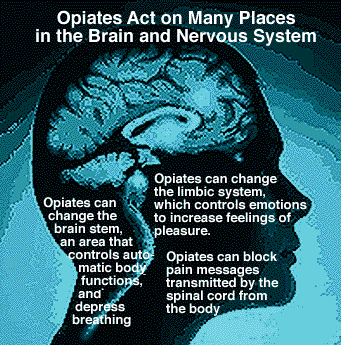
Our brains have natural opioid receptor hardwired within it. Opioid receptors interact with nerve cells in the brain and nervous system, controlling pain and delivering pleasure. Everyone on the planet does this naturally through our endorphin system.

brain3

When we engage in pleasurable activities the brain releases these feel good chemicals (dopamine/serotonin) and we experience them as a reward. These chemicals are the drive behind every habit we have. We will almost always do what that which gives us the greatest pleasure or has the greatest potential for removing pain or discomfort. We are hedonic seeking creatures. It’s why we eat when we’re hungry, have sex when we’re horny, and take medicine when we’re sick.

Our natural endorphin system has three primary functions; stabilize mood, provide energy/motivation, and control pain. All necessary to live a functional, normal life. Opiate dependent individuals ALL report they stopped using heroin and pain pills to get high within months of starting. They report primarily using just to feel normal, just to get up and go to work, take care of the kids, and not be sick.

scienceaddiction3

The Anatomy of an Opiate Addict

When we are prescribed or illicitly take opiates our brains hit the jackpot! Not only does this medication already belong in our systems, it’s much more powerful than the stuff we make naturally. If we take the medication or heroin long enough our brain, being a very efficient organ, will reduce or just stop manufacturing the naturally occurring chemicals and rely on you to provide it via drugs. It’s like the brain lays off all the workers and shuts down the factory.

Opiates are highly addictive because the chemical already belong there. The brain would fight off other foreign chemicals such as cocaine or methamphetamines because it sees them as a threat. But with opiates it just says, “Back that truck up and give me as much as you’ve got!” This is called dependency.

Unfortunately, the longer you use opiates the stronger the neural pathways get that support their use. Consequently, the lesser use natural pathways get weaker and less used neural pathways have a tendency to prune themselves to make room for more frequently used neurons/pathways. The brain, fueled by illicit or licit opiate use creates a superhighway that supports that drug use and he old, natural pathways are like rural back roads that aren’t driven anymore, overgrown and broken down. Even if you tried to take the old rural road it would be hard to traverse because of a lack of use.

So, now an individual is completely dependent on opiates and the brain structure has changed to accommodate this drug use. Paying for daily drugs gets expensive quickly as tolerance to the medication increases. This often leads a moral, kind, good person to do awful things they never imagined doing, such as stealing from grandmother, taking money from their kids piggy banks, selling the family jewelry, or robbing someone using physical force. All just to avoid feeling violently ill. All with the intent to make right as soon as they’re feeling better. But, that never comes. There’s always tomorrow and more sickness. The hole just gets deeper. Add to that the growing sense of shame, guilt, and remorse and you have a desperate, self-loathing person and the perfect antidote for feeling sick and hating yourself…use more drugs. Repeat. Repeat. Repeat.

If a person began using prescription pain medication and developed a dependency, it’s a short jump to heroin. Maintaining a pill addiction is very expensive and heroin is a cheaper, more powerful alternative. Once you use a needle to inject heroin, there’s no going back from there. Your life becomes a hopeless cycle of using drugs, getting high, hustling for money, getting high. Repeat. Repeat. Repeat.

Opiate use now becomes the only way for a person to function as a human. Most of the public lacks this understanding and perpetuates the false belief that if someone really wanted it bad enough they’d just stop using. Science tells us it simply does not work that way.

*In our next post we’ll explore the conditions known as tolerance and withdrawal and why quitting cold-turkey rarely works and can even be dangerous.


Overview of the Opioid Epidemic (part 1)


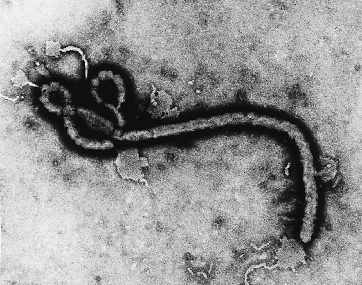
Let’s start with a brief overview of the current state of affairs related to the opioid crisis. Some of these number will shock you and some will be hard to believe. As an addiction counselor working exclusively with opioid dependent individuals I can tell you these number don’t surprise me at all. Having worked in this field for a few years now I can attest to the growing number of opioid users, especially among the populations listed below. We’ve also seen a growing number of overdose related deaths due to opioid use. To those of us working in the field, it feels like the problem is growing faster than we can treat it. If this were the Ebola virus and that was happening we would do everything we could to contain its spread without hesitation.

The numbers…

Drug overdose is the leading cause of accidental death in the US, with 47,055 lethal drug overdoses in 2014. Opioid addiction is driving this epidemic, with 18,893 overdose deaths related to prescription pain relievers, and 10,574 overdose deaths related to heroin in 2014. From 1999 to 2008, overdose death rates, sales and substance use disorder treatment admissions related to prescription pain relievers increased in parallel. The overdose death rate in 2008 was nearly four times the 1999 rate; sales of prescription pain relievers in 2010 were four times those in 1999; and the substance use disorder treatment admission rate in 2009 was six times the 1999 rate. In 2012, 259 million prescriptions were written for opioids, which is more than enough to give every American adult their own bottle of pills. Four in five new heroin users started out misusing prescription painkillers. As a consequence, the rate of heroin overdose deaths nearly quadrupled from 2000 to 2013. During this 14-year period, the rate of heroin overdose showed an average increase of 6% per year from 2000 to 2010, followed by a larger average increase of 37% per year from 2010 to 2013. 94% of respondents in a 2014 survey of people in treatment for opioid addiction said they chose to use heroin because prescription opioids were “far more expensive and harder to obtain.”

Adolescents (12 to 17 years old) 
In 2014, 467,000 adolescents were current nonmedical users of pain reliever, with 168,000 having an addiction to prescription pain relievers. In 2014, an estimated 28,000 adolescents had used heroin in the past year, and an estimated 16,000 were current heroin users. Additionally, an estimated 18,000 adolescents had heroin a heroin use disorder in 2014. People often share their unused pain relievers, unaware of the dangers of nonmedical opioid use. Most adolescents who misuse prescription pain relievers are given them for free by a friend or relative. The prescribing rates for prescription opioids among adolescents and young adults nearly doubled from 1994 to 2007.11

Women

Women are more likely to have chronic pain, be prescribed prescription pain relievers, be given higher doses, and use them for longer time periods than men. Women may become dependent on prescription pain relievers more quickly than men.

48,000 women died of prescription pain reliever overdoses between 1999 and 2010. Prescription pain reliever overdose deaths among women increased more than 400% from 1999 to 2010, compared to 237% among men. Heroin overdose deaths among women have tripled in the last few years. From 2010 through 2013, female heroin overdoses increased from 0.4 to 1.2 per 100,000.

*data from: http://www.asam.org/docs/default-source/advocacy/opioid-addiction-disease-facts-figures.pdf


Eroticizing Power


I came across this article about clergy sexual abuse and the concept of eroticized power seemed relevant to the current blog series on sexual abuse in the church.  I’d love to hear your thoughts on the following in the comments.

“A power imbalance is easily sexualized or eroticized. Carolyn Holderread Heggen notes that: The imbalance of power between men and women has become eroticized in our culture. Many persons find male power and female powerlessness sexually arousing. In general, men are sexually attracted to females who are younger, smaller, and less powerful than themselves. Women tend to be attracted to males who are older, larger, and more powerful. Male clergy have a great imbalance of power over their congregations, which are often predominately women, therefore, the stage is set for a sexually inappropriate expression of this power differential.
 
In some instances, misuses of power can be sexualized in situations that begin as mentoring. This could happen in the case of an older man or woman taking an interest in a younger person of either gender for the purpose of encouraging that youth’s development. Youth activities that begin as play can become a context of power and authority when youth leaders do not understand the power they possess simply by virtue of their age, authority and gender.
 
Because they have greater power, the leader always bears primary responsibility to protect the boundaries of the relationship. The person with the greater power must act in the best interests of the person with lesser power. This holds true even when the person with less power makes sexualized advances. A leader is the keeper of a trust and, as such, is responsible to ensure that no sexualized behavior occurs, “…no matter what the level of provocation or apparent consent.”

Keeping Children/Youth Safe From Abuse In Church: Best Practices


In our last post we looked at what faith communities need to know and think about regarding sexual abuse. In this post we will look at very specific behaviors churches/ministries can take to reduce the actual risk of sexual abuse occurring in their buildings and programs.

  • Do the hard work of developing policies

Many churches or youth and children ministries already have policies on how to address abuse when it occurs. It would be prudent to develop an abuse prevention policy as well. For example, have a 2-1 adult-child ratio at all times would be a safer practice that allowing 1-on-1 adult to child ratio. If a child needs spiritual counseling or is in a mentoring relationship with an adult, restricting physical touch to only public spaces or simply minimizing (side hug vs. full frontal, prolonged hug) is also a best practice.

  • Identify and question confusing behaviors

This will take an environmental curator, who is skilled at communication, to shape the culture and make it safe and acceptable to talk about confusing or uncomfortable behaviors. Nobody wants to accuse someone of sexual abuse but having a climate that identifies behavior that could potentially be misconstrued as inappropriate is a good starting point.

  • Don’t wait! Address inappropriate behaviors

Speaking up about your concerns is not the same as accusing someone of sexual abuse and could serve to keep unhealthy or dangerous behaviors from occurring in the first place. The very nature of prevention is to act before the illegal sexual behavior occurs. Drawing a boundary of safe and appropriate behavior early is the important work of prevention. Don’t wait until the line is crossed, be proactive.

  • No hide and seek

When planning for child/youth space, we often look at it through the lens of the child or physical harm to the child. We should also be looking at our physical spaces through the lens of a potential perpetrator; where are there blind spots, hiding spaces where abuse might occur. Be mindful of the activities you play, such as; hide and seek, sardines, etc. Consider adding windows to interior walls for safer viewing and higher levels of accountability.

  • Plan for messy people

The church is and should be a place of restoration and reconciliation. People who have sexually abuse others in the past often look to faith and religion as a means of overcoming their problem. What are your protocol for how they can navigate your community? Are certain areas off limits? What legal restrictions do they have? Who is meeting with the abuser for counseling and accountability? Thinking this through ahead of time will give you the opportunity to be proactive and decrease the likelihood of unwanted difficulties.


In our next post we will look at best practices for responding to a sexual abuse crisis should it happen in your church/program.

Church Readiness for Sexual Abuse: Reducing Risk


Churches that care about children are an important part of our culture. The need for spiritual and moral development is imperative for our future as humans and also for the future of all faith traditions. The significance of growing into a community of people that love and support you is essential for a successful transition into adulthood as well. Unfortunately, any community can be vulnerable to sexual abuse, especially when adults interact with those children on a regular basis.

  • It can happen in your church.

“It won’t ever happen here.” Famous last words. There is no such thing as a “typical” sexual predator. They come in all shapes and sizes. We can’t afford to live in denial about the possibility that sexual abuse can happen in our ministries. Talking about it won’t make it happen. Talking about it publicly will help keep it in the forefront of your minds and will communicate a sense of safety, that this issue is not being ignored. Parents are always thinking about the possibility so your ministry should as well.

  • You’re as sick as your secrets.

Should sexual abuse occur in your church or ministry, you might be tempted to avoid the public scandal. Don’t! Nothing feels worse to the victim than brushing abuse under the rug. Don’t minimize or victim-blame. Speak out directly to your community, cooperate with the police, walk alongside the victim, and walk alongside the abuser. This will be messy but it will be worth it in the end as it will give everyone a sense of security that this issue is taken seriously and that we (the church) is in it for the long road to recovery.

  • Background checks – it’s a good start.

Background checks should be required by now. If not, you’re already vulnerable to predatory individuals. While background checks are essential, law enforcement says that 88% of sexual assault goes unreported. That means 9 out of 10 offenders will not have a criminal background. Proper vetting, relationships, ongoing supervision, accountability, and policy are necessary to reduce the risk of abuse happening in your ministry.

  • The importance of policies and procedures.

Beyond background check, extensive and comprehensive policies and procedures are going to be your best defense against child/youth abuse in your community. Good policies make clear that your ministry is committed to nurturing safe spaces for your kids to explore faith and tradition.


Legal Issues For The Church Dealing With Child/Youth Abuse


Limits of Confidentiality/Legal Issues/Mandated Reporting

Everything that happens in therapy is strictly confidential and protected under the law. Your therapist cannot discuss anything about your therapy, or even identify that you are a client, unless you give your written permission. There are some instances when a therapist will talk with someone about your case without obtaining your consent that is allowed under the law. These include reviewing your case during Clinical Supervision or Peer Consultation, sharing required information with your health insurance, discussing your case with other mental health or healthcare providers to collaborate services provided to you.

There are some instances in which a therapist is required to break confidentiality under the law. These apply to those in ministry serving youth. They include:

Mandated Reporting Laws

Child Abuse – includes physical or sexual abuse, neglect, excessive corporal punishment, child abduction and exposure to domestic violence that is traumatizing to the child. Child abuse reporting only applies to children who are currently under the age of 18. Abuse that happened in your childhood prior to becoming an adult is not reportable unless there is a child who is currently in danger of being abused. The reporter is required to report suspected child abuse in addition to known incidents of abuse. Child abuse is reported to the Department of Children and Family Services who will investigate the abuse allegations.

Spend time with your staff and volunteers exploring what each form of abuse looks like and what your policy/procedures are for addressing it. (i.e., neglect – being left at home at a young age without adequate food available for long periods of time.)

Dependent Adult/Elder Abuse – includes physical abuse, sexual abuse, neglect, abduction, financial abuse, self-neglect, isolating the adult and not providing proper care, including medical and mental health needs. Again, the reporter is required to report suspected abuse in addition to know abuse.

Intent to Harm Yourself or Others

If anyone discloses the intention or a plan to harm another person, you are legally required to warn the intended victim and report this information to legal authorities. If they discloses or imply that they have  plan for to harm or kill themself, you, as a mandated reported, are required by law to take precautions to keep them safe, which includes contacting a family member or friend to watch over them for a specified amount of time, a referral to a psychiatric hospital or police intervention if necessary.


Contact your local child protective services to ask about state specific requirements and training.

Myths About Child Abuse


Myths of Abuse

Child abuse is more than bruises or broken bones. While physical abuse is shocking due to the scars it leaves, not all child abuse is as obvious. Ignoring children’s needs, putting them in unsupervised, dangerous situations, or making a child feel worthless or stupid are also child abuse. Regardless of the type of child abuse, the result is serious emotional harm.

MYTH #1: It’s only abuse if it’s violent.

Fact: Physical abuse is just one type of child abuse. Neglect and emotional abuse can be just as damaging, and since they are more subtle, others are less likely to intervene. .

MYTH #2: Only bad people abuse their children.

Fact: While it’s easy to say that only “bad people” abuse their children, it’s not always so black and white. Not all abusers are intentionally harming their children. Many have been victims of abuse themselves, and don’t know any other way to parent. Others may be struggling with mental health issues or a substance abuse problem.

MYTH #3: Child abuse doesn’t happen in “good” families.

Fact: Child abuse doesn’t only happen in poor families or bad neighborhoods. It crosses all racial, economic, and cultural lines. Sometimes, families who seem to have it all from the outside are hiding a different story behind closed doors.

MYTH #4: Most child abusers are strangers.

Fact: While abuse by strangers does happen, most abusers are family members or others close to the family

MYTH #5: Abused children always grow up to be abusers.

Fact: It is true that abused children are more likely to repeat the cycle as adults, unconsciously repeating what they experienced as children. On the other hand, many adult survivors of child abuse have a strong motivation to protect their children against what they went through and become excellent parents.

MYTH #6: Children/Youth somehow played a role in the abuse.

Fact: Regardless of age, victims of abuse are just that, victims. Victim-shaming is a practice of blaming the victim for the actions of the abuser. Children of young ages do not have the ability to defend themselves from an abuser. Adolescents, while often times oppositional, are still protected as minors and therefore not able to defend themselves against the attacks of an abuser. They lack resources to defend or protect themselves and are protected by the law because of this.

Abuse Defined


If we’re going to dig into this messy and difficult topic then we’re going to need to define what abuse is and identify the different types of abuse a child/young person can experience.

Abuse Defined

Child abuse and neglect are defined by Federal and State laws. The Federal Child Abuse Prevention and Treatment Act (CAPTA) provides minimum standards that States must incorporate in their statutory definitions of child abuse and neglect. The CAPTA definition of “child abuse and neglect,” at a minimum, refers to:

  • “Any recent act or failure to act on the part of a parent or caretaker, which results in death, serious physical or emotional harm, sexual abuse, or exploitation, or an act or failure to act which presents an imminent risk of serious harm”

The CAPTA definition of “sexual abuse” includes:

  • “The employment, use, persuasion, inducement, enticement, or coercion of any child to engage in, or assist any other person to engage in, any sexually explicit conduct or simulation of such conduct for the purpose of producing a visual depiction of such conduct; or
  • The rape, and in cases of caretaker or interfamilial relationships, statutory rape, molestation, prostitution, or other form of sexual exploitation of children, or incest with children”

Types of Abuse

Nearly all States, the District of Columbia, American Samoa, Guam, the Northern Mariana Islands, Puerto Rico, and the U.S. Virgin Islands provide civil definitions of child abuse and neglect in statute. As applied to reporting statutes, these definitions determine the grounds for intervention by State child protective agencies. States recognize the different types of abuse in their definitions, including physical abuse, neglect, sexual abuse, and emotional abuse. Some States also provide definitions in statute for parental substance abuse and/or for abandonment as child abuse.

Physical Abuse

Physical abuse is generally defined as “any non-accidental physical injury to the child” and can include striking, kicking, burning, or biting the child, or any action that results in a physical impairment of the child. In approximately 38 States and American Samoa, Guam, the Northern Mariana Islands, Puerto Rico, and the Virgin Islands, the definition of abuse also includes acts or circumstances that threaten the child with harm or create a substantial risk of harm to the child’s health or welfare.

Neglect

Neglect is frequently defined as the failure of a parent or other person with responsibility for the child to provide needed food, clothing, shelter, medical care, or supervision such that the child’s health, safety, and well-being are threatened with harm. Approximately 24 States, the District of Columbia, American Samoa, Puerto Rico, and the Virgin Islands include failure to educate the child as required by law in their definition of neglect. Seven States specifically define medical neglect as failing to provide any special medical treatment or mental health care needed by the child. In addition, four States define as medical neglect the withholding of medical treatment or nutrition from disabled infants with life-threatening conditions.

Sexual Abuse/Exploitation

All States include sexual abuse in their definitions of child abuse. Some States refer in general terms to sexual abuse, while others specify various acts as sexual abuse. Sexual exploitation is an element of the definition of sexual abuse in most jurisdictions. Sexual exploitation includes allowing the child to engage in prostitution or in the production of child pornography.

Emotional Abuse

Almost all States, the District of Columbia, American Samoa, Guam, the Northern Mariana Islands, Puerto Rico, and the Virgin Islands include emotional maltreatment as part of their definitions of abuse or neglect. Approximately 32 States, the District of Columbia, the Northern Mariana Islands, and Puerto Rico provide specific definitions of emotional abuse or mental injury to a child. Typical language used in these definitions is “injury to the psychological capacity or emotional stability of the child as evidenced by an observable or substantial change in behavior, emotional response, or cognition,” or as evidenced by “anxiety, depression, withdrawal, or aggressive behavior.”

Parental Substance Abuse

Parental substance abuse is an element of the definition of child abuse or neglect in some States. Circumstances that are considered abuse or neglect in some States include:

  • Prenatal exposure of a child to harm due to the mother’s use of an illegal drug or other substance (14 States and the District of Columbia)
  • Manufacture of a controlled substance in the presence of a child or on the premises occupied by a child (10 States)
  • Allowing a child to be present where the chemicals or equipment for the manufacture of controlled substances are used or stored (three States)
  • Selling, distributing, or giving drugs or alcohol to a child (seven States and Guam)
  • Use of a controlled substance by a caregiver that impairs the caregiver’s ability to adequately care for the child (seven States)

Abandonment

Approximately 17 States and the District of Columbia include abandonment in their definition of abuse or neglect, generally as a type of neglect. Approximately 18 States, Guam, Puerto Rico, and the Virgin Islands provide definitions for abandonment that are separate from the definition of neglect. In general, it is considered abandonment of the child when the parent’s identity or whereabouts are unknown, the child has been left by the parent in circumstances in which the child suffers serious harm, or the parent has failed to maintain contact with the child or to provide reasonable support for a specified period of time.

A WordPress.com Website.

Up ↑