Search

conversations on the fringe

Category

Depression

The Art of Connecting with Kids on the Fringe


After a workshop I facilitated on working with kids who have been abused, an elderly woman approached me to ask me a question.  She shocked me with the simplicity and depth of the question.  Here’s what she said,

“I love the kids in my community but I don’t know how to connect with the.  I want to reach out but don’t know where to start.  How do you do it?”

I can’t really remember what I told her, probably an overly simplified answer.  I never thought about it to be honest.  I just did what felt natural when reaching out to others.  Plus, I have the added benefit of being pretty simple, if I didn’t know someone I would just introduce myself and talk to them.  It wasn’t until I talked to my wife that she opened my eyes to the idea that for some this comes easy.  For others though it is an anxiety inducing event.  Imaging, you long to reach out to this generation, a generation that is slipping through the cracks right before your very eyes, but the words escape you when needed.  You don’t know how to connect beyond a simple “Hello, how are you today?”

My wife and I talked about this for several hours over the next few days.  We explored what is involved in connecting with these kids that seemed so different from us.  Asking me how I connect with fringe kids is like asking a fish to describe water.  I spend so much time out there on the fringe that it has become normal.   I have developed, over the years, skills to navigate those waters.  But many others haven’t and don’t know where to start.  That’s what this series in aimed at doing, equipping willing adults to connect with a generation where the gap is ever increasing.  Our thoughts are not exhaustive and it is my hope that other voices will chime in with their experience, wisdom, and insight.

We will cover the following over the next several weeks:

  • Bridge Building – How to make that initial contact in a meaningful way?
  • Cultivating a spirit of learning – Curiosity is key in connecting with others.  How do we foster a spirit of curiosity?
  • Law of the Lid – We will explore our preconceived expectations of these fringe kids and how they impede our interactions with them.
  • The Culture of an Individual – Each student is a culture unto themselves.  We will discuss how to explore that culture as it relates to effectively ministering to them.
  • Doing away with my Agenda – How my agenda actually breeds a distrust that is nearly impossible to overcome.
  • What is our Purpose of our Interactions – Moving from meaningless to Meaningful interactions.
  • Checking our Personal Bias at the Door – Often our personal biases impact how well we connect with others, especially those different than us.
  • Finding Common Ground – Discovering shared experiences, dreams, fear, and failures.
  • What is being said without Words – What story are they telling with their clothes, hairstyle, and nonverbal communication.

I hope you will contribute to this discussion because at the end of the day it will close the gap between us and the adolescents that reside in the world beneath…

Unhealthy Family System Model (Exploring Family pt. 2)


Most members of unhealthy family models oscillate between extremes of behavior choosing, mostly unconsciously, whichever behavior promises the greatest chance of surviving the moment.  You may see many of the following extremes in youth in your ministries.  It’s important to understand that these behaviors are functional and serve a purpose for these kids.  Understanding that will help you know what they need from us most.

High Intensity vs. Shutdown:  Alternating between feeling overwhelmed with emotional vs. physiological responses and shutting down.

Overfunctioning vs. Underfunctioning:  Alternating between working overtime to fill in what is missing vs. falling apart or barely holding it together.

Enmeshment vs. Disengagement:  Alternating between being overclose or fused in identities vs. avoidance, or cutting off leading to disengagement.

Impulsivity vs. Rigidity:  Alternating between behavior that leads to chaos vs. rigid, controlling behavior.

Grandiosity vs. Low Self-Worth:  Alternating between grandiose ideas and fantasies vs. feelings of low self-worth.

Denial vs. Despair:  Alternating between a state in which reality is denied or rewritten vs. despair, helplessness (or rage at having life as we know it slip away).

Abuser vs. Victim:  Alternating between the role of victim vs. the role of perpetrator.

Caretaking vs. Neglect:  Alternating between over concern leading toward enmeshment vs. underconcern leading toward disengagement.

Living with dysfunction is traumatizing to the body as well as the mind.  And living in this kind of system can lead to the kind of emotional deregulation that makes us want to turn to high-risk behaviors (substance use, unsafe sexual behavior, self-injury or violence towards others) to regain a sense of calm and regulation that dysfunction undermines.  The kids in our ministries are not typically “bad kids” making immoral choices because they lack long-term consequential thought processes.  Often the behaviors we see in our kids is simply their best attempt to manage life and survive in a world where most of the adults have left them to fend for themselves.

A Prayer When I Feel Hated


Loving God, you made me who I am.
I praise you and I love you, for I am wonderfully made,
in your own image.

But when people make fun of me,
I feel hurt and embarrassed and even ashamed.
So please God, help me remember my own goodness,
which lies in you.
Help me remember my dignity,
which you gave me when I was conceived.
Help me remember that I can live a life of love.
Because you created my heart.

Be with me when people make fun of me,
and help me to respond how you would want me to,
in a love that respects other, but also respects me.
Help me find friends who love me for who I am.
Help me, most of all, to be a loving person.

And God, help me remember that Jesus loves me.
For he was seen as an outcast, too.
He was misunderstood, too.
He was beaten and spat upon.
Jesus understands me, and loves me with a special love,
because of the way you made me.

And when I am feeling lonely,
help me remember that Jesus welcomed everyone as a friend.
Jesus reminded everyone that God loved them.
And Jesus encouraged everyone to embrace their dignity,
even when others were blind to that dignity.
Jesus loved everyone with the love that you gave him.
And he loves me, too.

One more thing, God:
Help me remember that nothing is impossible with you,
that you have a way of making things better,
that you can find a way of love for me,
even if I can’t see it right now.
Help me remember all these things in the heart you created,
loving God. Amen.

James Martin, SJ, is a Jesuit priest and the author of The Jesuit Guide to (Almost) Everything and My Life with the Saints.

The Trinity Of Depression


Beck (1963, 1964) noted the way depressed patients interpreted their current life experiences.  The depressed person tended to distort their experiences; they misinterpreted specific, irrelevant events in terms of personal failure, deprivation, or rejection; they tended to greatly exaggerate or overgeneralize any event that bore any semblance of negative information about themselves; they also tended to obsess over making indiscriminate, negative predictions of the future.  It is important to note that the depressed person’s cognitions reflect a systematic bias against oneself.  Because of this overemphasis of negative data to the relative exclusion of positive data, the label “cognitive distortion” is most appropriate when describing the thinking of depressed persons.

When an individual suffers from cognitive distortions they develop other idiosyncratic negative thematic content not observed in those of nondepressed persons.  This is referred to as the Triad of Depression.

A negative view of self.  The depressed individual shows a marked tendency to view himself/herself as deficient, inadequate, unworthy, and to attribute their unpleasant experiences to a physical, mental, or moral defect in himself/herself.  Furthermore, they regard themselves as undesirable and worthless because of their presumed defects and tends to reject himself/herself (and to believe others will reject him/her) because of it.

A negative view of the world. His/Her interactions with the environment are interpreted as representing defeat, deprivation, or disparagement.  He/She views the world as making exorbitant demands on him/her and presenting obstacles which interfere with the achievement of his/her life goals.

A negative view of the future. The future is seen from a negative perspective and revolves around a series of negative expectations.  The depressed person anticipates that his/her current problems and experiences will continue indefinitely and that he/she will increasingly burden significant others in his/her life.

I can name countless students who present in our ministries like this every day.  What are we doing, teaching, and modeling that would challenge the negative views of themselves, their world, or their future?  The triad exists when there is no hope.  Are we telling a story that communicates that there is hope for our personal redemption (through Christ), reconciliation in our relationship (with the Father), and a guiding, sustaining presence when times get dark (by the Spirit)?

Personal Inventory (youth pastor life skills series pt.3)


It’s important that we stop from time to time and take a sober look at the that of our life and ministry.  Scripture says to be “sober minded” and that requires a regular honest evaluation of or current state of affairs.  The following is not an exhaustive list but will give you a good idea, if you’re honest, as to whether or not there’s strategic balance in place.  This is essential for avoiding burnout, compassion fatigue, or avoiding a train wreck.  Take a few moments to ask yourself these questions but first ask God to reveal to us our blind spots…

O God,
by your Spirit tell us what we need to hear,
and show us what we ought to do,
to obey Jesus Christ our Savior. Amen.

Anger

How do you feel about the way you handle anger?

How do you feel when anger is directed at you?

What strategies or behaviors help you cope with anger?

Codependence

How do you understand the concept of codependence?

With whom do you have a codependent relationship?

How do these relationships affect your ministry?

What strategies will you use to avoid codependence in the future?

Commitment

What people or things have you been committed to in the past?

What are you committed to now?

How important is the commitment of family and friends to your life and ministry?

How will you support these commitments while serving in ministry?

Depression

How do you recognize that you’re depressed?

How do you respond when you recognize you are depressed?

What strategies or behaviors help you avoid becoming depressed?

What strategies or behaviors help you get over being depressed?

Emotions

How do you cope with dangerous emotions, such as loneliness, anger, and feelings of deprivation?

What strategies and techniques help you maintain an emotional balance?

Fear

When you entered ministry, what aspects of it were you afraid of?

Have your fears about ministry changed since you entered?

What has helped you move past your fear?

Friendship

Before you entered ministry, what were your friendships based on?

Now, what qualities do you look for in a friend?

Are they based on how they can support your ministry goals? Is this good or bad?

What plans do you have for making new, supportive friends and maintaining current friendships?

Fun

How have your fun and relaxing activities changed since you’ve been in ministry?

What do you do now to have fun and relax?

With whom do you have fun?

What role does having fun play in staying balanced in your ministry?

How will you incorporate new activities and hobbies into your life?

Grief

What experience have you had with grief?

How do you cope with feelings of grief now?

To whom do you turn when you experience grief?

Happiness

Since you’ve been in ministry, when have you been the most happy?

What made you happy?

Isolation

Are free time and being alone difficult for you?

Do you have a sense of feeling isolated since entering ministry?

In what ways is your drive to connect with kids driven by a fear of loneliness?

What activities can you pursue, outside of ministry, which will help you avoid isolation?

Motivation

Has your motivation for impacting young people changed since you’ve been in ministry?

What has been your biggest challenge so far?

Do you have a support network to help you through the hard times?

As you move forward in your ministry, what are the most important aspects for you to focus on?

Overwhelmed

What contributes to you feeling overwhelmed?

How risk does feeling overwhelmed pose to your ministry?

What can you do to ensure that you do not feel overwhelmed?

These would be great questions to talk over with your staff/team/volunteers.  We don’t pay enough attention to the well being of those we depend on to make our ministries successful.  Spend some time asking others these questions and in essence you’ll be saying, “I care about you and your well being.”

Suicide Grief: Living in the Aftermath of a Suicide


A student’s suicide can be emotionally devastating. Using and modeling healthy coping strategies — such as seeking support — will help you and others on the journey to healing and acceptance.

When a student dies, your grief may be heart-wrenching. When a student commits suicide, your reaction may be more complicated. Overwhelming emotions may leave you reeling — and you may be consumed by guilt, wondering if you could have done something to prevent this young person’s death. As you face life after a student’s suicide, remember that you don’t have to go through it alone.

Brace for powerful emotions

Suicide can trigger intense emotions. For example:

  • Shock. Disbelief and emotional numbness may set in. You may think that student’s suicide couldn’t possibly be real.
  • Anger. You may be angry with your student for abandoning their family, ministry, and friends or for leaving a legacy of grief — or angry with yourself or others for missing clues about suicidal intentions.
  • Guilt. You may replay “what if” and “if only” scenarios in your mind, blaming yourself for your student’s death.
  • Despair. You may be gripped by sadness, depression and a sense of defeat or hopelessness. You may have a physical collapse or even consider suicide yourself.

You may continue to experience intense reactions during the weeks and months after a student’s suicide — including nightmares, flashbacks, difficulty concentrating, social withdrawal and loss of interest in usual activities — especially if you were the last person they called or you witnessed or discovered the suicide.

Adopt healthy coping strategies

The aftermath of a student’s suicide can be physically and emotionally exhausting. As you work through your grief and help others with theirs, be careful to protect your own well-being.

  • Keep in touch. Reach out to family, friends and spiritual leaders for comfort, understanding and healing. Surround yourself with people who are willing to listen when you need to talk, as well as those who will simply offer a shoulder to lean on when you’d rather be silent.
  • Grieve in your own way. Do what’s right for you, not necessarily someone else. If you find it too painful to visit your student’s gravesite or share the details of their death, wait until you’re ready.  It is not healthy to be “Superman” or “Superwoman”.
  • Be prepared for painful reminders. Anniversaries, holidays and other special occasions can be painful reminders of a student’s suicide. Don’t chide yourself for being sad or mournful. Instead, consider changing or suspending ministry meetings that are too painful to continue.
  • Don’t rush yourself. Losing someone to suicide is a tremendous blow, and healing must occur at its own pace. Don’t be hurried by anyone else’s expectations that it’s been “long enough.”
  • Expect setbacks. Some days will be better than others, even years after the suicide — and that’s OK. Healing doesn’t often happen in a straight line.
  • Consider a support group for families/friends affected by suicide. Sharing your story with others who are experiencing the same type of grief may help you find a sense of purpose or strength.

Suicide grief: Healing after a student’s suicide

Know when to seek professional help

If you experience intense or unrelenting anguish or physical problems, consider asking your doctor or mental health provider for help. Seeking professional help is especially important if you think you might be depressed or you have recurring thoughts of suicide. Keep in mind that unresolved grief can turn into complicated grief, where painful emotions are so long lasting and severe that you have trouble resuming your own life.

Depending on the circumstances, you might benefit from individual or family therapy — either to get you through the worst of the crisis or to help you adjust to life after the suicide. Medication can be helpful in some cases, too.

Face the future with a sense of peace

In the aftermath of a student’s suicide, you may feel like you can’t continue in ministry or that you’ll never enjoy life again. In truth, you may always wonder why it happened — and reminders may trigger painful feelings even years later. Eventually, however, the raw intensity of your grief will fade. The tragedy of the suicide won’t dominate your days and nights. Understanding the complicated legacy of suicide and God, through the Holy Spirit, will guide us through the palpable grief will help you find peace and healing, without forgetting you’re your student.

PTSD and the Youth Worker


Suicide, sexual abuse, drive by shootings, car accidents, date rape.  These events and many other traumatic events occur on a seemingly regular basis and can impact the surviving student(s), families, or youth workers more deeply than imagined.  If you work with kids long enough then you will experience a traumatic event and it will serve you well to understand the phenomenon of Post Traumatic Stress Syndrome that is often left in the wake of a horrible event. 

The following is an overview of what PTSD might look like in your youth, their families, and those that serve them. 

Many triggers in the present environment can activate traumatic memory material and stimulate intrusions.  Triggers are cues – often harmless – that have become associated with the original trauma.  In some way, they remind us of the trauma or recall traumatic memories.  The association may be obvious or subtle.  They may trigger most of the memory or just certain fragments of it.  Often, they trigger intrusions against our will.  Recognizing triggers, and realizing that their power to elicit intrusions is understandable, are steps towards controlling its effects on our thoughts, feelings, and behaviors.

Some people find it helpful to understand triggers by their twelve categories:

  1. Visual: seeing blood or road kill reminds one of wounded bodies; black garbage bags can remind us of body bags; a secretary sees her boss standing over her and is reminded of her abusive father.
  2. Sound (auditory): a backfiring car sounds like gunshot to a veteran or inner city youth exposed to street violence; sounds during lovemaking remind one of sexual abuse.
  3. Smell (olfactory): the smell of semen or another’s body during intercourse, or the smell of cologne or aftershave reminds one of sexual assault.
  4. Taste (gustatory): eating a hamburger reminds one of an automobile accident that occurred as one drove away from a fast food restaurant.
  5. Physical or Body
  • Kinesthetic means the sensation of movement, tension, or body position.  Thus, running when tense might be reminiscent of trying to flee a beating; trying to do progressive muscle relaxation (tensing muscles, lying on one’s back with eyes closed) might trigger memories of sexual abuse.
  • Tactile or touch: pressure around wrists or waist, being gripped, held, or otherwise restrained (perhaps even a hug) reminds one of torture or rape; feeling someone on top of you; a man accidentally kicked in bed by his wife while sleeping recalls a midnight attack while in prison; being touch during sexual relations with a loved one in the same place or in the same way as occurred during abuse will likely trigger traumatic memories.
  • Pain or other internal sensations; surgical pain, nausea, headaches, or back pain might trigger memories of torture or rape.  Elevated heart rate from exercising at night might remind one of a similar sensation during a high stress encounter such as a drive by shooting.

      6.  Significant Dates or Seasons

  • Anniversary dates of the trauma
  • Seasons of the year with their accompanying stimuli (temperature, lighting, colors, sounds)
  • Other dates (e.g., a mother becomes distressed on the date of her murdered son would have graduated)

      7.  Stressful Events/Arousal: Sometimes changes in the brain due to the trauma cause it to interpret any stress signals as a recurrence of the original trauma.  At other times, seemingly unrelated events are actually triggers.  Examples include:

  • A woman visits her spouse in the hospital which triggers a flashback of grief and loss.  As a young woman she has a late term miscarriage in the same hospital.
  • An argument with a significant other triggers memories of parents arguing violently.
  • Criticism from a teacher reminds a person of being abused by his father.
  • A frightening dream with no apparent related theme activates the fear of a traumatic memory.  (Of course, a nightmare of the trauma would understandably elicit strong feelings of distress.)
  • Athletic competition reminds an athlete of a previous traumatic injury or of a being abused when she performed poorly in the past.

      8.  Strong Emotions: feeling lonely reminds one of abandonment; feeling happy reminds a woman of a rape that occurred after having dinner with her best friend; anything that makes one anxious, out of control, or generally stressed, such as PMS.  Some memories are state-dependent, meaning that the brain activates them only when the emotional state is the same as the original memory.  Thus, if one was drunk when raped, she may feel symptoms only when drinking; if raped when sober, then drinking might provide an escape from the symptoms.

      9.  Thoughts: rejection by a lover leads to the thought “I am worthless,” which triggers the same thoughts that occurred when one was abused as a child.

    10.  Behaviors: driving reminds a person of a serious accident.

     11.  Out of the Blue: Sometimes intrusions occur when you are tired, relaxing, or your defenses are down.  Often a thought or something you’re not aware of will elicit symptoms; so might the habitual act of dissociating during stressful times.

     12.  Combinations: often triggers contain several memory aspects at once.  For example:

  • Walking to the parking lot on a dark summer’s night (visual+kinesthetic+seasons) triggers a memory of a violent crime.
  • Fireworks (sound+flarelike sight) triggers combat memories.
  • Intercourse (weight+touch+sounds+relaxing+the smell of aftershave+the pressure of a hug or a squeezing sensation or the wrists) trigger memories of rape.


This list is by no means exhaustive but hopefully it will shed some light on the problems some of your students face.  There are some implications for our ministries too.  If we know a student has been sexually assaulted then we should be cognizant to the fact that some games we play where there is physical contact (human knot) or close proximity to others (passing a Life Saver on a toothpick) may trigger a response to that stimulus.  We can simply pull them aside and prep them ahead of time as to what the game will entail and give them an option to participate or not. 

Students who suffer from trauma need therapeutic interventions.  Often we operate outside of our expertise and we must realize that we are not trained counselor.  A referral for the student and their family is often the best thing we can do for them.  Be honest with yourself about your limitations and seek outside support if necessary.

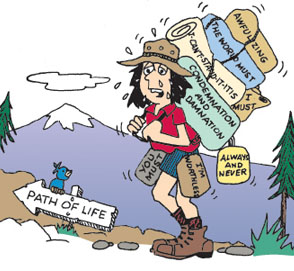
Examining False Core Beliefs


Research has found that a number of core beliefs identified by the psychologist Albert Ellis are consistently linked to self-dislike and depression.  I see these in many young  people today and they go largely unchallenged by adults because many of the adults in their lives are handicapped by the same irrational beliefs.  Below is a list of commonly held false core beliefs.  As an exercise, print this list and have your students circle those that they hold.  You might further discuss scriptural responses that challenge these false beliefs.


  1. I must be loved or approved of by everyone I consider significant.
  2. I must be thoroughly competent and adequate in everything I do.  I should not be satisfied with myself unless I’m the best or excelling.
  3. If something is or may be dangerous or fearsome I must be terribly concerned about it or keep on guard in case it happens.
  4. It is easier to avoid than face life’s difficulties and responsibilities.
  5. It’s bad to think well of oneself.
  6. I can’t be happy unless a certain condition – like success, money, love, approval, or perfect achievement – is met.
  7. I can’t feel worthwhile unless a certain condition if met.
  8. I’m entitled to happiness (or success, health, self-respect, pleasure, love) without having to work for it.
  9. One day when I make it, I’ll have friends and be able to enjoy myself.
  10. Work should be hard and in some way unpleasant.
  11. Joy is only gained through hard work.
  12. I am inadequate.
  13. Worrying insures that I’ll be prepared to face and solve problems.  So the more I worry the better.  (Constant worrying helps prevent future mistakes and problems and gives me extra control.)
  14. Life should be easy.  I can’t enjoy it if there are problems.
  15. The past makes me unhappy.  There’s no way around it.
  16. There’s a perfect solution, and I must find it.
  17. If people disapprove of (reject, criticize, mistreat) me, it means I’m inferior, wrong, or no good.
  18. I’m only as good as the work I do.  If I’m not productive, I’m no good.
  19. If I try hard enough, all people will like me.
  20. If I try hard enough, my future will be happy and trouble free.

Stigma, Identity, and Risk in LGBT Youth


LGBT youth have the same developmental tasks as their heterosexual peers, but they also face additional challenges in learning to manage a stigmatized identity.  This extra burden puts LGBT youth at increased risk for substance abuse and unsafe sexual behaviors and can intensify psychological distress and risk for suicide.

Studies of more recent generations of lesbian and gay youth suggest that the period between becoming aware of same-sex attraction and self-identifying as lesbian or gay is much shorter that in previous generations exposing them to greater potential social stressors at important developmental stages. (see chart below)

Average Age (Years) Event Onset

Behavior/Identity

Earlier Studies*

More Recent Studies**

Males

Females Males

Females

First awareness of same-sex attraction

13

14-16 9

10

First same-sex experience

15 20 13-14

14-15

First self-identified as lesbian or gay

19-21 21-23 14-16

15-16

From “A Providers Introduction to Substance Abuse Treatment for LGBT Individuals” www.samhsa.gov

*Studies of adults who remembered their experiences as children and adolescents

** Studies of adolescents who describe their experiences as they were happening or right after they happened

Although people may be more aware that an adolescent may be gay, they are generally no more tolerant and may even be less accepting of homosexuality in adolescents.  In fact, violence and harassment against LGBT youth appear to be increasing.  For those youth who choose to self-disclose or are found out, coping with this stressful life event is most challenging.  Adolescents at this point in their lives have not developed coping strategies and are more likely than adults to respond poorly to these stressors.  These youth must adapt to living in a hostile environment and learn how to find safety.  Combine this with other intersections such as; race, ethnicity, socio-economic, etc. and you have a kids on the fringe.

So my question is this…

What would an appropriate response from youth ministry look like to the problems LGBT youth face today?

Andrew Marin, founder of the Marin Foundation has been working to build bridges between the LGBT communities and the church.  I have the privilege of calling him my friend and support his work around the world.  If you’re not familiar with the work the Marin Foundation is doing you can visit their website here.

Andrew wrote a book last year entitled, “Love is an Orientation“.  In it he says this,

“We’re not called to posit theories that support our assumptions.  We’re not called to speculate about genetics or developmental experiences or spiritual oppression in faceless groups of other people.  We’re called to build bridges informed by the Scriptures and empowered by the Spirit.  We’re called to let a just God be the judge of his creation.  We’re called to let the Holy Spirit whisper truth into each person’s heart.  And we’re called to show love unconditionally, tangibly, measurably.”

So how do we move into that?  How do we move past our fears and judgements?  What will it take?

A WordPress.com Website.

Up ↑