Search

conversations on the fringe

Category

Criminal Youth

This is your brain on opiates (part 2)


What are Opioids?

Opioids are a powerful class of drug that includes the illicit drug heroin as well as the licit pain relievers, such as; oxycodone, hydrocodone, codeine, morphine, and fentanyl.

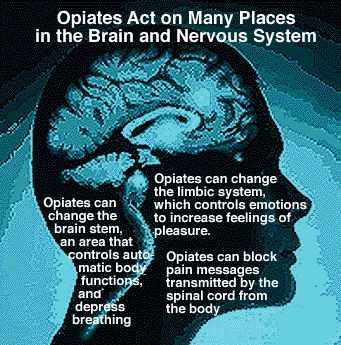
Our brains have natural opioid receptor hardwired within it. Opioid receptors interact with nerve cells in the brain and nervous system, controlling pain and delivering pleasure. Everyone on the planet does this naturally through our endorphin system.
brain3

When we engage in pleasurable activities the brain releases these feel good chemicals (dopamine/serotonin) and we experience them as a reward. These chemicals are the drive behind every habit we have. We will almost always do what that which gives us the greatest pleasure or has the greatest potential for removing pain or discomfort. We are hedonic seeking creatures. It’s why we eat when we’re hungry, have sex when we’re horny, and take medicine when we’re sick.

Our natural endorphin system has three primary functions; stabilize mood, provide energy/motivation, and control pain. All necessary to live a functional, normal life. Opiate dependent individuals ALL report they stopped using heroin and pain pills to get high within months of starting. They report primarily using just to feel normal, just to get up and go to work, take care of the kids, and not be sick.

scienceaddiction3

The Anatomy of an Opiate Addict

When we are prescribed or illicitly take opiates our brains hit the jackpot! Not only does this medication already belong in our systems, it’s much more powerful than the stuff we make naturally. If we take the medication or heroin long enough our brain, being a very efficient organ, will reduce or just stop manufacturing the naturally occurring chemicals and rely on you to provide it via drugs. It’s like the brain lays off all the workers and shuts down the factory.

Opiates are highly addictive because the chemical already belong there. The brain would fight off other foreign chemicals such as cocaine or methamphetamines because it sees them as a threat. But with opiates it just says, “Back that truck up and give me as much as you’ve got!” This is called dependency.

Unfortunately, the longer you use opiates the stronger the neural pathways get that support their use. Consequently, the lesser use natural pathways get weaker and less used neural pathways have a tendency to prune themselves to make room for more frequently used neurons/pathways. The brain, fueled by illicit or licit opiate use creates a superhighway that supports that drug use and he old, natural pathways are like rural back roads that aren’t driven anymore, overgrown and broken down. Even if you tried to take the old rural road it would be hard to traverse because of a lack of use.

So, now an individual is completely dependent on opiates and the brain structure has changed to accommodate this drug use. Paying for daily drugs gets expensive quickly as tolerance to the medication increases. This often leads a moral, kind, good person to do awful things they never imagined doing, such as stealing from grandmother, taking money from their kids piggy banks, selling the family jewelry, or robbing someone using physical force. All just to avoid feeling violently ill. All with the intent to make right as soon as they’re feeling better. But, that never comes. There’s always tomorrow and more sickness. The hole just gets deeper. Add to that the growing sense of shame, guilt, and remorse and you have a desperate, self-loathing person and the perfect antidote for feeling sick and hating yourself…use more drugs. Repeat. Repeat. Repeat.

If a person began using prescription pain medication and developed a dependency, it’s a short jump to heroin. Maintaining a pill addiction is very expensive and heroin is a cheaper, more powerful alternative. Once you use a needle to inject heroin, there’s no going back from there. Your life becomes a hopeless cycle of using drugs, getting high, hustling for money, getting high. Repeat. Repeat. Repeat.

Opiate use now becomes the only way for a person to function as a human. Most of the public lacks this understanding and perpetuates the false belief that if someone really wanted it bad enough they’d just stop using. Science tells us it simply does not work that way.

*In our next post we’ll explore the conditions known as tolerance and withdrawal and why quitting cold-turkey rarely works and can even be dangerous.


New Trainings for 2016


We’re excited to offer two brand new training opportunities for 2016. Both address much needed conversations around important and urgent issues; the opiate overdose epidemic, and the need for cultural intelligence in a rapidly changing world. If you are interested in bringing either of these conversations or any of our other trainings/workshops/community conversations to your area, just email us at cschaffner@fringeconversations.com

Connecting with Marginalized Youth (increasing your CQ)

Do you have a diverse group of kids? Do you want to be more effective in reaching a more diverse cross-section of youth in your community? Do you desire to impact the lives of LGBTQ youth, kids with disabilities, cross racial and ethnic barriers, and get to know those who are strikingly different than you and those in your ministry? Do you desire to increase your cultural intelligence in order to build a bridge across the gap between your church and others? This training focuses on developing and increasing our cultural intelligence (CQ) in order to begin the bridge building process of learning how to love our neighbors that appear to be different that us.

Understanding the Opiate/Heroin Overdose Crisis

According to a government website heroin related overdose deaths have seen a 10-fold increase since 2001. Many of those impacted by this growing trend at adolescents and young adults. Prescription narcotics and heroin have become the drug of choice for youth across all classes, races, and socio-economic ranges. Learn about the impact of opiates on the developing adolescent brain and body as well as how someone becomes addicted to opiates. In this training you will earn how to use a life saving medication called Naloxone, an opiate overdose reversal medication that can save a loved one’s life. This workshop is in partnership with the JOLT Foundation. Visit JOLT Foundation for more information on Naloxone.

Juvenile Justice Ministry: Returning Home After Incarceration


A juvenile offender’s home environment is often not helpful for encouraging adherence to pro-social behaviors. Ministry partners would benefit greatly by seeking to understand the family dynamics of the individual you are trying to impact. Negative family dynamics take many forms. The juvenile offender may be the scapegoat for family problems, making his or her return to the home counterproductive. Also, other family members may be actively using drugs or involved in criminal activities.

Domestic violence and child abuse situations present additional issues, including the personal safety of family members. Training on handling abuse situations, including sign of abuse and mandated reporting laws in each state should be required of all who serve in ministry to youth.

Other areas of support that will require attention are basic needs such as education/vocational support, housing, substance abuse treatment, identity development, financial concerns, and peer social networks.

Youth ministries and the church as a whole are equipped to address all these concerns and more when they are connected to the community, invested in families, and are willing to take Spirit led risks to do ministry outside the box.

What ways have your ministries been creative in meeting the needs of juvenile offenders who are trying to turn their lives around?

Juvenile Justice Ministry: Meeting Them Where They Are


Anyone who has worked with you learned very quickly that unless the young person wants to change they very likely won’t change. At best you might get some shallow compliance with whatever expectations we have for them but the change is not real and is short lived. This awareness is a key factor when working and ministering to juvenile offenders. Our efforts are likely to be ineffective until the individual accepts the need for real transformation to occur.

A juvenile offender’s motivation to participate in programs perceived to be trying to “change” the individual will be seen as not trustworthy and they will be skeptical that our intentions are good. Too often this population is motivated by fear of consequences (i.e., jail, sanction, threats, loss, etc.) and not compelled by grace and love. In reality, both are needed to bring about transformation. It was God’s wrath and subsequent grace that compels us in our own transformation, empowered by the indwelling Spirit.

Motivation for help changes over time, and offenders can often cycle through predictable stages of change during their engagement with our programs. The Stages of Change was developed by Prochaska to describe the various stages of motivation, and includes the following:

  • Precontemplation (unaware of problems – denial)
  • Contemplation (awareness of problems)
  • Preparation (decision point)
  • Action (active behavior change)
  • Maintenance (ongoing preventative behaviors)

Juvenile offenders who are in the precontemplative stage of change have little awareness of the problems they are facing and have little intention of changing their behavior. Awareness of problems grow in later stages often leading to intrinsic motivation to change, However, due to the high rate of recidivism and environmental and pro-criminal influence the young person may not move in a linear manner through the various stages, often returning to an earlier stage before eventually seeing a more permanent change in attitude and behavior.

So what does this mean for us serving juvenile offenders in ministry settings? It means that sometimes our expectations are not realistic for the stage of change that the youth is in. If we were able to recognize their level of motivation and meet them where they’re at we may be able to influence them towards the next stage. Imagine this, on a scale from 0 – 5, zero = criminal behavior and 5 = pro-social/God-honoring behavior, do we not expect the young person to jump from 0 – 5 immediately? How realistic is that? In reality most people change like this, 0 – 1 – 2 – 1 – 2 – 3 – 3 – 2 – 4 – 3 – 4 – 5 – 5 – 5 – 4 – 5 – 5 – 5 – 5…You get the point.

Meeting a young person where they are at means having a long view. It means that for the moment, we may find ourselves tolerating certain attitudes, language, and behaviors until real change can occur. This allows grace to have its way in the heart of the offender.

Take a moment and think of the student you’re working with and try to determine what stage of change they might be in. Now ask yourself if you need to adjust your strategies to meet him/her where they’re at.


Thoughts?

Juvenile Justice Ministry: Evaluating Risk-Factors for Juvenile Offenders


Evaluating your ministries role in addressing recidivism among juvenile offenders is of critical importance to those attempting to reintegrate into the community. Characteristics and environmental factors used to estimate the likelihood of future criminal behavior are called “risk factors”.

Once these risk factors are identified, research leads us to believe that structured and concentrated strategies can help individuals who have offended previously. Researchers have identified several potential interventions based on these following risk factors:

  • Developing and nurturing life management, problem solving, and self-leadership skills
  • Developing networks with or relationships and bonding with pro-social and anti-criminal peers and with pro-social and anti-criminal mentors
  • Enhancing closer family feelings and communication
  • Improving and strengthening positive family systems to promote accountability
  • Managing and changing anti-social thoughts, attitudes, and feelings.

What a tremendous opportunity for the church to step up and be the incarnate Christ to a population of people who are largely discarded as useless and of no value, irredeemable.

What ministries exist in your church that addresses the needs above?

What ministries need to be created to address the above needs?

Juvenile Justice Ministry: Reintegrating Juvenile Offenders


Youth incarcerated in juvenile detention centers are undergoing significant stress related to arrest, the uncertainties of their legal issues, and the potential loss of freedom, trust, respect of family and community, and future dreams. Effective ministry to these individuals should be based on the expected duration of the sentence (30 days vs. 1 year) but should also be focused more on the transition out of incarceration and reintegration back into the community. The better this transition is the greater the likelihood that the youth will not recidivate back into illegal behaviors.

SAMHSA Substance Abuse Treatment for Individuals in the Criminal Justice System identifies the following key factors to consider when helping an individual coming out of incarceration:

 Substance Use

  • Substance use history
  • Motivation for change
  • Treatment history

 Criminal Involvement

  • Criminal thinking tendencies
  • Current offenses
  • Prior charges/convictions
  • Age of first offense
  • Type of offenses (violent vs. non-violent, sexual, etc.)
  • Number of offenses
  • Prior successful completion of probation/parole
  • History of personality disorders (unlikely if under 18 years of age)

 Health

  • Infectious disease (TB, hepatitis, STD, HIV, etc.)
  • Pregnancy
  • General health
  • Acute conditions

 Mental Health

  • Suicidality/History of suicidal behavior
  • Any diagnosis of MH
  • Prior treatment/counseling and outcomes
  • Current/Past medication
  • Symptoms
  • Trauma

 Special Considerations

  • Education level
  • Reading level/Literacy
  • Language/Cultural barriers
  • Disabilities (physical, intellectual, learning, etc.)
  • Housing
  • Family issues
  • History of abuse (victim and/or perpetrator)
  • Other service providers (counselor, probation officer, social worker, etc.)

 This is a long list of issues that require attention. Remember, you are not alone in service this youth. Partner with others that are investing as well. Establish open communication between you and the others so you do not unintentionally work against each other. Have the other providers come do trainings for you and your staff so that you can better understand the complexities involved in serving juvenile offenders. The more you can work together with the community the greater the odds are that your youth will overcome the obstacles they are facing.

 What are ways you have partnered with individuals attempting to reintegrate after returning from incarceration?

 Are there special considerations for juvenile offenders vs. young adults?

 How have you been successful in engaging resistant families?

Juvenile Justice Ministry: Restoration of Criminal Youth


mental-health-youth-1-460x250Shame and stigma are difficult barriers for juvenile offenders to rise above after an arrest or in making the transition between incarceration and the community. Some of those barriers are juvenile peers that have pro-criminal attitudes and reinforce the criminal behavior/thinking as well as there being no clear pathway from juvenile criminal behavior to responsible, pro-social behaviors as an adult.

One effective approach to rising above this stigma involves encouraging ex-offenders to become active as a volunteer in support of community activities. Providing an opportunity for individuals to make a positive contribution to the community – to “give back” – may reduce feelings of alienation and build empathy and positive self-regard, paving the way to a life that has been restored.

If you serve in ministry, there are youth all around you that are engaged in criminal behaviors. Regardless of the reasons for their behaviors, we are called to “put on the flesh of Christ” and pursue them.

How might your ministry create opportunities that could lead to restoration for these youth between themselves, their communities, and God?

A WordPress.com Website.

Up ↑