Search

conversations on the fringe

Category

Adolescent Development

The Importance Of Harmonious Peer Relationship


Just how important is it for human beings to establish and maintain harmonious relationships with their peers?  Apparently it is very important.  One recent review of more than 30 studies revealed that youngsters who had been rejected by their peers during grade school are much more likely that those who had enjoyed good peer relations to drop out of school, to become involved in delinquent or criminal activities, and to display serious psychological difficulties later in adolescence and young adulthood. (Parker & Asher, 1987; see also Kupersmidt & Coie, 1990)  So merely having contact with peer associates is not enough to ensure normal developmental outcomes; getting along with peers in important too.

How can we measure children’s peer acceptance and identify those youth who are at risk of experiencing adverse outcomes later in life?  Researchers generally rely on sociometric techniques. In a sociometric survey each child in a peer group might be asked to name several peers whom she likes and several whom she dislikes; or, alternatively, each child might be asked to rate all peer-group members in terms of their desirability as companions.  By analyzing the choices that kids make, it is usually possible to classify each group member into one of the following categories: (1) popular children (those liked by most peers and rejected by few), (2) amiables, or “accepteds” (those who are chosen less frequently than “populars” but who receive a clear preponderance of positive nominations), (3) neglectees (children who are rarely nominated as liked or disliked and who seem almost invisible to peers), and (4) rejectees (those who are disliked by many peers and accepted by few).*  And it seems that rejected children fall in roughly equal numbers into two distinct subcategories: those who are highly and inappropriately aggressive (aggressive rejectees) and others who are anxious, low in self-esteem, and inclined to withdraw from peer contacts (nonaggressive rejectees) (Boivin & Begin, 1989, French, 1988).

Notice that both neglectees and rejectees are low in peer acceptance.  Yet it is not nearly as bad to be ignored by one’s peers as to be rejected by them.  Neglectees do not feel as lonely as rejectees do (Asher & Wheeler, 1985), and they are much more likely than rejected children to eventually become accepted or even popular should they enter a new class or new peer group (Coie & Dodge, 1983).  In addition, it is the rejected child, particularly the aggressive rejectee, who faces the greater risk of displaying deviant, antisocial behavior or other serious adjustment problems later in life (Asher & Coie, 1990; Kupersmidt & Coie, 1990; Roff, 1974).

All of this underlies the importance of community.  Not psuedo-community but genuine community.  See, Jesus came to bring reconciliation.  He came to bring it to those who have been rejected and neglected.  His chief aim was to reconcile them first to Himself and then to community with others.  This is why we, as God’s people, must actively seek out relationships with those marginalized.  It is because of God’s original design for community that this is how He choses to be known, through relationships.

We have the task of redefining what is “acceptable” or the “norm” and what is “valuable” when it comes to relational capital.  Those factors, such as; attractiveness, economic status, and position do not determine placement in God’s relational economy.  We must fight against adopting the worlds class system and embrace those who have been cast off as not having value because it is what God did with us.  Our families and ministries should reflect God’s heart for all of mankind.  If it doesn’t then we’ve missed the mark.

Basic Brain Function and Emotional Hijacking


Understanding a few basics of what is happening in the brain of an adolescent prior to an impulsive and destructive behavior (i.e., self-injury, fighting, etc.) will help you walk through the lies, negative thoughts, and emotions that often drive these behaviors.

The goal is to teach them when they are being hooked by lies from the enemy, self-doubt, and old negative patterns of behaviors and thought so they can step back, get centered, and make life-giving choices instead of life-stealing choices.  Choices that honor God and support their value as created beings.

The brain is divided into three major areas:

  1. The Cerebral Cortex
  2. The Limbic System, and
  3. The Brainstem
  • The Cerebral Cortex is out thinking brain.  It is the part of the brain that surrounds the Limbic System and fills the upper part of the skull.  The Cerebral Cortex helps us to reason, reflect on our experiences and consider various options for responding.  This part of the brain enables us to put words to our feelings, to settle ourselves when we are upset, and to make intentional choices.
  • The Limbic System is our feeling brain.  It surrounds the brain stem, and is the primary center for storage and processing of emotional memory.  It is the key player in the triggering of the brain’s alarm system (fight or flight) when we perceive threat or danger.  It is a place of no words, no thoughts.
  • The Brainstem is the automatic brain.  It surrounds the top of the spinal cord and is responsible for regulating basic life functions such as breathing and heartbeat.  It regulates functions you don’t have to think about to make happen.  It does it automatically.
  • The Alarm Mechanism of the Limbic System is said to be sloppy.  What this means is that when we are in a situation that we think is dangerous or threatening, we respond emotionally first, before we are aware of what we are responding to.
  • An Emotional Hijacking occurs when the Limbic System’s quick alarm system short-circuits the Cerebral Cortex’s ability to more thoroughly process the situation.

This emotional hijacking can sometime be adaptive or helpful.  For example, imagine that you are walking down a deserted street at night, and a large dog jumps out from between two buildings, starts to snarl and bark, and begins to run toward you.  If you were to pause, think about the situation, and consider alternatives, you might get eaten.  Instead, this event sets off a full-body hormonal response that bypasses the thinking part of the brain and is experienced physically as overwhelming and possibly uncontrollable fear.  Before we are aware of it, our Limbic System signals our brainstem to increase breathing and heart rate, and we are primed to fight or flight.

Emotional hijacking can be destructive; however, when the Limbic System’s short-circuiting of the thinking brain occurs in situations in which it is not helpful or adaptive for the Cerebral Cortex to shut down.  For example, imagine that your student is with a group of friends, and somebody says something to him/her that is hurtful or mean.  This experience brings on an immediate and painful escalation of negative emotions – shame, fear, embarrassment and anger.  They are not able to pause, think things through, and act or speak in a positive manner.  They literally can’t think straight.  Instead, he/she either lashes out in anger (fight), which results in greater escalation, or they shut down (flight), and tell themselves that they are “no good,” “a loser,” or that “nothing ever works out” for them.  In either case, your student may feel hooked, or taken over by the negative thoughts and emotions, and later, in an attempt to make those feelings go away; engage in a negative and destructive behavior.  This process often happens so quickly that when it does happen it seems like they are on autopilot.  When internal reactions result in repeating old unhealthy and ineffective patterns of speech and behavior, this is known as emotional hijacking.

Fortunately their brains have a tremendous capacity to change, to reorganize and restructure neural connections over the entire lifespan.  In order to restructure negative neural connections, they need to learn how to step back (Galatians. 5:23) and settle themselves a bit before acting or speaking (Psalm 34:13, 1 Peter 3:10) when they become overwhelmed with painful emotions and the quick alarm mechanism of the Limbic System.

In terms of brain operation, this literally gives the thinking brain a chance to catch up with the alarm signals of the feeling brain, to make a more thorough analysis of the present situation and avoid an emotional hijacking that results in repeating old habitual behaviors.

The practices of prayer and meditation enables young people to break their old emotional habits and replaces them with more thoughtful and effective ways of thinking (Romans 12:2).  These practices allow the old brain circuits conditioned by fear to die out as we help replace them with new neural circuits created by God’s word and the Spirit’s activity in their lives.

How does this help us better understand adolescent behavior?

What implications do this have on how we practice youth ministry?

Are there times when we are inadvertantly reinforcing our students negative emotions, behaviors, and stories?

Examining False Core Beliefs


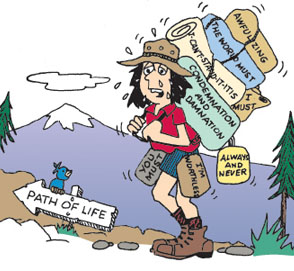
Research has found that a number of core beliefs identified by the psychologist Albert Ellis are consistently linked to self-dislike and depression.  I see these in many young  people today and they go largely unchallenged by adults because many of the adults in their lives are handicapped by the same irrational beliefs.  Below is a list of commonly held false core beliefs.  As an exercise, print this list and have your students circle those that they hold.  You might further discuss scriptural responses that challenge these false beliefs.


  1. I must be loved or approved of by everyone I consider significant.
  2. I must be thoroughly competent and adequate in everything I do.  I should not be satisfied with myself unless I’m the best or excelling.
  3. If something is or may be dangerous or fearsome I must be terribly concerned about it or keep on guard in case it happens.
  4. It is easier to avoid than face life’s difficulties and responsibilities.
  5. It’s bad to think well of oneself.
  6. I can’t be happy unless a certain condition – like success, money, love, approval, or perfect achievement – is met.
  7. I can’t feel worthwhile unless a certain condition if met.
  8. I’m entitled to happiness (or success, health, self-respect, pleasure, love) without having to work for it.
  9. One day when I make it, I’ll have friends and be able to enjoy myself.
  10. Work should be hard and in some way unpleasant.
  11. Joy is only gained through hard work.
  12. I am inadequate.
  13. Worrying insures that I’ll be prepared to face and solve problems.  So the more I worry the better.  (Constant worrying helps prevent future mistakes and problems and gives me extra control.)
  14. Life should be easy.  I can’t enjoy it if there are problems.
  15. The past makes me unhappy.  There’s no way around it.
  16. There’s a perfect solution, and I must find it.
  17. If people disapprove of (reject, criticize, mistreat) me, it means I’m inferior, wrong, or no good.
  18. I’m only as good as the work I do.  If I’m not productive, I’m no good.
  19. If I try hard enough, all people will like me.
  20. If I try hard enough, my future will be happy and trouble free.

Ten Strategies for Working with Boys


Research from Nancy Bayley’s at UCLA showed that for boys more than girls there is indeed a direct link to learning difficulties when early childhood touch and attachment doesn’t occur or occurs inconsistently.  In her study, boys who experienced insecure attachment as infants tested out lower in adolescent intellectual skills than girls who did not receive secure attachment.  Although girls can end up with severe problems or diseases, the effect of lack of early attachment is harsher on the learning brains” of boys.  This does not negate the vulnerability of girl but only highlights the vulnerability of boys.

In all this, the bottom line is, often we receive damaged goods into our care.  Michael Gurian, of the Gurian Institute has developed in conjunction with Pat Crum, the director of the Family Nurturing Center of Michigan ten key strategies to promote attachment in boys, which in turn enables an adolescent male to master necessary life skills.

  1. Bursts of Attention – Offer at least five long bursts – many minutes at a time – and many shorter, intermittent periods of undivided attention throughout every day.
  2. Lots of Affirmation – Notice and support the young boy’s efforts and accomplishments verbally and, when appropriate, with other rewards, including physical hugs.
  3. Verbal Mirroring – Describe in words back to the boy what he is doing, “I like how you just put that book back on the shelf.”
  4. Physical Play – Because play is organic learning time for the body and brain, engage in play with boys a number of times per day.
  5. Leadership – In work and play relationships, let boys take the lead as much as you lead him.
  6. Enthusiasm – Infuse your interaction with joy, enthusiasm, and the pleasure of being together.  Find things to do that inspire him and provide an outlet for his often untamed passion.
  7. Predictability – Provide consistent, predictable structure and clear limits.
  8. Self-Management – Implement behavior management strategies that are based on the boy’s developmental stage.  Many adolescent males have not yet developed their cognitive processes that guide decision making.  Understanding this prevents unrealistic expectations.
  9. Choice-Making – Teach boys to make acceptable decisions.  Making the right choice builds that crucial learning center in the brain – the frontal lobe.  Do as little “for” the boy as you can, making him do as much for himself as he can.
  10. Appropriate Discipline – Avoid behavior management strategies designed to frighten boys into right behavior.  If punitive threat worked there would be no repeat offenders in our jails today.  And, often, all that a boy learns from punishment is that he’s a failure.  Identifying his reward system (what motivates him) is a better approach to making lasting change in behavior.

While this is pretty straight forward behavioral stuff there’s a lot of value in the above ten suggestions.  While they are based in science they do not take into account the activity of the Holy Spirit dwelling inside our boys.  This doe not mean they are contradictory, it does mean that there is a variable that we can’t predict or control.  We must add one more important strategy to this list for us to maintain fidelity to our calling; teaching boys to discern the leadings of the Spirit.

If we do all of the above our boys will pray, play and obey in a way that makes a lasting difference in their lives, in our lives, and in the world that they live in.

To Be A Boy


When I pause and watch the teenage age boys in our community, and when I reflect on my own adolescent experience, I begin to understand the struggle that every boy confronts in his efforts to navigate adolescence.  He is faced with a complex set of internal demands: sexual drives, longing to give and receive love, the drive to prove his masculinity – and through it all he doesn’t want to get hurt or rejected.  This is a daunting emotional challenge, because each of these internal demands involves difficult obstacles and consequences if handled wrong.

Boys yearn for emotional connections, but they are allowed very little practice at it.  Most have spent a majority of their free time engaged in competitive games, trying to “man up” and prove themselves superior.  I still see constant teasing and “bashing” during their regular interactions.  As they get older, often the consumption of alcohol allows them a psuedo-sense of emotional connection.

Boys also long for an intimate connection between themselves and girls but developmentally lack the emotional language to connect in a meaningful way.  They often lack the ability to pick up on emotional cue and other non-verbal communications such as facial expressions or body-language.  This impedes their ability to empathetically connect with members of the opposite sex and since modern culture doesn’t encourage boys to cultivate empathy, they misread social and sexual cues from the girls.  This is obviously reiterated in the statement I hear regularly from these boys, “I just don’t understand girls”.  The natural follow statement to that is, “Screw it, let’s just go shoot hoops”, and they remain aloof, never learning to untangle the emotional ball of string they are presented with.

Whether boys become kind, devoted lovers and sexual partners, or heartless and exploitative, depends on the boy, his early experiences with gender roles, his social environment, the kind of “script” that is written for him by his family, peers, and the culture in which he lives.  From his earliest gender experiences, and the adolescent stirrings of lust and curiosity, a boy develops his own sense of what relationships and sexuality are all about.

Reference: Raising Cain by Dan Kindlon Ph.D & Michael Thompson Ph.D

We all play a role in shaping our young men and women.  If you don’t like what you see today we must first accept partial, if not total, responsibility for systematically abandoning them.  We have, in many cases, left them to figure out the adolescent journey by themselves. 

Here are some questions to wrestle with your teams/families.  How you answer them has potential consequences for the youth in your care.

  • Are there older men and women in your church that seek out young people, outside of  “programs”?
  • Are the youth in your community left to fend for themselves the other six days of the week?
  • Do you mainly use other young adults, often not much older than the youth themselves, to provide a majority of spiritual and life guidance?  What are the pro’s and con’s of doing this?
  • Has your pastor lifted up the value of the older generations pouring themselves into the younger generations?  Why or why not?
  • How does your church culture reinforce positive/negative gender stereotypes?
  • Is sexuality openly discussed in your current faith context?  Why or why not?
  • Does how you handle “sex and sexuality” in your church impact young people’s sexual behaviors?  How?

Stigma, Identity, and Risk in LGBT Youth


LGBT youth have the same developmental tasks as their heterosexual peers, but they also face additional challenges in learning to manage a stigmatized identity.  This extra burden puts LGBT youth at increased risk for substance abuse and unsafe sexual behaviors and can intensify psychological distress and risk for suicide.

Studies of more recent generations of lesbian and gay youth suggest that the period between becoming aware of same-sex attraction and self-identifying as lesbian or gay is much shorter that in previous generations exposing them to greater potential social stressors at important developmental stages. (see chart below)

Average Age (Years) Event Onset

Behavior/Identity

Earlier Studies*

More Recent Studies**

Males

Females Males

Females

First awareness of same-sex attraction

13

14-16 9

10

First same-sex experience

15 20 13-14

14-15

First self-identified as lesbian or gay

19-21 21-23 14-16

15-16

From “A Providers Introduction to Substance Abuse Treatment for LGBT Individuals” www.samhsa.gov

*Studies of adults who remembered their experiences as children and adolescents

** Studies of adolescents who describe their experiences as they were happening or right after they happened

Although people may be more aware that an adolescent may be gay, they are generally no more tolerant and may even be less accepting of homosexuality in adolescents.  In fact, violence and harassment against LGBT youth appear to be increasing.  For those youth who choose to self-disclose or are found out, coping with this stressful life event is most challenging.  Adolescents at this point in their lives have not developed coping strategies and are more likely than adults to respond poorly to these stressors.  These youth must adapt to living in a hostile environment and learn how to find safety.  Combine this with other intersections such as; race, ethnicity, socio-economic, etc. and you have a kids on the fringe.

So my question is this…

What would an appropriate response from youth ministry look like to the problems LGBT youth face today?

Andrew Marin, founder of the Marin Foundation has been working to build bridges between the LGBT communities and the church.  I have the privilege of calling him my friend and support his work around the world.  If you’re not familiar with the work the Marin Foundation is doing you can visit their website here.

Andrew wrote a book last year entitled, “Love is an Orientation“.  In it he says this,

“We’re not called to posit theories that support our assumptions.  We’re not called to speculate about genetics or developmental experiences or spiritual oppression in faceless groups of other people.  We’re called to build bridges informed by the Scriptures and empowered by the Spirit.  We’re called to let a just God be the judge of his creation.  We’re called to let the Holy Spirit whisper truth into each person’s heart.  And we’re called to show love unconditionally, tangibly, measurably.”

So how do we move into that?  How do we move past our fears and judgements?  What will it take?

Roles Of Children In Dysfunctional Families


When we think of a DYSFUNCTIONAL FAMILY it’s like a machine which is run by gears with weak or cracked cogs. As one cog breaks it puts more stress on the other cogs of that gear and then on other cogs of other gears. Eventually the whole machine shuts down. DYSFUNCTION means just that: unable to FUNCTION properly. Each individual in a family is like a gear and each perceived responsibility is like the cog. The main or original DYSFUNCTIONAL person may show their DYSFUNCTION in many ways: they may have difficulty coping, may yell, rage, isolate, verbally abuse, physically abuse, chemically abuse, gamble, cheat on their partner, threaten to leave, threaten suicide, give the silent treatment etc. This causes everyone to walk on eggshells and lots of CRAZY MAKING goes on.

The grown-ups or parent figures assume two roles: DYSFUNCTIONAL PERSON and the other plays the ENABLER. You decide which applies to your situation. In some cases the mother may be the DYSFUNCTIONAL PERSON and father the ENABLER and visa versa in other cases. Both roles play off each other. The DYSFUNCTIONAL PERSON is trapped in self delusion. They actually believe that they are justified in what they do and how they act. They have very distorted thinking. They seem to find ways to strengthen their own credibility and weaken everyone else’s in the family. Therefore, if anyone were to tell someone outside the family who the DYSFUNCTIONAL PERSON really was, many people would not really believe them because of the way they present themselves to the public.

The ENABLER also has distorted thinking and believes that they are basically responsible for the other person’s DYSFUNCTION. And they are therefore very fixated on the other person and often times appear to be uncaring or neglectful toward their children. But this person has only so much energy to go around and most of it goes toward the “squeakiest wheel,” the DYSFUNCTIONAL PERSON.

The children in the family may play more than one role at a time or only one. Each role gives the child their basic identity and shapes their script and future. The role also gives them their sense of worth and value. So they too get trapped in their roles and also develop distorted thought patterning. This is how the tapes, to be carried through life, about who we are and who we will become, begin to develop. Each role carries some aspect about the DYSFUNCTION of the whole family.

The following suggestions are for dealing with some of the typical behaviors of children from dysfunctional families.

A. “The Hero” is……always volunteering, very responsible and manifests a drive, almost a compulsion, to be on top. These students have an insatiable need for attention and approval and are often class leaders who are parental or bossy in their relationships with other peers. They tend to be very disappointed when losing, superior or snobbish when winning, and are frequently labeled “teacher’s pet” by other students.

Recommended adult behaviors:

1. Give attention at times when the student is not achieving.
2. Validate the student’s intrinsic worth, and try to separate his or her feelings or self-worth from achievements.
3. Let the student know it’s OK to make a mistake.

Adult behaviors to avoid:

1. Letting the student monopolize conversations or always be the first to answer a question or to volunteer.
2. Letting the student validate his or her self-worth by achieving.

B. “The Scapegoat”……tends to blame others, makes strong peer alliances, and is often disciplined by teachers or other adults for breaking rules. The rebel tends to talk back, neglects work, and can be very frustrating to work with. The typical adult comments are “I don’t know what to do with that kid,” or “I’ve tried everything!”

Recommended adult behaviors:

1. Let the student know when the behavior is inappropriate.
2. Give the student strokes whenever he or she takes responsibility for something.
3. Attempt to develop empathy for the student. This prevents adults from being angry or getting defensive.
4. Set limits. Give clear explanations of the student’s responsibilities and clear choices and consequences.

Adult Behaviors to avoid:

1. Feeling sorry for the student.
2. Treating the student as special and giving him/her more power.
3. Agreeing with the student’s complaints about other students or other adults.
4. Taking the student’s behavior personally or as a sign of one’s own incompetence as a teacher, counselor, pastor, volunteer, etc.

C. “The Mascot”……

tends to be funny or distracting and gets attention frequently. This student likes to hide, make faces, pull the chair out from someone else, stick chalk in the erasers and otherwise act out.

Recommended adult behaviors:

1. It’s OK to get appropriately angry at the “class clown’s” behavior.
2. Try to give the student a job in the class with some importance and responsibility.
3. Hold him/her accountable.
4. Encourage responsible behavior.
5. Encourage appropriate sense of humor.
6. Insist on eye contact.

Adult behaviors to avoid:

1. Do not try to “laugh with” the clown. He/she will not understand it.
2. Remember the class clown’s underlying fear.
3. Remember the underlying depression this behavior often masks.

D. “The Lost Child”……

often gets lost in the shuffle. Adults sometimes can’t remember the student’s name because he/she is so quiet and is seldom a behavior problem. These students tend to have few, if any, friends and like to work alone in group settings, often in very creative though non-verbal ways. Other students either leave them alone or tend to tease them about never getting involved.

Recommended adult behaviors:

1. Every adult should take an inventory. If there are names that you consistently cannot remember, that may be a lonely or lost student.
2. Try to pick on their personal interests and often they will begin to talk.
3. Try some contact on a one-to-one basis. Find out who they are!
4. Point out and encourage the student’s strengths, talents and creativity.
5. Use touch slowly.
6. Help the student to be in a relationship. There will usually be one student they are drawn to in the class.
7. Encourage working in small groups, two’s and three’s, to build trust and confidence.

Adult behaviors to avoid:

1. Do not let the student off the hook by allowing him/her to remain silent or never calling on them.
2. Do not let other kids take care of the student by talking or answering for him/her.

E. “The Caretaker”……

tends to focus on helping other people feel better. They are motherly in their relationships to other students. This is usually a “liked” child by friends and adults. This student’s sensitivity is noticeable.

Recommended adult behaviors:

1. Assist the student on focusing on him/herself.
2. Ask the student to identify their desires for themselves.
3. Help this kids learn to play.
4. When they are assisting another, ask them to identify how they are feeling about the other’s pain.
5. Validate the student’s intrinsic worth, separating their worth from their care-taking.

Adult behaviors to avoid:

1. Calling on these students to focus on another’s emotional pain.

sources:

http://www.thechildrensplaceprogram.org

http://www.samhsa.org


Bullying: Everyone Plays A Role


Most of the time when we think of bullying we only see two parties as being involved; the bully and the bullied.  Olweus theory suggests that everyone plays a role in bullying.  If this is true then to combat bullying would require a collaborative effort by all parties.  Below is a diagram of the various parties involved in bullying.

After seeing this chart I began noticing the specific roles in the youth in our community.  Bullying is a systemic problem that requires a well thought out approach if we are going to quell this dangerous behavior and it’s consequences.  Below is Olweus’s components for addressing bullying in our communities.

Our churches and ministries can and should take the lead in confronting this behavior and implementing a plan of action to address bullying.

What might it say should a church take the lead in this fight?

What does this communicate to our kids when a community fights for their safety?

How does this impact an adolescents search for identity and autonomy?

Parents In Denial About Sexually Active Children


In an article from PsychCentral a new study from North Carolina State University shows that many parents think that their children aren’t interested in sex — but that everyone else’s kids are.

The article suggests that many parents have certain beliefs about adolescent sexual behavior that may be, albeit unintentionally, reinforcing certain stereotypes that shape the sexual behavior of their kids.

You can read the full article here.

We want to know more about the stereotypes you hold about teen sexual behavior.  What are the beliefs you have and how did you develop them?  We also want to know if you think they contribute to adolescent sexual behaviors?

A WordPress.com Website.

Up ↑