Search

conversations on the fringe

Category

Adolescent Development

A Look into the Crystal Ball of Youth Ministry


crystal ball

I work in the clinical world and often can’t help but wonder if the changes we are seeing in treating adolescents are parallel to what is happening in youth ministry as well.  I know it is audacious to think I have any more or a crystal ball that anyone else, but here’s my two cents regarding the future of youth ministry.

As I see more and more adolescents in our offices presenting with significantly more acute distress I am immediately concerned at how overwhelmed youth workers will be when and if they bother to show up at their church door.  Long gone are the days when you could single out the one or two problems kids had and walk alongside them as the work it out.  We are seeing more young people with co-occurring disorders, meaning they are presenting with any of the following in combination; substance use disorders, mood disorders, criminal or legal difficulties, family system breakdowns, and higher levels of stress that youth have historically been accustomed to.

What will this mean for how we train the youth workers of the future?  What kind of supervision will they need?  Will they all need to grow in competencies not typical to youth ministry, such as criminal justice, advanced counseling, developmental psychology or a host of other disciplines?  How will they increase their support network with others in the community?  Who do those in the support network need to be?

We will see significant change over the next ten years in youth culture.  I suggest developing competencies in the following areas:

  1.  Adolescent Culture:  We are and will likely continue to be a youth-focused nation and products and marketing will continue to grow in these areas.  We would serve our kids better if we understood how consumerism impacts their beliefs and views of the world, as well as their place in it.
  2. Adolescent Development:  We are learning new information at a break-neck pace about the human body and brain.  How that will impact our ministry practices has yet to be determined but it undoubtedly will.
  3. Criminal Justice:  In increasing number of youth (urban, suburban, and non-urban) are finding themselves in legal trouble that could create significant barriers to entering adulthood intact.  We could better serve our youth by developing partnerships with probation, courts, police departments, etc.  What if the church was the first place these entities turn to when a kid breaks from the social norms?
  4. Technology:  There will be an ever increasing focusing on technology as a means of reaching and staying connected to youth in our communities but also around the world.  The internet makes the world small.  For volunteers technology increases access to advanced training opportunities to be better equipped to help our students.
  5. Minorities:  With the changing face of America it is imperative that we grow in our cultural intelligences.  There will be a need for more culturally relevant and culturally sensitive expressions of Christian ministry.
  6. Families:  We’ve already begun to see a trend of moving to a family oriented expression of ministry.  This is a positive trend and I pray it continues.  It’s hard to remove a single part from its whole and try to impact it outside of it’s natural ecology.  Family ministry is necessary for the future of our churches.

 This is not an exhaustive list by any means.  Every crystal ball is foggy at best.  What are other trends you believe will need to be addressed to ensure the viability of youth ministry in the next ten years?

Jesus vs. Schemas (pt. 1 of 2)


Schemas — What They Are

A schema is an extremely stable, enduring negative pattern that develops during childhood or adolescence and is elaborated throughout an individual’s life. We view the world through our schemas.  When one does not learn a healthy theology and understanding of who they are in Christ, these schemas take root where theology should live.

Schemas are important beliefs and feelings about oneself and the environment which the individual accepts without question. They are self-perpetuating, and are very resistant to change. For instance, children who develop a schema that they are incompetent rarely challenge this belief, even as adults. The schema usually does not go away without therapy. Overwhelming success in people’s lives is often still not enough to change the schema. The schema fights for its own survival, and, usually, quite successfully.

It’s also important to mention the importance of needs in schema formation and perpetuation. Schemas are formed when needs are not met during childhood and then the schema prevents similar needs from being fulfilled in adulthood. For instance a child whose need for secure attachments is not fulfilled by his parents may go for many years in later life without secure relationships while seeking maladaptive ways (often sinful but functional) to satisfy his or her longings.

Even though schemas persist once they are formed, they are not always in our awareness. Usually they operate in subtle ways, out of our awareness. However, when a schema erupts or is triggered by events, our thoughts and feelings are dominated by these schemas. It is at these moments that people tend to experience extreme negative emotions and have dysfunctional thoughts.

There are eighteen specific schemas. Most individuals have at least two or three of these schemas, and often more. A brief description of each of these schemas is provided below.

Emotional Deprivation

This schema refers to the belief that one’s primary emotional needs will never be met by others. These needs can be described in three categories: Nurturance—needs for affection, closeness and love; Empathy—needs to be listened to and understood; Protection—needs for advice, guidance and direction. Generally parents are cold or removed and don’t adequately care for the child in ways that would adequately meet the above needs.

Abandonment/Instability

This schema refers to the expectation that one will soon lose anyone with whom an emotional attachment is formed. The person believes that, one way or another, close relationships will end eminently. As children, these individuals may have experienced the divorce or death of parents. This schema can also arise when parents have been inconsistent in attending to the child’s needs; for instance, there may have been frequent occasions on which the child was left alone or unattended to for extended periods.

Mistrust/Abuse

This schema refers to the expectation that others will intentionally take advantage in some way. People with this schema expect others to hurt, cheat, or put them down. They often think in terms of attacking first or getting revenge afterwards. In childhood, these individuals were often abused or treated unfairly by parents, siblings, or peers.

Social Isolation/Alienation

This schema refers to the belief that one is isolated from the world, different from other people, and/or not part of any community. This belief is usually caused by early experiences in which children see that either they, or their families, are different from other people.

Defectiveness/Shame

This schema refers to the belief that one is internally flawed, and that, if others get close, they will realize this and withdraw from the relationship. This feeling of being flawed and inadequate often leads to a strong sense of shame. Generally parents were very critical of their children and made them feel as if they were not worthy of being loved.

Failure

This schema refers to the belief that one is incapable of performing as well as one’s peers in areas such as career, school or sports. These individuals may feel stupid, inept or untalented. People with this schema often do not try to achieve because they believe that they will fail. This schema may develop if children are put down and treated as if they are a failure in school and other spheres of accomplishment. Usually the parents did not give enough support, discipline, and encouragement for the child to persist and succeed in areas of achievement, such as schoolwork or sport.

Dependence/Incompetence

This schema refers to the belief that one is not capable of handling day-to-day responsibilities competently and independently. People with this schema often rely on others excessively for help in areas such as decision-making and initiating new tasks. Generally, parents did not encourage these children to act independently and develop confidence in their ability to take care of themselves.

Vulnerability to Harm and Illness

This schema refers to the belief that one is always on the verge of experiencing a major catastrophe (financial, natural, medical, criminal, etc.). It may lead to taking excessive precautions to protect oneself. Usually there was an extremely fearful parent who passed on the idea that the world is a dangerous place.

Enmeshment/Undeveloped Self

This schema refers to a pattern in which you experience too much emotional involvement with others – usually parents or romantic partners. It may also include the sense that one has too little individual identity or inner direction, causing a feeling of emptiness or of floundering. This schema is often brought on by parents who are so controlling, abusive, or so overprotective that the child is discouraged from developing a separate sense of self.

Subjugation

This schema refers to the belief that one must submit to the control of others in order to avoid negative consequences. Often these individuals fear that, unless they submit, others will get angry or reject them. Individuals who subjugate ignore their own desires and feelings. In childhood there was generally a very controlling parent.

Self-Sacrifice

This schema refers to the excessive sacrifice of one’s own needs in order to help others. When these individuals pay attention to their own needs, they often feel guilty. To avoid this guilt, they put others’ needs ahead of their own. Often individuals who self-sacrifice gain a feeling of increased self-esteem or a sense of meaning from helping others. In childhood the person may have been made to feel overly responsible for the well being of one or both parents.

Emotional Inhibition

This schema refers to the belief that you must suppress spontaneous emotions and impulses, especially anger, because any expression of feelings would harm others or lead to loss of self-esteem, embarrassment, retaliation or abandonment. You may lack spontaneity, or be viewed as uptight. This schema is often brought on by parents who discourage the expression of feelings.

Unrelenting Standards/Hypercriticalness

This schema refers to the belief that whatever you do is not good enough, that you must always strive harder. The motivation for this belief is the desire to meet extremely high internal demands for competence, usually to avoid internal criticism. People with this schema show impairments in important life areas, such as health, pleasure or self-esteem. Usually these individuals’ parents were never satisfied and gave their children love that was conditional on outstanding achievement.

Entitlement/Grandiosity

This schema refers to the belief that you should be able to do, say, or have whatever you want immediately regardless of whether that hurts others or seems reasonable to them. You are not interested in what other people need, nor are you aware of the long-term costs to you of alienating others. Parents who overindulge their children and who do not set limits about what is socially appropriate may foster the development of this schema. Alternatively, some children develop this schema to compensate for feelings of emotional deprivation or defectiveness.

Insufficient Self-Control/Self-Discipline

This schema refers to the inability to tolerate any frustration in reaching one’s goals, as well as an inability to restrain expression of one’s impulses or feelings. When lack of self-control is extreme, criminal or addictive behavior rule your life. Parents who did not model self-control, or who did not adequately discipline their children, may predispose them to have this schema as adults.

Approval-Seeking/Recognition-Seeking

This schema refers to the placing of too much emphasis on gaining the approval and recognition of others at the expense of one’s genuine needs and sense of self. It can also include excessive emphasis on status and appearance as a means of gaining recognition and approval. individuals with this schema are generally extremely sensitive to rejections by others and try hard to fit in. Usually they did not have their needs for unconditional love and acceptance met by their parents in their early years.

Negativity/Pessimism

This schema refers to a pervasive pattern of focusing on the negative aspects of life while minimizing the positive aspects. Individuals with this schema are unable to enjoy things that are going well in their lives because they are so concerned with negative details or potential future problems. They worry about possible failures no matter how well things are going for them. Usually these individuals had a parent who worried excessively.

Punitiveness

This schema refers to the belief that people deserve to be harshly punished for making mistakes. People with this schema are critical and unforgiving of both themselves and others. They tend to be angry about imperfect behaviors much of the time. In childhood these individuals usually had at least one parent who put too much emphasis on performance and had a punitive style of controlling behavior.

—————————————————————————————————————————

There are two primary schema operations: Schema healing and schema perpetuation. All thoughts, behaviors and feelings may be seen as being part of one of these operations. Either they perpetuate the schema or they heal the schema. We will explore both in part 2.

UPDATE: Being Good News to LGBTQ Students 2016


The plight of LGBTQ youth has been a growing passion for CotF over the last several years. As we continue to look deeper into what it means to be a gay youth we are regularly surprised by the vilification of these adolescents by the church and the exploitation of them by the world. CotF is committed to pulling back the curtain in LGBTQ youth related issues, to bring an end to the continued marginalization of this potentially vulnerable group of beloved youth.

*This is an update on a previous post that challenges the church to consider whether it is actually Good News or contributes to the further victimization of LGBTQ youth.

Adolescence is a time of significant physical and psychosocial development.  As youth develop, they are typically informed by and supported by their peers.  Experimentation, exploration, and risk characterize adolescence, and many engage in high-risk behaviors during this time.  Beyond the impulsive, risk-taking nature of adolescents their budding identity is being shaped as well.  This is often a difficult and exciting time of exploration but can be even more difficult for a self-identified LGBTQ (Lesbian, Gay, Bisexual, Transgendered, Questioning) adolescent.  While all teens are at risk to some degree, LGBTQ students are at a higher risk by the very nature of their orientation.

The following are just some of the reasons that LGBTQ youth are at a higher risk than the average student:

Alcohol and Drug Use in LGBTQ Youth

LGBTQ youth use alcohol and drugs for many of the same reasons as their heterosexual peers: to experiment and assert their independence, to relieve tension, to increase feelings of self-esteem and adequacy, and to self-medicate for underlying depression or other mood disorders.  However, LGBTQ youth may be more vulnerable as a result of the need to hide their sexual identity and the ensuing social isolation.  As a result, they may use alcohol or drugs to deal with stigma and shame, to deny same-sex attraction/feelings, or to help them cope with ridicule and antigay violence.

Stigma, Identity, and Risk

LGBTQ students have the same developmental tasks as their heterosexual peers, but they also face additional challenges in learning how to manage a stigmatized identity.  This extra burden puts LGBTQ youth at increased risk for substance abuse and unprotected sex and can intensify psychological distress and risk for suicide.  This is even more true when there are compounding intersections such as; being a minority, having a disability, etc.

Abuse and Homelessness

LGBTQ youth are at a high risk for antigay violence such as bullying (which is really peer assault and harassment), verbal, emotional, and social abuse.  Antigay attacks heighten an adolesent’s feelings of vulnerability, intensifies their inner conflict, and typically drives them further into isolation, reinforcing their sexual identity.

Homelessness is a particular concern for LGBTQ youth, because many teens may run away as a result of harassment and abuse from family members or peers who disapprove of the sexual orientation.  Still others may be thrown out of the home when their parents learn they are gay.  Like their heterosexual peers, LGBTQ homeless and runaway youth have many health and social problems, including mental health problems, high risk for suicide, and STDs (including being at high risk for HIV/AIDS).

*excerpts taken from SAMHSA: A Providers Instruction to Substance Abuse Treatment for Lesbian, Gay, Bisexual and Transgender Individuals

At first glance, adolescents who work in the commercial sex industry may be identified as prostitutes. As prostitution is illegal in most countries, adolescents may initially be labeled as criminals. However, since sex trafficking and prostitution involve the sale of sex and sexual acts, adolescents are actually, according to the legal criteria, the victims of criminal activity, i.e., of sex trafficking. Specifically, adolescents who are forced into commercial sex acts through the use of coercion, fraud, or threats are considered victims of sex trafficking regardless of their age, and any person younger than age 18 involved in any form of commercial sexual exploitation (e.g., prostitution, pornography, sex tourism, and stripping) is considered the victim of the crime of sex trafficking of a minor. The legal criteria or definitions, which provide additional legal protection to victims, are provided under the Trafficking Victims Protection Act, which was adopted by the U.S. Congress in 2000 and reauthorized and revised in 2003, 2005, and 2008.

Crimes committed against child trafficking victims (e.g., threats, extortion, theft of documents or property, false imprisonment, aggravated or sexual assault, pimping, rape, and murder) result in an immeasurable amount of short- and long-term physical, mental, and emotional harm. Minors are targeted more frequently because they are easy to manipulate and unable to protect themselves. LGBT minors who are homeless are at the highest risk for sex trafficking and sexual exploitation. According to the U.S. National Coalition for the Homeless (www.nationalhomeless.org), homeless LGBT youth are much more vulnerable to sexual exploitation and trafficking than other homeless youths. For instance, only 20 percent of homeless youth are LGBT in the United States, and 58.7 percent of them are exploited through sexual prostitution. This is a much higher rate than the 33.4 percent of heterosexual homeless youth that are at risk of sexual exploitation on the street.

Lack of reporting limits the ability to protect LGBT youth. If local publications and news channels do not report on the prevalence of human trafficking and on the disproportionate number of our homeless and runaway youth that are LGBT, it creates a perception that LGBT human trafficking and youth homelessness are issues outside the community or are issues only affecting the “Western world.” Increasing awareness of the worldwide prevalence of such issues will lead to a productive debate in society that could potentially tap into the core issues affecting LGBT homeless and LGBT youth at risk of sex trafficking.

*source: http://www.ncbi.nlm.nih.gov/pmc/articles/PMC4204396/

Love146, a organization working to prevent child trafficking and exploitation, reports that sexual exploitation is devastating to a child. The after effects that children/youth face include…

Drug and alcohol dependencies, depression and anxiety, HIV and other STDs, revictimization, PTSD and/or complex stress disorder, unplanned pregnancy, addiction to money, fistulas and other health complications, hypersexualization, shame and humility, complex issues of self-worth, trauma bonds and Stockholm Syndrome, suicide attempts and self-injury, guilt and self-blame, mental illness, pressure from family, and prostitution in adulthood.

We CANNOT continue to allow this to happen. The church has mandate to NOT allow this. If our practices, intentionally or unintentionally, contribute to a system that further marginalizes and exploits LGBTQ youth then it is simply not Christian.

So my question is this…How can the church (and our youth ministries) be Good News to these precious kids that are at such a high risk?


Credibility in Youth Ministry


honestyWe all know youthworkers who have lost credibility with their students.  We often pass judgment on them and know personally what we would have done differently.  However, what makes a youthworker credible in an teenager’s eyes may be different from what a youthworker thinks will make them credible.  Credibility is often confused with trustworthiness and likeability, with the youthworker more concerned with with being liked than respected.  But teens are smart consumers, and they know the difference between authentic adults and those just trying to sell a product.

 We want to look at the ways adults in youth ministry often lose credibility with the students in their ministry.  Usually the intentions are good, but sometimes the outcomes of our ministry efforts are not.  Adults in general can try to hard, control too much, or pretend something is working when it clearly in not, and this is typically because they don’t know what else to do. 

Craving the Teen’s Approval

For some of us the validation we receive from the teens we serve can be a powerful experience.  Many of us involved in youth work are there because we had a particular experience in our own adolescence.  For some of us, it is an opportunity to return the favor and investment made on our behalf.  It is a chance to make a difference in the lives of the youth in our community and we have a sense of calling and/or obligation to do this. 

For others though, it may be a more pathological motivation.  I have met, on more than one occasion, the youth worker who is trying to re-live their teenage years vicariously through the students they minister to.  This is an insidious and often beneath the surface drive but is none-the-less real.  It plays out like this; I didn’t get validation from my peers during my formative years so now I am living that out in ministry and trying to gain their approval today, as if my intrinsic worth is tied up in their opinion of me. 

This typically results in shallow ministry fruit because the goal, intended or unintended, is not spiritual growth but personal validation from the students to the adult.  This does not mean that God won’t use an person’s past hurts in ministry today but if these hurts cloud your ability to see things clearly then the individual may do more harm than good.

Being too Cautious

As a result of seeking the student’s approval the youth worker must then measure everything that said to the youth.  This is much like a couple’s first date.  The individual does not want to say or do anything that would reflect poorly on them and end the chances of future endeavors. 

This can occur in ministry as well.  During the early stages of rapport building this is quite understandable but as time goes on trust and trustworthiness should develop.  These two things cannot develop is one party has an ulterior motive.  Also, once the relationship does develop it is difficult for the youth worker to speak challenging truth into the lives of their students for fear of losing their affirmation.  A wise man told me once that I should “love people enough to tell them the truth”.  This can’t be done if one can not remain objective.

Heaven’s Reward Fallacy

Rainbows, Pixies, Jelly Beans, and the Warm Fuzzies are not the substance of (most) teenagers lives.  Often, we sell them a fantasy world that says, “If you just accept Jesus then everything magically gets better!”  Ta-Da!  The quickest way to lose credibility, and therefore your influence, is to pull a bait-and-switch regarding what it means to follow Jesus.

Trying too Hard

Sometimes we can try way too hard to convince the students that they need Jesus.  I know that sounds antithetical to what we’re trying to do but kids can tell when the experiences they have with us are more about us meeting an objective that genuinely loving them.  Sometimes we need them to believe because we are the ones that doubt.  It’s like them coming to believe in Jesus validates our own faith.  This can be dangerous to both the students and us.  A faith that is built on “sand” is shakey at best and the damage it can do to the budding, young faith of a student is very real.  We must get this in check.

I’m Stumped

Lastly, we lose credibility when we try to be the expert on all things.  There is nothing so apparent to teens than a know-it-all youth worker.  We mask the fact that we don’t know the answers and kids can pick it up in our voice, our choice of words, body language, eye contact, and the stammer in our speech.  Our attempts to cover this unknowing only reduces our credibility and makes the situation worse.

This list in not even close to being exhaustive.  We should constantly be aware of those practices that erode our influence over our students.  It is our belief that students are looking for credible adult guides to lead them out of the wilderness of adolescence.  Teens will usually follow those worth following and their loyalty remains for many years after they leave our ministries.  Are you leading in such a way that you keep up a strong level of credibility?  Are you leading and serving in a way that young people know you are trustworthy of following?  And if you are, who is it you are pointing them toward?

The Power of Permission in Youth Ministry


permission grantedThe first time I learned about the validation that comes with giving someone permission to experience their reality came when I was 10 years old.  I was regularly invited to sleep over at my friend Joel’s house.  I suffered horribly from being homesick when I was younger.  It was often a source of ridicule from peers and a source of shame from within.

On this particular evening Joel had invited me to come stay the night.  I considered not even going to avoid the shame of Joel’s parents calling my mom at eleven o’clock at night to come pick me up.  But the virtual Disneyland playground in Joel’s backyard beckoned me to come and I had brought my laser weapon, for my role was always that of Han Solo.  Joel was Luke Skywalker and we would fight the clone army to save our beloved Princess Leia.  I had to go, so I mustered up the courage to try again.

I walked up to the door with my mom in tow on a Friday evening after school, and waited for what always happened.  I waited for my friend’s mom to tell me how much fun I was going to have that evening, and for the pressure of her promise to me that I’d never get homesick at their house.  I was sure I would disappoint.

But Joel’s mom did something different this time.  She brought me into the house, turned to my mother, and calmly said, “Goodbye for now, I’ll probably be seeing you later tonight.”  I stared up at this brilliant woman who had become the first person ever to give me permission to be homesick.  And because I walked around all evening thinking to myself that I could get homesick any time I wanted, and that it would be okay and even expected, I never once felt it come on.  I stayed at Joel’s for the first time and mom got to stay at home.

Permitting someone ownership of the his or her beliefs, impulses, defenses, and their consequences in your presence, without applying any pressure on the person to change, is a powerful phenomenon for encouraging the very change never asked for.  It’s a concept that Carl Roger’s coined unconditional regard.  It is an active appreciation of one’s felt need to stay as they are even when negative consequences are apparent or severe.  Never manipulative, never designed specifically for change nor offered up in the spirit of contradictory restriction, the act of respecting individuals’ control over their being and the choices they make serves naturally to liberate them from the need to defend, broadcast, or otherwise impose these choices.   In the absence of fear and threat, an individual is freer to consider what is working and what isn’t, and make changes experienced as autonomous.

When I think about many of the strategies we’ve seen in youth ministry to “win souls” or “disciple” our students, I wonder how many of them actually CHOOSE Christ versus how many are simply pressured into conformity.  It should come as no surprise when they leave our nests that they don’t return.  I’m not implying that we shouldn’t call out the best of our students but too often our means doesn’t allow for an autonomous choice driven by an awareness that the old way of doing things isn’t working and the promises of God are compelling enough to let them go.  Let’s give kids permission to be who they really are and to validate their perspectives and feelings (regardless of whether they reflect current reality).  Maybe by doing this our kids will allow us the influence we want but usually try to take by force.

Helping Students and their Families Resolve Difficulties


Over the years, I have sat through countless meetings with students and their families.  Often when a family is sitting in my office it is due to a conflict that has come to a head.  Early in my career I was easily confused by the complex dynamics represented by the family and at best could only offer vague advice or I would dole out shallow offerings of scripture and a prayer offering.  Managing a tense family meeting takes skill and awareness that isn’t usually taught in traditional youth ministry trainings.  We typically learn on the fly and by experience.  The following is a set of guidelines harvested from years of collective youth ministry experience from veterans in the trenches.

Preventing Problems in the First Place

Get the Parents in From the Beginning

           It does no good to sit in front of a reluctant teenager and try to get them to open up and discuss their difficulties.  This can actually make things worse because it sets up your time with the student as one where the youth worker repeated appeals to the teenager for his/her involvement.  This is like pulling teeth.

           Because there is a disconnect in perspective from both parties it is best to start with both parties present.  If the student is resistant then you can still work with the parents.  If the parents meet with you before hand this can limit the next meeting when they come together.  You will have already heard all the issues, so the meeting will start off on the wrong foot as the student will likely assume that there is an alliance between the youth worker and the parents.  This happens because the youth worker will have to (a) relay what he/she has heard from the parents, which can come off a paternalistic; (b) the parents tell it again for the kid’s benefit, but both he/she and the youth worker have already heard it all, so it’s old news; or (c) the parents and the youth worker asks the student what they think the problem is and if they already feel like the odds are stacked against them they may become defensive or dismissive.

Exceptions to the Rule

          As with all rules, sometimes there are circumstances in which parents and student should not meet together.  These can include:

  • The situation is too volatile
  • The parents are psychologically unavailable (neglectful or abusive)
  • The older student (16-18) feels empowered to address the concern on his/her own

Cautions to be Aware of

  • Do not immediately assume that one party or the other is right/wrong
  • Teens usually understand more than they are given credit for

Setting Ground Rules for the Meeting and Identifying Goals of Meeting

             From the beginning some “rules of engagement” should be stated and referred back to as the discussion progresses.  I always make clear my expectations when helping a family resolve conflict.  I start by telling them that the goal is to help each understand one another and find a resolve that is equally satisfying to both parties, therefore, anything that does not move us towards that goal is not useful or necessary.  Here are my ground rules for engagement:

  • No interrupting
  • No personal attacks
  • Stay in the present
  • Do not use the past as a bludgeoning tool
  • Listen to gain understanding

           As the conversation progresses the objective youth worker will want to practice listening.  Be slow to speak except to help maintain focus and control emotions. Emotions can be counter-productive when trying to find a resolve and stimulate subjectiveness and self-preservation in each party.  Here are some suggestions of things to listen for and they are largely defined by their absence: boundaries, respect, compassion, clarity, assertiveness, self-respect, humor, affection, listening to each other, genuineness, and empathy.

REMINDER:  Remain neutral.  Align yourself with all parties involved.  As youth workers we may have a tendency to align ourselves with the student.  If we do this we risk alienating the parents and possibly their alliance in their child’s spiritual development.

Potential Problems

  • Parents expect you to “fix” their kid while they watch
  • Parents may indulge their child’s dismissive or defensive attitude
  • The adolescent won’t talk
    • Move forward regardless.  As you converse with the parents the student will likely become involved, even if it is to refute their parent’s claims.
    • Take the pressure off the student.  Let them know they don’t have to share if they don’t want to.  Many times the “silent treatment” is an attempt to gain a sense of control over the experience.  By taking the pressure off of them it reduces anxiety and takes away their weapon of control.
    • Allow the student to just listen.  They may act disengaged but they are hearing everything being said.
    • Observe the parent’s response to the silent child (are they shameful towards the student or dismissive?)  Both of these send messages to the child.

           Using the above strategies and information will not guarantee a better outcome for your meetings but it will increase the likelihood of finding a resolve between both parties.  Be slow to give advice.  9 times out of 10 both parties just want to be heard and taken seriously.  They simply want to know that the other party understands them and that they were important enough to devote the time necessary to reach that understanding.  The youth worker can often help facilitate the family in reaching that goal and strengthen the spiritual alliance of all those involved.

The Functionality of Sin


ducttapeTraditional youth ministry training didn’t really prepare me for the acute problems my kids were showing up with at our youth ministry. I got into to youth ministry because the first time I walked into a youth ministry gathering I felt a connection, a calling to speak into their lives. I wanted desperately to impact their lives for the Kindgom. The typical fare in most youth ministry training programs is maybe a psych 110 class or an adolescent development overview but very little in the way of preparing me to minister effectively to them. Take Whitney, a 15 year old high school sophomore who had recently been hospitalized for depression, self-injury and suicidal ideation. When she was brought to our youth group by one of our “professional evangelism daters” we just weren’t sure what to do in order to walk with her and her family through the next couple of years. This started us on a journey of seeking to understand these fringe issues (which really aren’t fringe any longer), to be better equipped to love these kids that God was sending us. We believed we were called to be good stewards of the kids He sent us and that meant pulling our head out of the sand, rolling up our sleeves and getting our hands dirty.
Sin is such a complex issue, everything from understanding what it is to what it isn’t, to what are the systemic causes of it, to how we deal with the fallout of sin, to how we put programs in place to create an environment that not only discourages sin but fosters the belief that everyone, EVERYONE, is a child of God and treated accordingly.

Dr. Brene` Brown, in her book I Thought It Was Just Me (but it isn’t): Telling the Truth about Perfectionism, Inadequacy, and Power explains her research on the subject of shame as a study on the power of connection and the dangers of disconnection. When one considers the process to the product that is a sinful individual we must first understand that our primary drive is to be connected. God first existed in community and we are created in Their image, aren’t we? The longing to belong serves many purposes; survival, fulfillment, success, and procreation. Growing up as blank slates our families, environments, and culture shape how we “learn” to connect. We are taught skills and styles of connecting to others. Sometimes these means are healthy and affirming, and God honoring, placing God at the helm and others accordingly. Other times we are not taught healthy ways of connecting. We are taught that violence, aggression, manipulation and other illegitimate means are what are necessary to get what you need and want.

When we are not affirmed as worthy of being connected to others we learn to see ourselves as deficient, broken, not valuable, insignificant, etc., but our need for connection doesn’t leave us, we simply learn other ways to get what we need.

If this is done well, as God first intended, then it significantly increases the likelihood of having generations of people who choose to enter into a relationship with Him, just as He ordained from the beginning of time.
When this doesn’t go as God intended the opposite result is the outcome. Brokenness in God’s creation exists. God’s children all fighting and pining instead of cooperating to satisfy the deepest longings of their heart. Longings placed in them to direct them to God and each other, in that order. We experience sin and its collateral damage when we invert that order, placing me and others before our relationship with God the Father.

This is where sin becomes functional. Sin becomes a means to an end. For a long time we have demonized our sinful youth as just giving in to their hedonic nature. What if there was more going on than just simple pleasure seeking? What is we began to ask the question, “What purpose does sin have?”. Would this change the way we approach our youth and their sinful behaviors? What if we started having conversations about other ways, more God-honoring ways, to meet the deepest longings of their hearts? What if we spoke the language of their heart and longings? What if we told them of a God who can satisfy these longings in real ways, so that it is God’s love that draws them not the fear of Him. What if we created space in our homes and gathering places where youth felt they belonged and mattered? If we could do this, with the help of the Spirit, would they drop their cheap substitute (sin) for the real deal (God)? What do we have to lose?

Bueller…Bueller…(Youth Ministry 101)


Remember this scene from Ferris Bueller’s Day Off?  Man, this scene resonated with me because I had experiences like this when I was a student.  I have also, unfortunately had youth ministry experiences like this when students wiped their saliva off their cheek after nodding out from listening to me drone on and on…

Our first objective as teachers is to capture our students’ attention.  If we don’t gain their attention, the chance that they’ll learn anything is remote at best.  The process of attention serves two primary purposes, the first of which is survival.  The brain kept our ancestors safe by alerting them to possible hazards in their midst like strangers, thunder clouds, or wild animals.  Fortunately, it is the rare occasion that survival is at stake in youth ministry.  Instead, attention serves its second purpose – maintaining pleasurable feelings.  The hot girl with the pierced tongue, a double chocolate ice cream bar, and listening to pop music are pleasurable diversions for modern teenagers.  So are funny stories, terrible tragedies, and first loves, which the bible is full of.  

So why does it seem that our kids are tuning out?

The brain is bombarded with information from the senses.  Everything we see, hear, touch, smell, and taste finds its way to the sensory receptors, from the clothes on your back to the beige walls of the youth group room and the radio playing softly in the back ground.  At the base of the brain is the brain stem, which controls involuntary actions like breathing, blood pressure, and heartbeats.  Deep within the brain stem is the reticular formation, a system of neurons that gathers information from all of your senses and controls your awareness levels.  Some awareness is at a conscious level (what you see and hear a speaker do and say) and some at an uncounscious level (the color of the walls or the socks you are wearing).  It would be impossible for the brain to consciously focus on each bit of data it receives.  You may be oblivious to the feel of a baseball hat on your head while the cute girl beside you captures your full attention.  Consider the immense amount of information the brain is capable of absorbing, from the food stuck in your teeth to the lint on your coat, we are fortunate to be able to forget most things.  Otherwise, we’d overload.

Ask a group of teenagers what they think about youth group teaching times and you might hear answers like: “Boring.” “Stupid.” “It sucks.”  Of course, friends, potential dates, meals, and doodling don’t bore them; the adolescent brain is fascinated by (and seeks out) novelty and emotion (Koepp et al., 1998; Spear, 2000).  Sitting through a youth group lecture (especially one that is self-indulgent) that fails to include either is the real test of a teen’s attention.  Many teaching strategies have a great deal of difficulty keeping attention and arousing emotion, both of which are necessary to stimulate change in behavior.  Lecture, which can be an efficient way to deliver information, is often not emotionally charged.  Objective memorization rarely generate emotion and are often difficult to apply to real-world applications.  Yet lecture is still a dismayingly popular means of presenting content.  We miss opportunities when we overuse strategies that neglect our emotional and cognitive constitution – two powerful memory builders.

I’m not suggesting that we dress up like clowns and juggle for our students.  I am suggesting that we understand their learning abilities and compensate for their developmental limitations and strengths.

How can we engage our students cognitive and emotional abilities in ways that motivate change in their hearts and their behaviors?

Beliefs + Emotions = Action


Have you wondered why your students have a tendency to overreact emotionally?  Have you ever wondered why some of them seem to think the world revolves around them?  Have you ever wondered why, in spite of your and their parent’s best efforts, one of your high school students regularly leaves youth group in tears or angry and their friends? 

Adolescents are particularly prone to patterns of irrational thinking. Influenced by a myriad of sources, they often have an skewed perspective on themselves and the world they live in.  Dr. David Elkind coined the term “Imaginary Audience” that many adolescents belive they are in front of every minute of every day.  This type of thinking can be irrational and lead to all sorts of difficult behaviors.

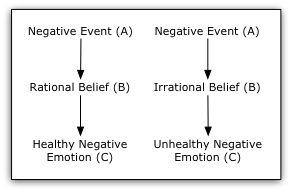
Albert Ellis (1977) described an ABC(DE) model of emotional disturbances that illustrates how beliefs influence emotions and how people become upset.  As shown below an individual’s beliefs (B) about an activating event (A) cause his or her emotional and behavioral consequences (C).  This is contrasted with the commonly held belief (by adolescents) that emotions and behaviors are caused by the events.  Disputation (D), or questioning and challenging irrational beliefs that young people might hold about themselves, others, events, and the world they live in will lead to a more constructive emotional and behavioral effects (E).


Ellis and his colleagues have identified numerous irrational beliefs commonly held in our culture that appear to cause emotional disturbance.  Some of the most frequently cited irrational beliefs can be found here.

Ellis (1980, pp.5-7) indicates that the irrational beliefs listed stem from the following three major irrational belief clusters:


  1. “I must do well and win approval for my performance, or else I rate as a rotten person.”
  2. “Others must treat me considerately and kindly in precisely the way I want them to treat me; if they don’t, society and the universe should severely blame, damn, and punish them for their inconsiderateness.”
  3. Conditions under which I live must get arranged so that I get practically everything I want comfortably, quickly, and easily, and get virtually nothing that I don’t want.


Bernard and Joyce (1984) state that these three irrational belief clusters cause major problems during childhood and adolescence as well as adulthood.  Waters (1982, p.572) has identified the following ten irrational beliefs of children:


  1. “It’s awful if others don’t like me.”
  2. “I’m bad if I make a mistake.”
  3. “Everything should go my way; I should always get what I want.”
  4. “Things should come easy to me.”
  5. “The world should be fair and bad people must be punished.”
  6. “I shouldn’t show my feelings.”
  7. “Adults should be perfect.”
  8. “There’s only one right answer.”
  9. “I must win.”
  10. “I shouldn’t have to wait for anything.”


In addition, Waters (1981, p.6) identified ten irrational beliefs held by adolescents:


  1. “It would be awful if my peers didn’t like me.  It would be awful to be a social loser.”
  2. I shouldn’t make mistakes, especially social mistakes.”
  3. “It’s my parents’ fault I’m so miserable.”
  4. “I can’t help it; that’s just the way I am and I guess I will always be this way.”
  5. “The world should be fair and just.”
  6. “It is awful when things don’t go my way.”
  7. “It is better to avoid challenges than to risk failure.”
  8. “I must conform to my peers.”
  9. “I can’t stand to be criticized.”
  10. “Others should always be responsible.”

We, as youth workers, are in a unique position where we can influence a students perspective and beliefs.  It is with great fear and reverence that we should move forward into this position.  We are in a position to shape their identity and the lens by which they interact with the world around them.  We are not alone in this as parents, teachers, friends and other play this role as well, but we have the privilege of helping them navigate this stage of life.  We should measure our words and be careful because we can either reinforce irrational beliefs (that shape their behaviors) or speak life and truth into their lives that help them understand who they are in Christ and the unique role they play in the Redemption Story.

A WordPress.com Website.

Up ↑