Search

conversations on the fringe

Category

Addiction

Opiate Tolerance and Withdrawal (part 3)


Tolerance

The struggle that Adam and Eve discovered in the garden, on that fateful day when they ate the apple, was that they learned about something they were never intended to know. Much like the Adam and Eve narrative, when we use opiates our brain learns about something it never knew existed, the increased capacity to experience higher levels of dopamine output. If that sounds too clinical for you then let me make it simple; they (opiate users) discovered a higher, more intense level of pleasure than they ever knew possible. It is so powerful in its reward that it almost immediately sets a new default for pleasure that the brain will always try to attain again.

Our brain is amazing. It is very plastic and adaptive. When it sets its “mind” on something it obsesses on it (cravings/urges) and if we surrender to those cravings we strengthen our connection to that which we are craving.

In the case of the opiate user our brains, the pathways that support the natural endorphin production work just fine but compared to the new superhighway of heroin/prescription narcotics it pales in comparison. The brain is flooded with significantly more endorphins and the brain has to create new pathways and places for them to land. This causes the brain to change and actually grow new endorphin landing sites, which in turn requires more of whatever it is that is flooding the brain with larger amounts of dopamine. Repeat the process. This is called tolerance and the brain is designed to make this happen.

Meanwhile, the old pathways that the naturally produced endorphins use to travel and growing old and less used. Imagine old rural county highways that are overgrown with grass, wore out and crumbled, with cracks and dirt beginning to cover them. They are becoming less traveled because of the nearby superhighway that is allowing more endorphins to travel at higher speeds to the reward center of the brain. In time, nothing will travel on those old roads and if they do it is likely to get lost along the way.

So, what use to give us pleasure; sex, food, relationships, work, recreation, movies, candy, etc. now pale in comparison and no longer deliver what it use to. Now, try to imagine that for a minute…nothing gives you pleasure except the medication your doctor prescribed you for your back pain. You quickly learn the only thing worth pursuing is the next fix, because, as well talk about next, withdrawal is so bad you’ll wish you were dead.

Withdrawal

You’ve been using these pills for several months now. They no longer work like the use to because you’ve developed a tolerance and your doctor is starting to become concerned about the frequency of which you ask for refills and is beginning to talk about not prescribing them anymore. You start to panic and begin visiting different urgent care centers hoping to score some Vicodin.

Instead, you decide to just stop taking the pills. They are costing a fortune and you don’t like the feeling of needing them just to help the kids get ready for school in the morning. So you just stop taking them one day.

REVOLT!

The brain has become dependent on the level of medication you’ve been giving it daily for the last nine months. It shut down its own production of natural endorphins and now relies on you to give it what it needs to function normally, to just get out of bed and not hurt. When the brain revolts like this it makes you feel deathly sick. It is reported that you feel like you’re dying but it never comes.

Common withdrawal symptoms are:

  • Sweating
  • Nausea
  • Muscle cramps
  • Diarrhea
  • Cold sweats/fever
  • Tremors
  • Pain
  • Depression
  • Possible seizures

Your stomach and digestive system has opiate receptors as well and since one of the side-effects of opiate use is constipation, diarrhea would result when in withdrawal. These symptoms are so severe that they would drive you to temporarily suspend your morality and do things you never imagined doing, such as; lying, cheating, stealing, manipulating, breaking the law, becoming violent, all to get money to get more opiates so you won’t be sick any longer. The criminal behavior often associated with drug use is typically a function of the drug use not a personality or character flaw. Stealing and selling possessions, lying or coercing others to get money is simply to not be sick any longer and so they can just get up and take care of their family, house, job, etc.

It is here that sympathies break down. When someone addicted to opiates begins to steal from a loved one we tend to become less empathetic. It’s important to remember at this time that your loved one is suffering from a brain altering dependency on an opiate. Nobody grows up hoping to become a heroin addict.

The brain is a fickle organ. It wants what it wants when it wants it and when it gets it over and over and over again it changes its neurological make-up to accommodate it. This is the nature of a brain disease/disorder that has biological, environmental, behaviors, cognitive, and personality variables influencing the outcome of dependency. At some point the person dependent on opiates loses their ability to choose. They MUST continue to use.

*in our next post we’ll explore the role of medications like methadone and suboxone in helping someone overcome opiate dependency.

This is your brain on opiates (part 2)


What are Opioids?

Opioids are a powerful class of drug that includes the illicit drug heroin as well as the licit pain relievers, such as; oxycodone, hydrocodone, codeine, morphine, and fentanyl.

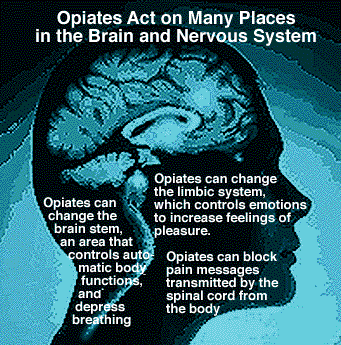
Our brains have natural opioid receptor hardwired within it. Opioid receptors interact with nerve cells in the brain and nervous system, controlling pain and delivering pleasure. Everyone on the planet does this naturally through our endorphin system.

brain3

When we engage in pleasurable activities the brain releases these feel good chemicals (dopamine/serotonin) and we experience them as a reward. These chemicals are the drive behind every habit we have. We will almost always do what that which gives us the greatest pleasure or has the greatest potential for removing pain or discomfort. We are hedonic seeking creatures. It’s why we eat when we’re hungry, have sex when we’re horny, and take medicine when we’re sick.

Our natural endorphin system has three primary functions; stabilize mood, provide energy/motivation, and control pain. All necessary to live a functional, normal life. Opiate dependent individuals ALL report they stopped using heroin and pain pills to get high within months of starting. They report primarily using just to feel normal, just to get up and go to work, take care of the kids, and not be sick.

scienceaddiction3

The Anatomy of an Opiate Addict

When we are prescribed or illicitly take opiates our brains hit the jackpot! Not only does this medication already belong in our systems, it’s much more powerful than the stuff we make naturally. If we take the medication or heroin long enough our brain, being a very efficient organ, will reduce or just stop manufacturing the naturally occurring chemicals and rely on you to provide it via drugs. It’s like the brain lays off all the workers and shuts down the factory.

Opiates are highly addictive because the chemical already belong there. The brain would fight off other foreign chemicals such as cocaine or methamphetamines because it sees them as a threat. But with opiates it just says, “Back that truck up and give me as much as you’ve got!” This is called dependency.

Unfortunately, the longer you use opiates the stronger the neural pathways get that support their use. Consequently, the lesser use natural pathways get weaker and less used neural pathways have a tendency to prune themselves to make room for more frequently used neurons/pathways. The brain, fueled by illicit or licit opiate use creates a superhighway that supports that drug use and he old, natural pathways are like rural back roads that aren’t driven anymore, overgrown and broken down. Even if you tried to take the old rural road it would be hard to traverse because of a lack of use.

So, now an individual is completely dependent on opiates and the brain structure has changed to accommodate this drug use. Paying for daily drugs gets expensive quickly as tolerance to the medication increases. This often leads a moral, kind, good person to do awful things they never imagined doing, such as stealing from grandmother, taking money from their kids piggy banks, selling the family jewelry, or robbing someone using physical force. All just to avoid feeling violently ill. All with the intent to make right as soon as they’re feeling better. But, that never comes. There’s always tomorrow and more sickness. The hole just gets deeper. Add to that the growing sense of shame, guilt, and remorse and you have a desperate, self-loathing person and the perfect antidote for feeling sick and hating yourself…use more drugs. Repeat. Repeat. Repeat.

If a person began using prescription pain medication and developed a dependency, it’s a short jump to heroin. Maintaining a pill addiction is very expensive and heroin is a cheaper, more powerful alternative. Once you use a needle to inject heroin, there’s no going back from there. Your life becomes a hopeless cycle of using drugs, getting high, hustling for money, getting high. Repeat. Repeat. Repeat.

Opiate use now becomes the only way for a person to function as a human. Most of the public lacks this understanding and perpetuates the false belief that if someone really wanted it bad enough they’d just stop using. Science tells us it simply does not work that way.

*In our next post we’ll explore the conditions known as tolerance and withdrawal and why quitting cold-turkey rarely works and can even be dangerous.


Overview of the Opioid Epidemic (part 1)


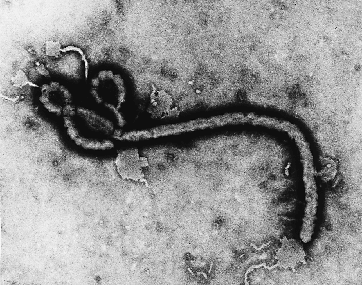
Let’s start with a brief overview of the current state of affairs related to the opioid crisis. Some of these number will shock you and some will be hard to believe. As an addiction counselor working exclusively with opioid dependent individuals I can tell you these number don’t surprise me at all. Having worked in this field for a few years now I can attest to the growing number of opioid users, especially among the populations listed below. We’ve also seen a growing number of overdose related deaths due to opioid use. To those of us working in the field, it feels like the problem is growing faster than we can treat it. If this were the Ebola virus and that was happening we would do everything we could to contain its spread without hesitation.

The numbers…

Drug overdose is the leading cause of accidental death in the US, with 47,055 lethal drug overdoses in 2014. Opioid addiction is driving this epidemic, with 18,893 overdose deaths related to prescription pain relievers, and 10,574 overdose deaths related to heroin in 2014. From 1999 to 2008, overdose death rates, sales and substance use disorder treatment admissions related to prescription pain relievers increased in parallel. The overdose death rate in 2008 was nearly four times the 1999 rate; sales of prescription pain relievers in 2010 were four times those in 1999; and the substance use disorder treatment admission rate in 2009 was six times the 1999 rate. In 2012, 259 million prescriptions were written for opioids, which is more than enough to give every American adult their own bottle of pills. Four in five new heroin users started out misusing prescription painkillers. As a consequence, the rate of heroin overdose deaths nearly quadrupled from 2000 to 2013. During this 14-year period, the rate of heroin overdose showed an average increase of 6% per year from 2000 to 2010, followed by a larger average increase of 37% per year from 2010 to 2013. 94% of respondents in a 2014 survey of people in treatment for opioid addiction said they chose to use heroin because prescription opioids were “far more expensive and harder to obtain.”

Adolescents (12 to 17 years old) 
In 2014, 467,000 adolescents were current nonmedical users of pain reliever, with 168,000 having an addiction to prescription pain relievers. In 2014, an estimated 28,000 adolescents had used heroin in the past year, and an estimated 16,000 were current heroin users. Additionally, an estimated 18,000 adolescents had heroin a heroin use disorder in 2014. People often share their unused pain relievers, unaware of the dangers of nonmedical opioid use. Most adolescents who misuse prescription pain relievers are given them for free by a friend or relative. The prescribing rates for prescription opioids among adolescents and young adults nearly doubled from 1994 to 2007.11

Women

Women are more likely to have chronic pain, be prescribed prescription pain relievers, be given higher doses, and use them for longer time periods than men. Women may become dependent on prescription pain relievers more quickly than men.

48,000 women died of prescription pain reliever overdoses between 1999 and 2010. Prescription pain reliever overdose deaths among women increased more than 400% from 1999 to 2010, compared to 237% among men. Heroin overdose deaths among women have tripled in the last few years. From 2010 through 2013, female heroin overdoses increased from 0.4 to 1.2 per 100,000.

*data from: http://www.asam.org/docs/default-source/advocacy/opioid-addiction-disease-facts-figures.pdf


Addressing the Heroin/Opioid Epidemic


The United States is in the midst of an epidemic. The small county I work in reports 3-5 calls per day for opiate related overdoses. Treatment programs from around the area have huge wait lists and people are dying every day. Experts at a recent round table discussion on the problem are predicting that it will only get worse as we tighten physician prescribing of opiates, as opiate dependent people will switch to the cheaper, more accessible heroin to fight off withdrawals.

This, and other reasons are why we are designating time and space to exploring this growing concern. Heroin and opiates are not an inner city problem. The largest growing base of new users are 20-something, middle class, Caucasians, especially women. This problem in already in your backyard if you live in the suburbs or a rural community.This is not to say opiates doesn’t affect those in the city but the myth that it’s inner city black males that are the largest consumer and dealer of illicit drugs in not supported by research.

Over the next several months we will explore the following topics related to the opiate epidemic that is sweeping across the nation.

  1. Who? What? Why? Where? – An overview of the current state of this problem
  2. Understanding how opiates change the brain
  3. Tolerance/Withdrawal/Detoxification
  4. Medication Assisted Treatment – Methadone & Suboxone
  5. What does effective treatment look like and what are the barriers to accessing it
  6. Harm Reduction (needle exchanges, narcan, and condoms)
  7. Mass Incarceration and the War on Drugs
  8. Co-occurring Disorders
  9. Family Systems and Substance Use
  10. Intersection of class, race, gender, sexual orientation
  11. Education and Employment
  12. What is the role of the church?

U.S. drug control strategy has largely been focused on law enforcement. Police have done their jobs and have done them well. In the last 20 year we have seen record arrests, drug seizures, and incarceration of drug offenders and yet the drug problem is only getting worse and more deadly, not to mention wasted valuable taxpayer resources. It’s time to collectively create a new way of addressing the drug problem in our country. What we’re doing now clearly isn’t working.

Building Bridges (pt. 3 – LGBTQ-Related Stress)


In the third part of our series on LGBTQ themes, our research/interviews revealed to us that there are extra layers of stress for LGBTQ students compared to their non-LGBTQ peers.

Growing up as a teen in today’s fast paced culture is hard enough as it is. To compound those struggles with stressors related directly to being an individual that identifies as LGBTQ can be overwhelming. So what are “normal stressors” all you are at risk for experiencing? Let’s take a quick look:

  • puberty/physical changes/body image issues
  • peer comparison
  • performance anxiety (school, athletics, roles at home, church, etc.)
  • pressures to engage in high-risk behaviors, such as; drug use, drinking, and sexual activity
  • academic stressors/college prep/career planning
  • family life/expectations (child care of younger siblings, household chores, etc.)
  • challenges related to managing emotions
  • onslaught of negative messages (self/family, peers, media, culture) and filtering them

Now let’s take a look at specific stressors identified by LGBTQ teens related to being LGBTQ:

  • internal/external homophobia
  • bullying/assault/death
  • stigma
  • social isolation/alienation/minority stress
  • academic struggles due to not feeling safe at school
  • higher risk of depression, self harm,, substance abuse, and suicide
  • fear of or actual rejection from family and friends
  • misconceptions by public related to what it means to be LGBTQ
  • pressure (internal or external) to suppress sexual identity/gender identity
  • incongruent identity
  • intersections, such as; disability, race, gender, gender norms, religious background/beliefs

These lists are probably incomplete but it gives you a clearer picture of what the average LGBTQ student is likely to deal with on any given day. High levels of relentless stress contribute to feeling hopeless and helpless, which is a precursor to suicidal ideation. This alone sets apart LGBTQ youth from their non-LGBTQ peers. This also contributes directly to further alienation and isolation. Regardless of your faith tradition and its respective doctrine about the issue of homosexuality, this kind of collateral damage to God’s beloved children cannot be acceptable to anyone calling themselves followers in the way of Jesus.

So, what might be a better way of engagement?

New Trainings for 2016


We’re excited to offer two brand new training opportunities for 2016. Both address much needed conversations around important and urgent issues; the opiate overdose epidemic, and the need for cultural intelligence in a rapidly changing world. If you are interested in bringing either of these conversations or any of our other trainings/workshops/community conversations to your area, just email us at cschaffner@fringeconversations.com

Connecting with Marginalized Youth (increasing your CQ)

Do you have a diverse group of kids? Do you want to be more effective in reaching a more diverse cross-section of youth in your community? Do you desire to impact the lives of LGBTQ youth, kids with disabilities, cross racial and ethnic barriers, and get to know those who are strikingly different than you and those in your ministry? Do you desire to increase your cultural intelligence in order to build a bridge across the gap between your church and others? This training focuses on developing and increasing our cultural intelligence (CQ) in order to begin the bridge building process of learning how to love our neighbors that appear to be different that us.

Understanding the Opiate/Heroin Overdose Crisis

According to a government website heroin related overdose deaths have seen a 10-fold increase since 2001. Many of those impacted by this growing trend at adolescents and young adults. Prescription narcotics and heroin have become the drug of choice for youth across all classes, races, and socio-economic ranges. Learn about the impact of opiates on the developing adolescent brain and body as well as how someone becomes addicted to opiates. In this training you will earn how to use a life saving medication called Naloxone, an opiate overdose reversal medication that can save a loved one’s life. This workshop is in partnership with the JOLT Foundation. Visit JOLT Foundation for more information on Naloxone.

Sex (A little porn never hurt anyone, right…?)


porn-hook

As with any behavior we engage in there are payoffs and there are consequences.    This post explores the negative consequences of obsessive and compulsive consumption of pornography.

  1.  Misusing sexuality or unhealthy sexual expression for the gratification of personal lusts and desires rather than the divine purpose if was gifted to use for (pro-creation and monogamous bonding/attachment) creates a host of attachments neuro-chemically and emotionally.  When we complete a sex act (climax) we have engaged a process that includes attaching (oxytocin/vasopressin) to the object of our sexual desire.  If these objects are images on a screen then we form a connection with those objects that was intended for your partner.  Repeated gratification to pornography can lead to difficulty bonding with a loved one in meaningful ways, emotionally and physically.
  2. Because of the impact of porn, our ability to connect with others emotionally is reduced.  The real problem is that our understanding of the true nature of sexual relationships gets polluted with porn consumption (creates fantasy).  Porn creates something less life-giving, commitment-solidifying, joy-producing for transient, sensual, immediate gratification.  As a result we learn that porn consumption, leading to masturbation and climax can be a powerful “mood altering experience” helping us deal with the stress of day-to-day life.
  3. Regular pornography viewing can also create a distorted perspective on reality.  It reinforces body types that are not natural, sexual positions that are only for a good camera angle not a natural position during sex, it creates expectations for our and our partners sexual behaviors and puts pressure on both to perform as what is seen on the screen.  Neural wiring changes occur due to regular porn viewing that reinforces our desires for what we see on the screen.   We begin to crave in real life what we see on screen.  This can also lead to a sense of emotional disconnect in which we are observes of our own sex acts rather than fully present with our partner.
  4. Emotional deregulation can occur when we become dependent on porn to relieve stress or make us feel pleasure.  When we are frustrated with our partner being sexually unavailable we turn to porn out of frustration or to extract secret revenge for their scorn after a fight.
  5. In order to consume porn regularly we must disengage morally.  This is dangerous because if done frequently or repetitively we lose our ability to empathize with others.  Moral disengagement allows us to do that which is socially unacceptable by blaming others, justifying our behavior as deserved or just, or by displacement of responsibility of our choices.
  6. Porn will likely reinforce negative gender stereotypes.  Cultural messages still support traditional gender roles and elevate the notion that women exist for men’s pleasure in a male dominated world.
  7. The shame and guilt that often accompanies pornography related problems is intense.  One the episode is over these feelings rush in and drives the behaviors underground to keep them hidden from others.  This leads to isolation and disconnect from important relationships.  This can lead to depression or hopelessness and helplessness.  The feeling that one is trapped in a shame cycle is often reported.

This list is not exhaustive but is a good gauge of what can happen to an individual that compulsively and/or obsessively consumes pornography.  In the next post we will look at ways to walk alongside someone stuck in the labyrinth of pornography.

Sex (There’s An App For That)


3xgalleryiphonepicIf you’re a youth worker then you already know about the abundance of pornography due to modern technology. If you don’t, you should pay attention. Due to new technology porn has never been more accessible, affordable, or anonymous than it is today. At the same time, sale of Smart phones to adolescents is driving the mobile phone industry. Add these two factors together and you have a new way to engage in an old struggle.

Young people are historically impulsive and vulnerable to addictive behaviors. This is not a revelation to anyone but the temptations and opportunities to act on those impulses have increased significantly in recent years. Viewing pornography almost seems like a rite of passage and current research tells us that first exposure to pornography is occurring at an average age of 11-years-old. The natural but curious nature of sex often makes it hard for even the most convicted teenager to resist the compulsion to revisit these sites again and again.

Accessible – Youth have unlimited means of accessing outlets to pornographic material today; smart phones, apps, tablets, gaming systems, the internet, television, pay-per-view, and peer-to-peer sexting. There are a myriad of ways that kids can intentionally or unintentionally view material that captivate their bodies and brains in a powerful way.

Affordable – Access to porn has typically come with a price tag that served as a barrier for most young people accessing such material. Today, much like a drug dealer that fronts you a sample to “hook” you, porn website offer free samples in short increments with the same intention.

Anonymous – Because much of this is done of personal i-Devices the stigma typically associated with these behaviors is diminished. One can privately browse content for hours and easily delete any browsing record of such indiscretions. Instead of going to the seedy gas station to buy a magazine, or to the backroom of the video store to find the adult movie selection, technology allows those outlets to come directly to the consumer.

I do not want to demonize the adolescent’s desire for sexual expression. God gave us a sexual desire and it is good. It is important to distinguish between normal sexual curiosity and unhealthy/unsafe sexual practices. Nevertheless, we know that when anyone engages in a behaviors repeatedly neurological changes can occur, rewiring our brains to a “new” norm. Compulsive pornography consumption will fundamentally change the way we, especially our youth, will experience sex. Everything from expectations about sex to the physical experience of sex to our ability to attach to others in an intimate fashion will be impacted.

All is not hopeless. In this blog series we will continue to unpack to the problems associated with sex, as experienced as the norm today, and how we might have better conversations with our youth, their parents, and ourselves about sex and sexual behaviors.

Youth Ministry and the Glee Effect


Cory MonteithThis past Saturday my wife I and I were anxiously awaiting the verdict of the trail for George Zimmerman, the man accused of shooting 17 year old Trayvon Martin.  While this “trial of the century” was capturing America’s attention another story was unfolding in a Canadian hotel.  Glee superstar and main man Finn, played by Cory Monteith, was found dead in his hotel room.

We won’t know the cause of his death for several days but speculation abounds regarding substance use and suicide, a history of depression, etc.  The horrible irony is that the writers for Glee have attempted to bring light to these and other issues that youth face on a daily basis.

Update: Autopsy reports say the a combination of heroin and alcohol contributed to Cory’s death.

No one can deny the impact Glee has had on youth culture over the last several years.  At the very least it has provided a soundtrack for the lives of countless youth.  More importantly Glee has given our youth a voice in a world where very few believe anyone is listening.  I heard from countless teens who expressed a form of solidarity with the characters from the show.  It had every stereotype one could imagine and they all found common ground singing for the lovable Mr. Schuester in Glee Club.  It was here that they all found meaning and a sense of belonging.  Glee Club became their refuge from a crazy world of bullies, expectations, pressure, stress, and the myriad of difficulties of being a teenager.  They often spoke of Glee Club in transcendent language.

I came to see Glee Club, as portrayed on the show, as a desire for a safer world in which youth can navigate the journey to adulthood, ripe with mentors willing to walk alongside them regardless of the personal cost.  Glee changed the expectations young people had for their schools, homes, and relationships with each other.  I’m wondering if, with Cory’s death, it will leave many of the show’s Gleeks feeling a sense of hopelessness that nothing they had come to believe in will actually make a difference.  This could be soil for fruitful conversations about what is worth putting our hope and trust in.

I have said to my wife during more than one viewing of Glee that I felt like these kids could be the kids from our community or youth group.  Hearing about Cory’s untimely death impacted me emotionally and I wept upon receiving the news.  Finn, Cory’s character, was the arch-type male student, popular, pretty girlfriend, football quarterback, and could rock some Journey like no one else.  I’m concerned about the level of celebrity worship in our culture.  I’m concerned about its impact on our youth, who take their cues for living life from their idols, whether they’re conscious of it or not.  This misplaced investment is fruitless and leads to despair.  When a celebrity of Cory’s stature can’t escape the pull of destructive choices then what are the kids in our communities supposed to do?

Cue the church…

Glee struck a chord with young people like I’ve never seen before.  It spoke of the things that no one else would speak about and they did it creatively and honestly.  Many in the camp of Christianity wrote off Glee as obviously secular with an agenda but many failed to hear the messages of our youth that were reflected in the show’s storytelling.  Weekly, the show masterfully addressed the deepest longing of our kids and one could hear it only they would listen.

What if our youth ministries, what if our churches, what if our faith communities had the magnetic pull that Glee had for so many?  I really believe that kids vote with their presence, meaning, if our ministries even remotely smell like the shallow offerings the world has to offer they will not partake of it.  I believe in my core that youth will choose that which is most compelling.  We love to blame the youth for being apathetic regarding their spiritual growth and commitment to their faith but what if it wasn’t them?  What if it was our ministries?  What if we created deep ministries, like Glee, where students who felt they weren’t wanted anywhere could find a place to belong?  What if they were safe communities where they could let down their guard and be real and honest about the things in their lives that are important and troubling to them, issues like depression, stress, sexuality, self-injury, self-image, or their futures?  What if they felt they mattered because we loved them in spite of what they do and not just because they jump through our hoops and fit our mold of what we think they should be?  What if there were a number of adults who would commit to walking alongside them, regardless of how difficult it became?  What if our ministries were places of real hope that pointed to the Source of all hope? How is it that Glee has been kicking our butts when it comes to influencing and reaching our kids?  And I don’t buy the line, “Because it appeals to their fleshly desires” or what ever version of that sentiment might be.  I think it is because it speaks to the longings that are most important to youth and it does so in a meaningful way.

My heart is broken for Cory Monteith.  It’s broken because in spite of the Glee’s efforts to create the world described above, it still falls short.  Cory’s death is a reminder to us all that this world is broken and God’s children, apart from Him, are broken.  It reminds me that when we seek the satisfaction of those deep longings apart from Christ the world will always come up short.  I pray that our ministries are a place where the deepest longings of our hearts are fully satisfied through our ever growing relationship with Christ and His body.  It is there and only there we might experience the Kingdom on earth, as it is in heaven.

Don’t stop believing…

A WordPress.com Website.

Up ↑