Search

conversations on the fringe

Author

CotF Admin

What Are We Saying When We Don’t Say Anything?


“When we block our awareness of feelings, they continue to affect us anyway.  Research has shown repeatedly that even without conscious awareness, neural input from the internal world of the body and emotion influences our reasoning and our decision making.  Even facial expressions we’re not aware of, even changes in heart rhythm we may not notice, directly affect how we feel and so how we perceive the world.  In other words, you can run but you can’t hide.”

excerpt from Mindsight by Daniel J. Siegel, M.D.

If what Dr. Siegel suggests is true then this holds implications for how we interact with young people in our ministries.  For example, a 14 year old girl in your youth group asks to talk to you privately.  She reveals that she is a victim of sexual abuse and to cope with it she cuts herself.  How we respond to her, including our tone, facial expressions, and body posture will all communicate something to her. 

What are we communicating to our young people beyond our words? 

How does this help or hinder their ability to trust us? 

How can we grow in our own emotional management?

Have You Seen These Parents?


In Tim Elmore’s book, “iY – Our Last Chance To Save Their Future”, Tim describes different types of parenting styles that are less than helpful.  As I reflect on my youth ministry experiences I clearly see many of the following:

  • Helicopter Parents – they hover too close to the kids at all times.
  • Karaoke Parents – they try too hard to be cool, often parroting back what their kids do, say, and wear.
  • Dry-Cleaner Parents – drop their kids off for others to raise.
  • Volcano Parents – erupt over minor issues. (If you’ve never witnessed this just spend more time at Wal-Mart.  You’re bound to encounter these parents.)
  • Dropout Parents – these parents have just quit on their kids.
  • Bullied Parents – can’t stand up to their kids. 
  • Groupie Parents – treat their kids like rock stars.
  • Commando Parents – let rules trump relationships.

Parenting is hard.  When I think about the challenges facing kids today I can see why parents may be tempted to default to the perceived “path of least resistance” when it comes to parenting. 

Those of us in ministry take sabbath rests (or we should), clinicians work to prevent compassion fatigue to avoid burnout, those in the workforce are allowed vacation/sick time to recoup, but what about parents?  When are they afforded an opportunity to rest?  To retreat?  To sharpen their parenting skills?  To avoid parenting burnout? 

Can our ministries find better ways to support our parents? Here are a couple of suggestions:

1.  Plan regular gatherings for parents (i.e., retreats, workshops, one day training events, etc).  Events that just validates the struggles of parenting kids in today’s world.  Target the single mom, the over worked dad, the couple struggling to find time for each other and provide a soul care getaway. 

2.  Develop a mentoring ministry just for parents.  Find those from previous generations that have earned the grey hair from weathering the storm of raising kids and have them walk alongside a younger couple neck-deep in the pool.  (This would be a great affinity group for your small group ministry.)

These are just a couple of ideas to get you thinking.  We are likely to have the full support of the parents in our ministry efforts if they know we have their back first.

Communication Breakdown


When working with kids, parents, volunteers, other staff most of our problems begin with a breakdown in communication.  Dr. Alan Godwin, a practicing psychologist certified in Alternative Dispute Resolution, writes in his book, “How to Solve Your People Problems” that when in conflict there are typically four types of problems we encounter and knowing which one we are dealing with is half the battle.

He says, “Pay attention the next time you’re in an argument or hear an argument.  You’ll probably notice at least four types of conflict problems:

  • Preference Problems.  These problems result from actual differences.  One person prefers to do it one way, and the other person prefers to do it another way.  The differences of opinion may be significant or trivial.
  • Perception Problems.  These problems result from perceived differences.  One person inaccurately attributes meaning to the words or actions of the other person.
  • Process Problems.  These problems result from falling into the trap of bad conflict, such as buttons getting pushed, reactions taking over, and pushing the other’s buttons.  For instance, in the middle of a conversation, one person pushes the other person’s button by being sarcastic.  Suddenly the argument now involves two topics – the original issue plus a new one, the person’s sarcasm.
  • Pressure Problems.  These are circumstances that make solving conflict problems more difficult.  Pressures from outside the relationship drain the time and energy needed to solve problems inside the relationship.  For instance, some couples are so pressured by limited time that they never sit down and work things through.  Other examples of pressure problems include financial difficulties, health problems, fatigue, and lack of privacy.

We solve perception problems by clearing up misperceptions.  We solve process problems by restricting our buttons, responding rather than reacting, and refraining from pushing buttons.  We solve pressure problems by acknowledging their effects and making the necessary adjustments.  Preference problems are solved by answering five questions.”

  1. Which problem am I trying to fix?
  2. Why do I feel so strongly?
  3. How can we agree to fix this?
  4. What will we do to implement it?
  5. When will we evaluate it?

This has been a great framework for personal and professional use for addressing conflict.  Experts tell us that conflict is healthy and should be expected but rarely has a prescription for dealing with it been so concisely.

Gender Biased Vocabulary In Toy Ads


I came across an amazing graphic today and just had to share it with you.  I’d love to hear what you all think this means, if anything at all.  These graphics are word clouds created by the website achilleseffect.com exploring key words used in advertisement of toys for boys and girls.  My concern is what messages are our kids receiving as a result of marketing such as this?  We’d love to hear your thoughts on this.  How do you think this type of marketing is impacting our kids? 

UYWI Reload 2011 – Chicago


Reload 2011 from North Park University on Vimeo.

Reload Chicago is an exciting learning opportunity for urban youth workers.  This is an affordable, one day training event.  Reload will be hosted on the beautiful campus of North Park University.  We’ll be leading a workshop on how to minister to youth who have experienced abuse.  We’re hoping to see you there…

Bullying (part 5): Restitution, Resolution, and Reconciliation


If the student was a follower/supporter of the bully:

  1. Intervene Immediately
  2. Provide a system of graceful accountability while allowing natural consequences to occur
  3. Create opportunities to “do good”
  4. Nurture empathy
  5. Teach friendship skills – assertive, respectful, and peaceful ways to relate to others
  6. Monitor/Criticize/Converse about TV shows, movies, music, and video games that reinforce violence against others
  7. Engage in more constructive, entertaining, and energizing activities

If your student hurts others through gossip have them:

  1. Apologize to the student who was hurts by the rumor
  2. Go to everyone they told it to and have them tell them it wasn’t true
  3. Ask them to stop spreading it
  4. To the best of their ability, repair any damage done to the target by the act of spreading the rumor
  5. Take the next step of building a new and healthier relationship

Three principles that foster moral independence:

  1. Teach your students that he/she and only he/she is responsible for the consequences of his/her own action (kids who accept responsibility for their own actions are more likely to live up to their own moral code)
  2. Build your student’s confidence in his or her ability to make good decisions (kids who have confidence in their own judgments are not easily manipulated by others)
  3. Teach your students how to test reasons/motivations on his or her own (kids who have confidence in their own ability to reason are more questioning and more resistant to passive acceptance of others)

Bullying (part 4): The Bystander


Four Reasons for not intervening:

1.  The bystander is afraid of getting hurt himself.  The bully is bigger and stronger and has a reputation that justifies the fears; so jumping into the melee doesn’t appear to be a smart thing to do.


2.  The bystander is afraid of becoming a new target of the bully.  Even if the bystander is able to intervene successfully, there is a chance she will be singled out at a later date for retribution.  Bullies are quick to disparage and malign anyone who tries to intervene.


3.  The bystander is afraid of doing something that will only make the situation worse.


4.  The bystander does not know what to do.  He hasn’t been taught ways to intervene, to report the bullying, or to help the target.  Just as bullying is a learned behavior, so must young people be taught ways to stop it.


Excuses for not Intervening:

  1. The bully is my friend
  2. It’s not my problem!  This is not my fight!
  3. She’s not my friend
  4. He’s a loser anyway
  5. He deserved to be bullied, asked or it, had it coming
  6. Bullying will toughen him up
  7. Kids have a deeply embedded code of silence
  8. It’s better to be in the in-group than to defend the outcasts
  9. It’s too big a pain

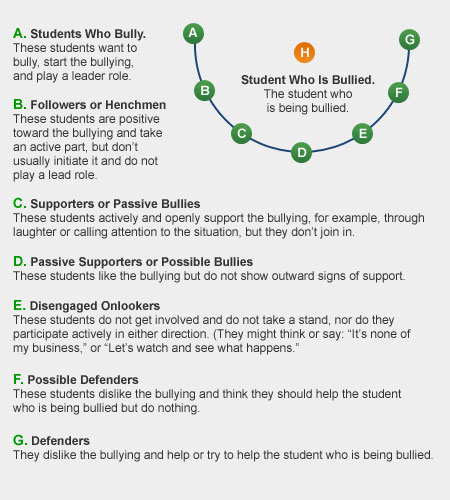
Everyone plays a role in the bullying cycle.  Educating the “players” is an important first step in ending the gripping power of bullying.  We often focus, to the exclusion of the others, on just the bully or victim.  Educating and empowering the other participants, regardless of how passive their roles may be, is a crucial step towards addressing the issue of bullying.

Bullying (part 3): Text-Bullying And Mobile Technology


Adults are becoming more and more savvy about protecting kids from cyber bullying—harassment using technology, such as email, instant messaging, or social networking sites like MySpace, Facebook, and Twitter. But during the upcoming spring break, when kids have more unstructured time than usual, they are also at risk of exposure to bullying through text messaging (“text bullying”), or even being “sexted,” using the text-messaging feature on cell phones, which a reported 87 percent of teens own (National Campaign to Prevent Teen and Unplanned Pregnancy, 2008).

Sexting” is sending nude or sexually suggestive pictures and accompanying text via cell phone. Although the original “sexter” may only send the suggestive message to one person—a girlfriend or boyfriend, for example—that message can be forwarded to anyone in the recipient’s address book, and from there, all across a school or community. Once it’s out there, there’s no way to take back the message or the accompanying embarrassment or humiliation.

There are possible long-term consequences, too. Since school admissions officers and potential employers often look at online profiles, the repercussions of sending an inappropriate message could be endless. And one newspaper reports that sexters can “face felony charges for child pornography” (Borgman, 2009), landing them on the registry for sexual predators, a label they’ll bear for the rest of their lives.

What Kids Can Do About It

According to the Anti-Defamation League, critical thinking is “the best tool against hate” (Tiven, 2003). You can coach kids to use the same problem-solving skills for text bullying that they would use in any other situation. The more they think before pressing the “send” key, the less likely they will be to disseminate a photo or message that will get them in trouble and ruin their reputation.

When kids receive harassing or inappropriate text messages, there are several things they can do:

  • Never, ever respond to the message sender.
  • Report it as soon as possible to a trusted adult (and if that person doesn’t help, tell others until someone does).
  • Save or print the message to keep a record, then delete it from the phone.
  • Only keep contact information of close friends and family in their address book.
  • Talk to their wireless provider about how they can help (such as blocking the messages or changing their number).

What Parents Can Do About It

If critical thinking is a kid’s best defense against text bullying, communication is yours. Just as you talk to your kids about sex, relationships, and drugs, it’s also important to talk to them about how they use their phones, and with whom.  “Supervising and monitoring your kids’ whereabouts in real life and in cyberspace doesn’t make you a nag; it’s just part of your job as a parent” (NCPTUP, 2008).

It’s best not to take away kids’ phone privileges when they come to you with a text bullying problem. That might make them feel as if they’re being punished for someone else’s transgression. Here are some things you can do instead:

  • Talk to your kids about text bullying and sexting, especially the short- and long-term consequences.
  • Monitor their cell phone use: Who are they texting? Who is texting them?
  • Suggest that everyone’s cell phone stay on the kitchen counter or another centralized place while they’re home.
  • Set rules about the kind of behavior that is and is not acceptable—on a cell phone, or anywhere else. Remind kids of the rules periodically.
  • Many cell phone provider’s website allow for varying degrees of parental control available from their website.  This allows for parents to control the hours of which a child may receive or send text/pix messages, block callers/numbers from any activity on that specific phone line, and keep record of your child’s mobile activities.

References

Borgman, L. (2009, February 24). Safe sexting? There’s no such thing. Lexington Herald-Leader.

Brock, K. (2008, May 6). Text bullying. WLS-TV Chicago, IL. Retrieved February 24, 2009 from http://abclocal.go.com/wls/story?section=news/national_world&id=6124134.

National Campaign to Prevent Teen and Unplanned Pregnancy. (2008). Sex and tech: Results from a survey of teens and young adults. Washington, DC: Author.

NCH: The Children’s Charity. (2005). Stoptextbully top 10 tips. Retrieved February 24, 2009 from http://www.pkc.gov.uk/NR/rdonlyres/F1ABA3FA-C050-4913-BD29-0AC7A531F110/0/StoptextBullyingTop10Tips.pdf.

Tiven, L. (2003). Hate on the Internet: A response guide for educators and families. Albany, NY: Anti-Defamation League.

Bullying (part 2): Warning Signs


The following is a list of warning signs that a student may be getting bullied.  Please make a copy, edit it, be creative, add artwork or whatever, but place it publicly where your students can see it.  Consider making a copy and editing it for your parent’s newsletter/email.


  • Shows an abrupt lack of interest in school or a refusal to go to school.  (According to a National Association of School Psychologists report, 160,000 children in the United States miss school every day for fear of being bullied.)


  • Takes an unusual route to school.  (Going north and three blocks east to get to a school that is south of your home makes a lot of sense if going directly south will put you in the path of bullies.)


  • Suffer a drop in grades.  (It’s hard to concentrate on school work when you are trying to figure out how to avoid the bullies.)


  • Withdraws from family and school activities, wanting to be left alone.  (When you feel isolated, shamed, scared, and humiliated, you just want to curl up in a ball and not talk to anyone – or lock yourself in your room and cry.)


  • Is hungry after school, saying he lost his lunch money or wasn’t hungry at school.  (The bully takes great pleasure in extorting lunch money.  The lunchroom ranks third behind the playground and hallways in the order of places where bullies attack their targets, so it’s a good place to avoid, even if you do have lunch money.)


  • Is taking parents’ money and making lame excuses for where it went.  (Once again the bully separates you from your money.  The threat of retaliation can convince you that stealing from your mom’s purse or your dad’s wallet poses a lesser risk to body and mind than not showing up with the money for the bully.)


  • Makes a beeline to the bathroom when she gets home.  (Since bathrooms are number four on the list of places bullies like to attack, you figure it’s best to “hold it,” even at the risk of a bladder infection.  A bladder infection can’t possibly hurt as much as having your head dunked in a swirling toilet or seeing your reputation attacked via insulting graffiti on the mirrors over the sinks.)


  • Is sad, sullen, angry, or scared after receiving a phone call, text, email, or IM, etc.  (You don’t know how to tell your parents that the girls on the other end of the line called you ugly names and then all laughed at you before hanging up.  You are ashamed to talk about the obscene lies the boy in your English class write about you and sent to all 500 friends on MySpace or Facebook.  Even your cell phone isn’t safe anymore.  If they can reach you in your own home then how can anyone help you?)


  • Does something out of character.  (You would rather get caught skipping school than caught in the school yard or on the wrong block by a bunch of bullies who circle around you every day and “pretend” to be playing.  You would be willing to pull your pants down at recess if it meant those girls would promise to quit taunting you and let you into their social cluster.)


  • Uses derogatory or demeaning language when talking about peers.  (If you’re being called ugly names, poked, shoved, shunned, and laughed at, you won’t have any terms of endearment for the kids who started the bullying or for those who joined or looked the other way.)


  • Stops talking about and everyday activities.  (If you’re being bullied, you have no everyday activities that are not colored in pain, frustration, fear, and terror.)


  • Has disheveled, torn, or missing clothing.  (You don’t like to resolve conflict by duking it out, and it wasn’t a one-on-one fight by equals.  But saying you got into a fight sounds better than saying you got beaten up.  Besides, last time you told your dad about the bullying, he told you to fight back.  Or you surrender your favorite jacket rather than risk an attack, but saying that you “accidentally” left it in the locker room will go over better at home than admitting how you really lost it.)


  • Has physical injuries not consistent with explanation.  (Saying that you walked into a locker sure sounds better than admitting you were shoved into one.  Saying you sprained your ankle running to class beats revealing that those girls tripped you in the middle of the bus aisle, then laughed at you as you limped back to your seat.  “I don’t know how I got that back eye; I must have fallen out of bed,” rings less painfully that recalling how you were held down and kicked in the face on the way to school.)


  • Has stomachaches, headaches, panic attacks, is unable to sleep, sleeps too much, is exhausted.  (Bullies can be real pains in the brain and in the body.  The body responds to the stress of being targeted by turning on its chemical defense system so you can fight or flee.  But with daily attacks, this system can never shut down.  Adrenaline keeps getting released.  The body stays on hyper-alert, churning up the stomach, twitching the limbs, and numbing the brain.  Constantly resisting and fearing the bully taxes the mental and physical defenses.  Eventually the system breaks down and the mind and body collapse into a state of exhaustion.)

A WordPress.com Website.

Up ↑