Search

conversations on the fringe

Author

CotF Admin

Helping Students and their Families Resolve Difficulties


Over the years, I have sat through countless meetings with students and their families.  Often when a family is sitting in my office it is due to a conflict that has come to a head.  Early in my career I was easily confused by the complex dynamics represented by the family and at best could only offer vague advice or I would dole out shallow offerings of scripture and a prayer offering.  Managing a tense family meeting takes skill and awareness that isn’t usually taught in traditional youth ministry trainings.  We typically learn on the fly and by experience.  The following is a set of guidelines harvested from years of collective youth ministry experience from veterans in the trenches.

Preventing Problems in the First Place

Get the Parents in From the Beginning

           It does no good to sit in front of a reluctant teenager and try to get them to open up and discuss their difficulties.  This can actually make things worse because it sets up your time with the student as one where the youth worker repeated appeals to the teenager for his/her involvement.  This is like pulling teeth.

           Because there is a disconnect in perspective from both parties it is best to start with both parties present.  If the student is resistant then you can still work with the parents.  If the parents meet with you before hand this can limit the next meeting when they come together.  You will have already heard all the issues, so the meeting will start off on the wrong foot as the student will likely assume that there is an alliance between the youth worker and the parents.  This happens because the youth worker will have to (a) relay what he/she has heard from the parents, which can come off a paternalistic; (b) the parents tell it again for the kid’s benefit, but both he/she and the youth worker have already heard it all, so it’s old news; or (c) the parents and the youth worker asks the student what they think the problem is and if they already feel like the odds are stacked against them they may become defensive or dismissive.

Exceptions to the Rule

          As with all rules, sometimes there are circumstances in which parents and student should not meet together.  These can include:

  • The situation is too volatile
  • The parents are psychologically unavailable (neglectful or abusive)
  • The older student (16-18) feels empowered to address the concern on his/her own

Cautions to be Aware of

  • Do not immediately assume that one party or the other is right/wrong
  • Teens usually understand more than they are given credit for

Setting Ground Rules for the Meeting and Identifying Goals of Meeting

             From the beginning some “rules of engagement” should be stated and referred back to as the discussion progresses.  I always make clear my expectations when helping a family resolve conflict.  I start by telling them that the goal is to help each understand one another and find a resolve that is equally satisfying to both parties, therefore, anything that does not move us towards that goal is not useful or necessary.  Here are my ground rules for engagement:

  • No interrupting
  • No personal attacks
  • Stay in the present
  • Do not use the past as a bludgeoning tool
  • Listen to gain understanding

           As the conversation progresses the objective youth worker will want to practice listening.  Be slow to speak except to help maintain focus and control emotions. Emotions can be counter-productive when trying to find a resolve and stimulate subjectiveness and self-preservation in each party.  Here are some suggestions of things to listen for and they are largely defined by their absence: boundaries, respect, compassion, clarity, assertiveness, self-respect, humor, affection, listening to each other, genuineness, and empathy.

REMINDER:  Remain neutral.  Align yourself with all parties involved.  As youth workers we may have a tendency to align ourselves with the student.  If we do this we risk alienating the parents and possibly their alliance in their child’s spiritual development.

Potential Problems

  • Parents expect you to “fix” their kid while they watch
  • Parents may indulge their child’s dismissive or defensive attitude
  • The adolescent won’t talk
    • Move forward regardless.  As you converse with the parents the student will likely become involved, even if it is to refute their parent’s claims.
    • Take the pressure off the student.  Let them know they don’t have to share if they don’t want to.  Many times the “silent treatment” is an attempt to gain a sense of control over the experience.  By taking the pressure off of them it reduces anxiety and takes away their weapon of control.
    • Allow the student to just listen.  They may act disengaged but they are hearing everything being said.
    • Observe the parent’s response to the silent child (are they shameful towards the student or dismissive?)  Both of these send messages to the child.

           Using the above strategies and information will not guarantee a better outcome for your meetings but it will increase the likelihood of finding a resolve between both parties.  Be slow to give advice.  9 times out of 10 both parties just want to be heard and taken seriously.  They simply want to know that the other party understands them and that they were important enough to devote the time necessary to reach that understanding.  The youth worker can often help facilitate the family in reaching that goal and strengthen the spiritual alliance of all those involved.

Top 10 Blog Posts of 2012


It’s been a busy year for us here at Fringe.  We’re having more opportunities to speak into communities around our area as well as an ever-increasing broader scope.  Some of our highlights were working with Access Living in Chicago, Simply Youth Ministry Conference by Group Publishing, and simply meeting with parents and students throughout the state of Illinois.  2013 looks promising as we look to publish resources for those working with adolescents that are at-risk. 

The most read blog posts give us an idea of what is important to you and what resources are needed most.  In 2012 you read the following posts more than any other.

Roles Of Children In Dysfunctional Families

Youth Suicide Risk Assessment

Bullying (part 3): Text-Bullying And Mobile Technology

Basic Brain Function and Emotional Hijacking

Your Youth Group Sucks! – Building Rapport with Difficult Students

The Functionality of Sin

Self-Mutilation in Abuse Survivors

Supervision in Youth Ministry

What’s Wrong With Young People Today?

Ten Strategies for Working with Boys

Thanks to all of you for making 2012 a great year.   Here’s to deeper and continued conversations about things that matter in the new year. 

Blessings,

Chris

The Functionality of Sin


ducttapeTraditional youth ministry training didn’t really prepare me for the acute problems my kids were showing up with at our youth ministry. I got into to youth ministry because the first time I walked into a youth ministry gathering I felt a connection, a calling to speak into their lives. I wanted desperately to impact their lives for the Kindgom. The typical fare in most youth ministry training programs is maybe a psych 110 class or an adolescent development overview but very little in the way of preparing me to minister effectively to them. Take Whitney, a 15 year old high school sophomore who had recently been hospitalized for depression, self-injury and suicidal ideation. When she was brought to our youth group by one of our “professional evangelism daters” we just weren’t sure what to do in order to walk with her and her family through the next couple of years. This started us on a journey of seeking to understand these fringe issues (which really aren’t fringe any longer), to be better equipped to love these kids that God was sending us. We believed we were called to be good stewards of the kids He sent us and that meant pulling our head out of the sand, rolling up our sleeves and getting our hands dirty.
Sin is such a complex issue, everything from understanding what it is to what it isn’t, to what are the systemic causes of it, to how we deal with the fallout of sin, to how we put programs in place to create an environment that not only discourages sin but fosters the belief that everyone, EVERYONE, is a child of God and treated accordingly.

Dr. Brene` Brown, in her book I Thought It Was Just Me (but it isn’t): Telling the Truth about Perfectionism, Inadequacy, and Power explains her research on the subject of shame as a study on the power of connection and the dangers of disconnection. When one considers the process to the product that is a sinful individual we must first understand that our primary drive is to be connected. God first existed in community and we are created in Their image, aren’t we? The longing to belong serves many purposes; survival, fulfillment, success, and procreation. Growing up as blank slates our families, environments, and culture shape how we “learn” to connect. We are taught skills and styles of connecting to others. Sometimes these means are healthy and affirming, and God honoring, placing God at the helm and others accordingly. Other times we are not taught healthy ways of connecting. We are taught that violence, aggression, manipulation and other illegitimate means are what are necessary to get what you need and want.

When we are not affirmed as worthy of being connected to others we learn to see ourselves as deficient, broken, not valuable, insignificant, etc., but our need for connection doesn’t leave us, we simply learn other ways to get what we need.

If this is done well, as God first intended, then it significantly increases the likelihood of having generations of people who choose to enter into a relationship with Him, just as He ordained from the beginning of time.
When this doesn’t go as God intended the opposite result is the outcome. Brokenness in God’s creation exists. God’s children all fighting and pining instead of cooperating to satisfy the deepest longings of their heart. Longings placed in them to direct them to God and each other, in that order. We experience sin and its collateral damage when we invert that order, placing me and others before our relationship with God the Father.

This is where sin becomes functional. Sin becomes a means to an end. For a long time we have demonized our sinful youth as just giving in to their hedonic nature. What if there was more going on than just simple pleasure seeking? What is we began to ask the question, “What purpose does sin have?”. Would this change the way we approach our youth and their sinful behaviors? What if we started having conversations about other ways, more God-honoring ways, to meet the deepest longings of their hearts? What if we spoke the language of their heart and longings? What if we told them of a God who can satisfy these longings in real ways, so that it is God’s love that draws them not the fear of Him. What if we created space in our homes and gathering places where youth felt they belonged and mattered? If we could do this, with the help of the Spirit, would they drop their cheap substitute (sin) for the real deal (God)? What do we have to lose?


In the wake of two superstorms youth workers will be loving on many of the youth whose families are trying to put their lives back together again. Here are some guidelines for working with kids through traumatic events.

CotF Admin's avatarconversations on the fringe

As a youthworker you may be struggling with how to talk with your students about a shooting rampage. It may be difficult to talk to your students about the devastation of an F4 tornado that wipes out a small town. It is important to remember that children look to the adults in their life to make them feel safe. This is true no matter what age the children are, be they toddlers, adolescents, or even young adults.

Consider the following tips for helping your students manage their distress.

Talk with your students. Talking to your students about their worries and concerns is the first step to help them feel safe and begin to cope with the events occurring around them. What you talk about and how you say it does depend on their age, but all students need to be able to know you are there listening to them.

  • Find…

View original post 497 more words

Bueller…Bueller…(Youth Ministry 101)


Remember this scene from Ferris Bueller’s Day Off?  Man, this scene resonated with me because I had experiences like this when I was a student.  I have also, unfortunately had youth ministry experiences like this when students wiped their saliva off their cheek after nodding out from listening to me drone on and on…

Our first objective as teachers is to capture our students’ attention.  If we don’t gain their attention, the chance that they’ll learn anything is remote at best.  The process of attention serves two primary purposes, the first of which is survival.  The brain kept our ancestors safe by alerting them to possible hazards in their midst like strangers, thunder clouds, or wild animals.  Fortunately, it is the rare occasion that survival is at stake in youth ministry.  Instead, attention serves its second purpose – maintaining pleasurable feelings.  The hot girl with the pierced tongue, a double chocolate ice cream bar, and listening to pop music are pleasurable diversions for modern teenagers.  So are funny stories, terrible tragedies, and first loves, which the bible is full of.  

So why does it seem that our kids are tuning out?

The brain is bombarded with information from the senses.  Everything we see, hear, touch, smell, and taste finds its way to the sensory receptors, from the clothes on your back to the beige walls of the youth group room and the radio playing softly in the back ground.  At the base of the brain is the brain stem, which controls involuntary actions like breathing, blood pressure, and heartbeats.  Deep within the brain stem is the reticular formation, a system of neurons that gathers information from all of your senses and controls your awareness levels.  Some awareness is at a conscious level (what you see and hear a speaker do and say) and some at an uncounscious level (the color of the walls or the socks you are wearing).  It would be impossible for the brain to consciously focus on each bit of data it receives.  You may be oblivious to the feel of a baseball hat on your head while the cute girl beside you captures your full attention.  Consider the immense amount of information the brain is capable of absorbing, from the food stuck in your teeth to the lint on your coat, we are fortunate to be able to forget most things.  Otherwise, we’d overload.

Ask a group of teenagers what they think about youth group teaching times and you might hear answers like: “Boring.” “Stupid.” “It sucks.”  Of course, friends, potential dates, meals, and doodling don’t bore them; the adolescent brain is fascinated by (and seeks out) novelty and emotion (Koepp et al., 1998; Spear, 2000).  Sitting through a youth group lecture (especially one that is self-indulgent) that fails to include either is the real test of a teen’s attention.  Many teaching strategies have a great deal of difficulty keeping attention and arousing emotion, both of which are necessary to stimulate change in behavior.  Lecture, which can be an efficient way to deliver information, is often not emotionally charged.  Objective memorization rarely generate emotion and are often difficult to apply to real-world applications.  Yet lecture is still a dismayingly popular means of presenting content.  We miss opportunities when we overuse strategies that neglect our emotional and cognitive constitution – two powerful memory builders.

I’m not suggesting that we dress up like clowns and juggle for our students.  I am suggesting that we understand their learning abilities and compensate for their developmental limitations and strengths.

How can we engage our students cognitive and emotional abilities in ways that motivate change in their hearts and their behaviors?

Beliefs + Emotions = Action


Have you wondered why your students have a tendency to overreact emotionally?  Have you ever wondered why some of them seem to think the world revolves around them?  Have you ever wondered why, in spite of your and their parent’s best efforts, one of your high school students regularly leaves youth group in tears or angry and their friends? 

Adolescents are particularly prone to patterns of irrational thinking. Influenced by a myriad of sources, they often have an skewed perspective on themselves and the world they live in.  Dr. David Elkind coined the term “Imaginary Audience” that many adolescents belive they are in front of every minute of every day.  This type of thinking can be irrational and lead to all sorts of difficult behaviors.

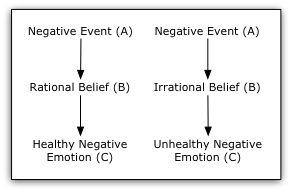
Albert Ellis (1977) described an ABC(DE) model of emotional disturbances that illustrates how beliefs influence emotions and how people become upset.  As shown below an individual’s beliefs (B) about an activating event (A) cause his or her emotional and behavioral consequences (C).  This is contrasted with the commonly held belief (by adolescents) that emotions and behaviors are caused by the events.  Disputation (D), or questioning and challenging irrational beliefs that young people might hold about themselves, others, events, and the world they live in will lead to a more constructive emotional and behavioral effects (E).


Ellis and his colleagues have identified numerous irrational beliefs commonly held in our culture that appear to cause emotional disturbance.  Some of the most frequently cited irrational beliefs can be found here.

Ellis (1980, pp.5-7) indicates that the irrational beliefs listed stem from the following three major irrational belief clusters:


  1. “I must do well and win approval for my performance, or else I rate as a rotten person.”
  2. “Others must treat me considerately and kindly in precisely the way I want them to treat me; if they don’t, society and the universe should severely blame, damn, and punish them for their inconsiderateness.”
  3. Conditions under which I live must get arranged so that I get practically everything I want comfortably, quickly, and easily, and get virtually nothing that I don’t want.


Bernard and Joyce (1984) state that these three irrational belief clusters cause major problems during childhood and adolescence as well as adulthood.  Waters (1982, p.572) has identified the following ten irrational beliefs of children:


  1. “It’s awful if others don’t like me.”
  2. “I’m bad if I make a mistake.”
  3. “Everything should go my way; I should always get what I want.”
  4. “Things should come easy to me.”
  5. “The world should be fair and bad people must be punished.”
  6. “I shouldn’t show my feelings.”
  7. “Adults should be perfect.”
  8. “There’s only one right answer.”
  9. “I must win.”
  10. “I shouldn’t have to wait for anything.”


In addition, Waters (1981, p.6) identified ten irrational beliefs held by adolescents:


  1. “It would be awful if my peers didn’t like me.  It would be awful to be a social loser.”
  2. I shouldn’t make mistakes, especially social mistakes.”
  3. “It’s my parents’ fault I’m so miserable.”
  4. “I can’t help it; that’s just the way I am and I guess I will always be this way.”
  5. “The world should be fair and just.”
  6. “It is awful when things don’t go my way.”
  7. “It is better to avoid challenges than to risk failure.”
  8. “I must conform to my peers.”
  9. “I can’t stand to be criticized.”
  10. “Others should always be responsible.”

We, as youth workers, are in a unique position where we can influence a students perspective and beliefs.  It is with great fear and reverence that we should move forward into this position.  We are in a position to shape their identity and the lens by which they interact with the world around them.  We are not alone in this as parents, teachers, friends and other play this role as well, but we have the privilege of helping them navigate this stage of life.  We should measure our words and be careful because we can either reinforce irrational beliefs (that shape their behaviors) or speak life and truth into their lives that help them understand who they are in Christ and the unique role they play in the Redemption Story.

The Three R’s of Bullying Interventions


The issue of bullying just doesn’t seem to be going away so today let’s talk about strategies to fix what bullying does.  The following would be a great resource to put in the hands of parents of your students.  It is also good kindling for discussion on reconciliation.

Restitution, Resolution, and Reconciliation 

If student was a follower/supporter of the bully: 

  1. Intervene immediately
  2. Provide a system of graceful accountability while allow natural consequences to occur
  3. Create opportunities to “do good”
  4. Nurture empathy
  5. Teach friendship skills – assertive, respectful, and peaceful ways to relate to others
  6. Monitor/Criticize/Converse about TV shows, movies, music, and video games that reinforce violence against others
  7. Engage in more constructive, entertaining, and energizing activities 

If your student hurt others through gossip: 

  1. apologize to the child who was harmed by the rumor
  2. go to everyone she told it to and tell them it wasn’t true
  3. ask them to stop spreading it
  4. ask them to let everyone they told that she was a part of spreading the rumor and that she wants to correct it
  5. to the best of her ability, repair any damage done to the target by the act of spreading the rumor
  6. take the next step of building a new and healthier relationship 

Three principles that foster moral independence: 

  1. Teach your student that he and only he is responsible for the consequences of his actions (kids who accept responsibility for their own actions are more likely to live up to their own moral code) 
  2. Build your student’s confidence in his or her ability to make good decisions (Kids who have confidence in their own judgments are not easily manipulated by others) 
  3. Teach your student how to evaluate reasons on his or her own (Kids who have confidence in their own ability to reason are more questioning and more resistant to passive acceptance of orders.)

reference: Bully, the Bullied, and the Bystanders by Barbara Coloroso

Creating Caring Communities that Challenge Bullying


The following is a brief outline for creating an environment that leaves little room for bullying.  Whether your group is in a classroom, youth group room, large group meeting room, or small group this following principles will be helpful for the leader to cultivate a safe environment.  This can also be used in training volunteers as there is a Powerpoint Presentation that goes with it at the bottom of this post.

Four Key Principles 

  1. warmth, positive interest, and involvement from adults
  2. firm limits as to unacceptable behavior
  3. in case of violations of limits and rules, consistent application of non-hostile, non-physical sanctions (discipline as opposed to punishment)
  4. behavior by adults at home and in community organizations that creates an authoritative (not authoritarian) adult – child interaction

 Elements to Effective Anti-Bullying Policies 

  1. A strong, positive statement of the organizations desire to promote positive peer relations and especially to oppose bullying and harassment in any form it may take by all members of the community
  2. A succinct definition of bullying or peer victimization, with specific examples
  3. A declaration of the rights of individuals and groups in the community – students, teachers, clergy, LGBTQ, minorities, etc – to be free of victimization by others
  4. A statement of the responsibility of those who witness peer victimization to seek to stop it
  5. Encouragement of students and parents with concerns about victimization to speak with school/church/community leaders about it
  6. A general description of how the community organization proposes to deal with the bully/victim problem
  7. A plan to evaluate the policy in the near future

 Prevention Strategy 

  1. Gathering information about bullying in community directly from students
  2. Establishing clear organizational rules about bullying
  3. Training all willing adults in the community to respond sensitively and consistently to bullying
  4. Providing adequate adults supervision, particularly in less structured areas, such as playgrounds, parks, swimming pools, etc.
  5. Improving parental awareness of and involvement in working on the problem.

Bullying Training

Four Markers of Bullying


With every person we talk to about bullying we get a different definition of what it is.  There seems to be some difficulty defining what bullying is and what it isn’t.  Norwegian researcher Dan Olweus defines bullying as when the person is

“exposed, repeatedly and over time, to negative actions on the part of one or more other persons.”

He defines negative actions as “when a person intentionally inflicts injury or discomfort upon another person, through physical contact, through words or in other ways.”

The following are markers that may help determine if an act of aggression is actually bullying or simply the result of conflict between two parties.

1. Imbalance of Power

The bully can be older, bigger, stronger, more verbally adapt, higher up on the social ladder, of a difference race, or of the opposite sex. Sheer numbers of kids banded together to bully can create this imbalance. Bullying is not sibling rivalry, nor is it fighting that involves two equally matched kids who have conflict.

2. Intent to Harm
 
The bully means to inflict emotional and/or physical pain, expects the action to hurt, and takes pleasure in witnessing the hurt. This is no accident or mistake, no slip of the tongue, no playful teasing, no misplaced foot, no inadvertent exclusion.
 
3. Threat of Further Aggression
 
Both the bully and the bullied know that the bullying can and probably will occur again. This is not meant to be a one time event. When bullying escalates unabated, a fourth element is added:
 
4. Terror
 
Bullying is systematic violence used to intimidate and maintain dominance. Terror struck in the heart of the child targeted is not only a means to an end, it is an end in itself. This is not a one time act of aggression elicited by anger about a specific issue, nor is it an impulsive response to a rebuke.

A WordPress.com Website.

Up ↑